
BuzzFeed, Inc.: AI Ambitions, Revenue Contraction, and the Stakes of Strategic Overhaul
BuzzFeed’s latest transformation—marked by board control turnover, executive reshuffling, and deep cost cuts—unfolds against a backdrop of audience erosion and severe revenue declines. As the company doubles down on AI-driven content and commerce, the question is whether operational resets and technology bets can offset financial and strategic vulnerabilities.
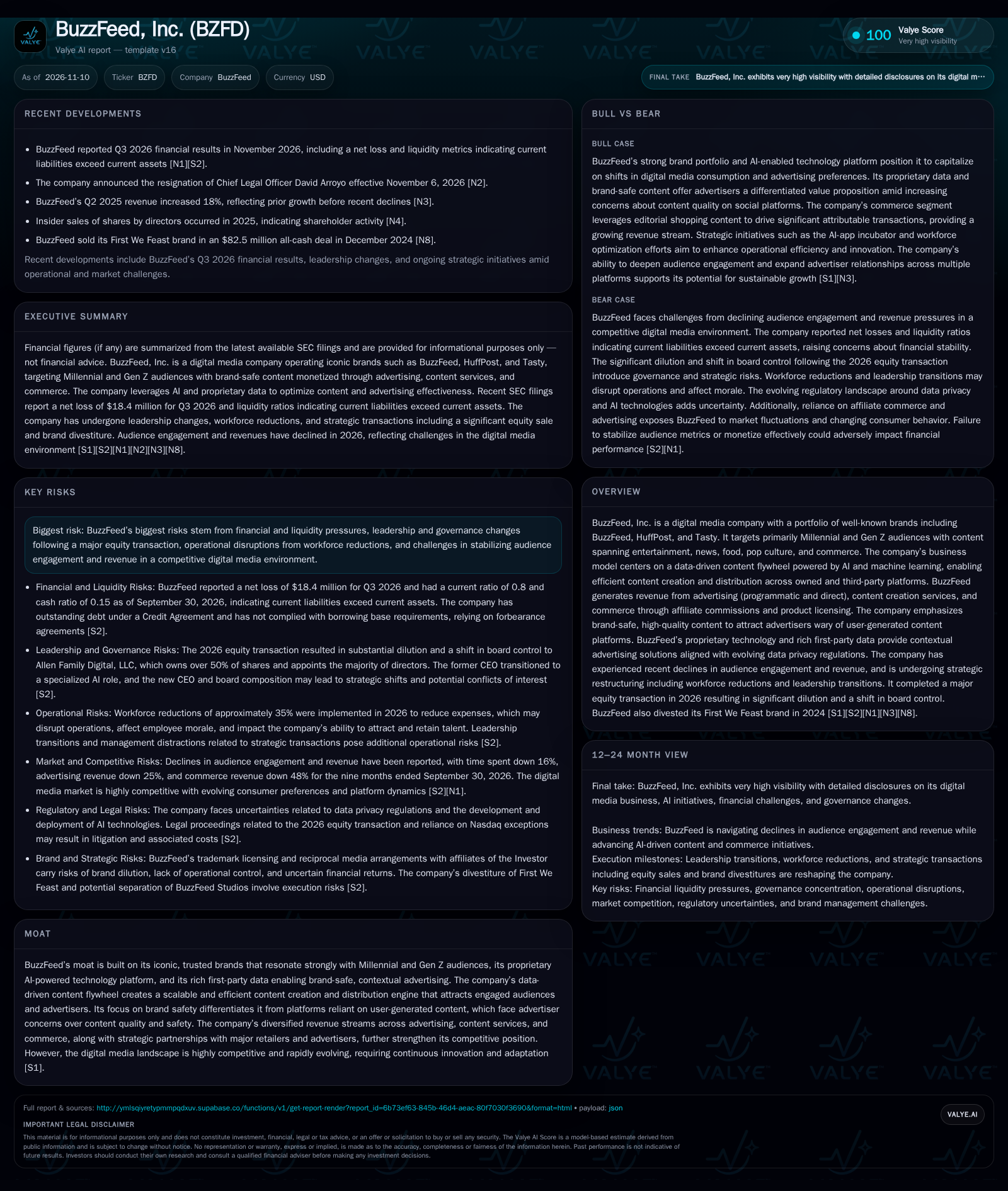
BuzzFeed is experiencing a period of acute challenge: audience engagement and core revenue streams have dropped sharply in 2026, forcing a 35% workforce reduction and leadership overhaul. A major equity sale shifted board control to Allen Family Digital, with a new CEO and a renewed focus on AI initiatives. While the company maintains strong brand assets and proprietary technology, its liquidity position is strained and its operational reset is unproven. The company’s future trajectory will hinge on the execution of its AI-driven strategy, stabilization of its user base, and the ability to regain advertiser and commerce partner confidence in a fast-moving digital media landscape. [S1] [S2] [N1]
BuzzFeed, Inc. stands at a pivotal juncture after a tumultuous 2026, defined by steep audience and revenue declines, a change in board control, and a sweeping operational reset. The company’s financials reveal acute liquidity pressure and ongoing losses, as leadership pivots to an AI-centric future under new CEO Byron Allen. With its core brands still resonant among younger audiences and a proprietary technology stack, BuzzFeed’s prospects now rest on its ability to translate AI investments and cost rationalization into renewed growth. The stakes are high: failure to stabilize engagement or restore advertiser trust could further imperil both financial viability and long-term relevance.
Liquidity Stress, Audience Contraction, and Governance Overhaul Define 2026
The most consequential recent developments for BuzzFeed are a sharp decline in operating performance and a fundamental shift in corporate governance. This liquidity strain comes as the company faces a 16% drop in time spent on its platforms, a 25% fall in advertising revenue, and a 48% collapse in commerce revenue for the first nine months of 2026. In May 2026, BuzzFeed executed a major equity transaction with Allen Family Digital, LLC, resulting in substantial dilution and a shift in board control, with Byron Allen taking over as CEO and the former CEO moving to lead the company’s AI efforts. A 35% workforce reduction plan was also announced in July 2026 to reduce expenses and improve cash flow. These interlinked developments—financial stress, audience erosion, and a new governance structure—set the stage for the company’s ongoing transformation. [S1] [S2] [N1]
Monetization Challenges and the Economics of Digital Content at Scale
BuzzFeed’s revenue streams are diversified across advertising (programmatic and direct), custom content creation, and commerce (affiliate commissions and product licensing). Historically, advertising has been the largest contributor, with a heavy reliance on major partners—most notably Amazon, which accounted for 28% of 2025 revenue through affiliate-driven commerce. The company aims to differentiate itself through proprietary AI-driven content creation, distribution, and first-party data targeting. However, the sharp contraction in both user engagement and monetized commerce activity in 2026 suggests that volume and mix have turned against BuzzFeed: fewer engaged users mean fewer ad impressions and less commerce conversion.
Operating leverage in digital media can be a double-edged sword. Fixed costs—platform investments, content creation infrastructure, and technology development—are significant, but so are the potential margin benefits if scale returns. The 35% reduction in workforce is designed to reset the fixed cost base, but it also risks undermining creative output and institutional knowledge. Unless the AI-driven content flywheel can rapidly yield efficiency gains or new revenue, the risk of negative operating leverage remains acute. [S1] [S2]
Brand Equity Versus Platform Giants and the Risks of Substitution
BuzzFeed’s core competitive assets are its iconic brands (BuzzFeed, HuffPost, Tasty), proprietary technology stack, and rich first-party data, all of which are positioned to offer advertisers a brand-safe alternative to user-generated content platforms. Its focus on contextual targeting and data privacy compliance is increasingly relevant as third-party cookie deprecation and regulatory scrutiny reshape digital advertising.
However, the competitive landscape is unforgiving. Platform giants—social networks, video platforms, and search engines—command the largest audiences and the most robust ad ecosystems. User-generated content platforms continue to capture both consumer attention and advertising budgets, while niche digital publishers compete for the same Millennial and Gen Z eyeballs. Substitution risk is high: audiences can shift quickly, and advertisers can redirect spend with little friction. BuzzFeed’s dependence on a single commerce partner (Amazon) for a large share of revenue amplifies vulnerability to partner policy changes or affiliate rate shifts. The company’s ability to reestablish growth, therefore, hinges on its capacity to deliver differentiated, high-engagement content and to monetize that engagement more effectively than generic aggregators or social platforms. [S1]
AI-Powered Product Reinvention Sparks Re-Engagement and Revenue Recovery
The most optimistic scenario for BuzzFeed centers on the successful execution of its AI-driven strategy. The transition of the former CEO to lead BuzzFeed AI, coupled with the development of new interactive storytelling formats and the AI-app incubator (Branch Office), could enable the company to produce more personalized, engaging, and scalable content at lower marginal cost. If these AI investments yield a step-change in user engagement—measured by a turnaround or rebound in time spent and content consumption—advertisers could be enticed back by improved targeting and brand safety, and commerce partners could see higher conversion rates.
Confirmation of this scenario would require evidence of stabilized or growing audience metrics, a return to positive advertising and commerce revenue trends, and new AI-driven product launches that gain traction with core demographics. Margin expansion, improved operating cash flow, and renewed interest from blue-chip advertisers would further validate the upside. Falsification would be signaled by continued declines in engagement, lackluster advertiser interest in new formats, or failure to launch compelling AI-powered products in a timely manner.
Incremental Stabilization Amid Cost Cuts and Platform Experimentation
A more probable path is one of partial stabilization: BuzzFeed may succeed in reducing its cash burn through aggressive cost-cutting, while AI initiatives and content innovation yield incremental, rather than transformational, benefits. In this scenario, audience and revenue declines slow but do not fully reverse, and the company maintains relevance with a core—albeit smaller—user base. Direct advertising relationships with brand-conscious Fortune 500 clients could remain, but at lower volumes, and commerce revenue may stabilize at a new, reduced baseline.
Evidence for this outcome would include modest improvement or stabilization in audience engagement metrics, smaller sequential declines in advertising and commerce revenue, and operating losses narrowing due to a leaner cost structure. The company would still face liquidity constraints and would need to demonstrate successful refinancing, asset sales, or further expense management to avoid financial distress. Falsification would occur if audience and revenue metrics continue to deteriorate despite restructuring, or if liquidity pressures force further asset divestitures or a distressed transaction.
Failure to Reignite Engagement Triggers Further Erosion and Restructuring Risk
The adverse scenario is that BuzzFeed’s operational reset and AI ambitions fail to halt the downward spiral in audience and revenue. Continued declines in engagement would further reduce advertising inventory and commerce activity, while cost cuts undermine the company’s ability to produce differentiated content.
Confirmation of this scenario would come from another period of double-digit declines in engagement and revenue, persistent negative cash flow, and disclosures of additional asset divestitures or urgent financing needs. An inability to launch successful AI products, a loss of major commerce partners, or departures of key talent would further exacerbate downside risks. Falsification would require clear evidence of operational stabilization and renewed advertiser or audience momentum, which would contradict this negative trajectory.
Milestones That Will Determine Whether BuzzFeed’s Reset Succeeds or Fails
Sequential changes in audience engagement metrics (e.g., time spent, unique visitors) will be critical for assessing whether the company is stabilizing or continuing to lose relevance.
Quarterly trends in advertising and commerce revenue, especially the rate of decline or signs of stabilization, will provide early signals on the effectiveness of restructuring and product innovation.
The pace of AI-driven product launches and evidence of user adoption or advertiser uptake will help test whether the company’s technology bets are translating into real value.
Cash flow from operations and quarterly liquidity updates are essential to gauge financial runway and risk of further asset sales or distressed actions.
Retention and expansion of direct advertiser relationships, particularly with Fortune 500 clients, will indicate whether BuzzFeed’s brand-safe proposition is resonating in the market.
Developments in affiliate commerce partnerships, especially with Amazon, should be monitored for any changes in commission structures or traffic attribution.
Management and board disclosures regarding further cost cutting, asset divestitures, or refinancing efforts will signal how leadership is navigating ongoing financial constraints.
Legal and regulatory developments, including outcomes related to the 2026 equity transaction and any new privacy or AI compliance requirements, could materially affect both operational freedom and strategic direction.
Disclaimer: This is research-only, informational analysis and not investment advice. It may include AI-generated interpretation and general industry context. Always verify important details using primary sources.

Comments