
Onto Innovation: Metrology Leadership, Advanced Packaging Tailwinds, and the Stakes of Semiconductor Cyclicality
Onto Innovation’s strong Q3 2026 financials and the integration of Semilab USA signal momentum in advanced metrology and inspection, but the company’s exposure to capital spending cycles and execution risks around new technologies and acquisitions remain central to the investment debate.
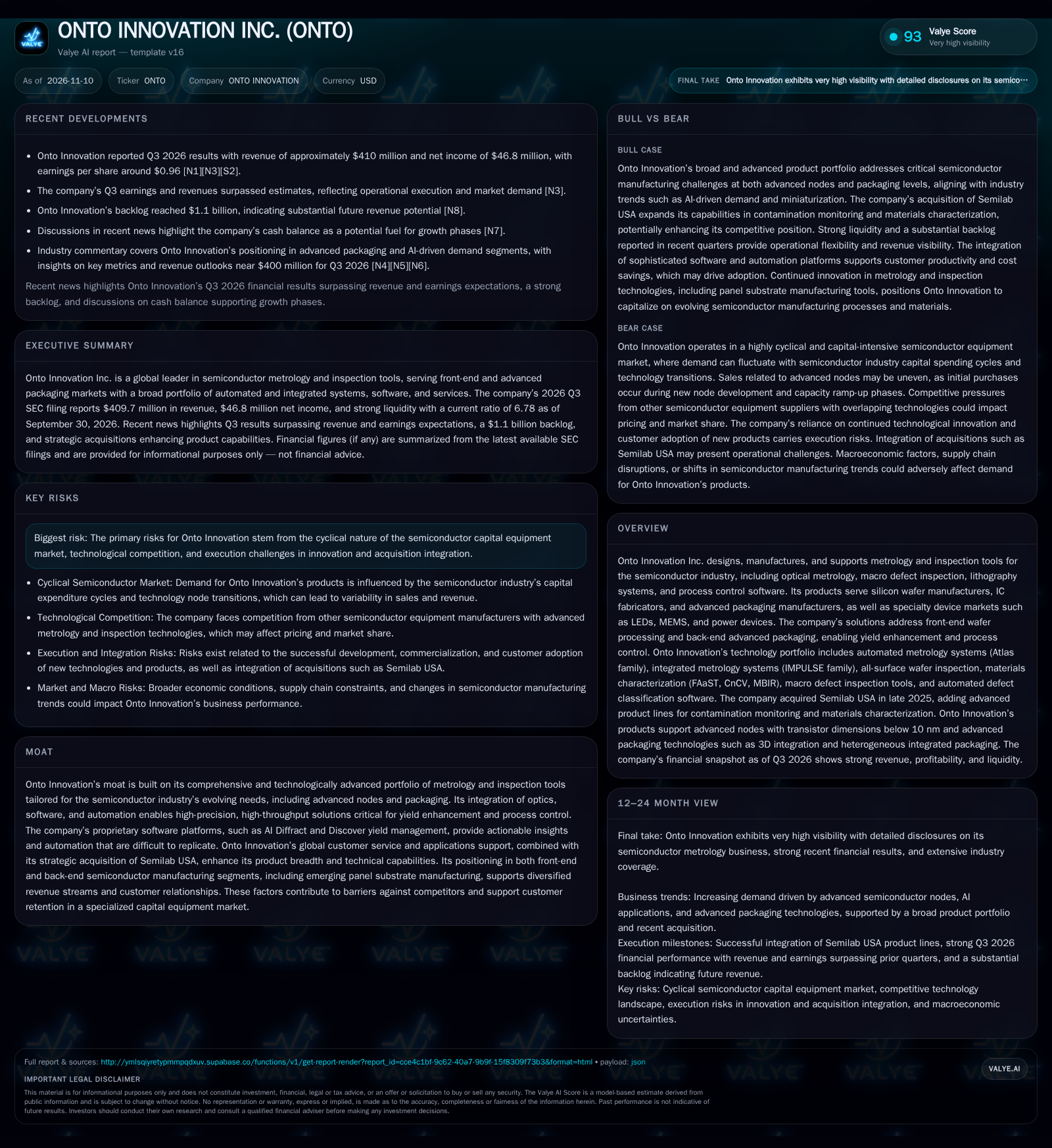
Onto Innovation reported Q3 2026 revenue of $409.7 million and net income of $46.8 million, continuing its positioning as a key supplier of metrology and inspection tools to the semiconductor industry. The acquisition of Semilab USA expands its footprint in contamination monitoring and materials characterization. While advanced node and packaging demand—especially for AI applications—underpins growth, the company’s exposure to industry cyclicality and integration risks warrant close monitoring. [S2] [S1]
Onto Innovation stands at the intersection of semiconductor process control and the next wave of chip miniaturization and packaging complexity. Its Q3 2026 results highlight both financial strength and strategic breadth, following the integration of Semilab USA’s advanced metrology lines. As advanced node and packaging requirements intensify—driven by AI, 3D integration, and heterogeneous packaging—the company’s tools and software are increasingly mission-critical for yield and reliability. However, the persistent cyclicality of semiconductor capital equipment spending and the challenges of integrating acquired technologies and teams create a complex risk/reward calculus for investors.
Recent Results and Strategic Moves Shape the Investment Debate
For the quarter ended September 30, 2026, Onto Innovation reported revenue of $409.7 million, net income of $46.8 million, and basic EPS of $0.96. This performance exceeded analyst expectations and reflects robust demand for the company’s metrology and inspection solutions, particularly in advanced node and advanced packaging segments. [S2] [N3]
Onto Innovation completed the acquisition of Semilab USA in Q4 2025, adding three advanced product lines (FAaST, CnCV, MBIR) to its portfolio. These additions enhance the company’s capabilities in wafer contamination monitoring and materials characterization, broadening its addressable market and deepening its technical moat. [S1]
The company’s reported balance sheet position, with $400.7 million in cash and equivalents and a current ratio of 6.78 as of September 30, 2026. This provides a financial buffer for continued R&D, potential further acquisitions, or navigating semiconductor spending volatility. [S2]
Industry commentary and management focus highlight Onto Innovation’s positioning to benefit from AI-driven semiconductor demand and the ongoing shift toward advanced packaging and panel-level manufacturing. [N4] [N5] [S1]
Revenue Drivers, Operating Leverage, and the Economics of Process Control
Onto Innovation’s business economics are anchored in the sale of high-value capital equipment (metrology, inspection, and lithography systems) and recurring streams from software, service, and upgrades. Revenue is closely tied to fab expansion, node transitions, and technology upgrades—especially at leading-edge foundries and advanced packaging facilities.
Pricing for Onto’s tools reflects their mission-critical role in yield management, defect detection, and process control, with customers often willing to pay a premium for accuracy, speed, and integration into high-throughput environments. Software platforms (such as AI Diffract and Discover) augment the value proposition, potentially driving higher margin, stickier revenue versus hardware alone.
Variable costs are primarily tied to manufacturing, with R&D and SG&A providing operating leverage as revenue scales. However, the capital intensity of ongoing innovation—especially to keep pace with sub-10 nm nodes and advanced packaging—means sustained investment is required. The recent Semilab USA acquisition likely increases both R&D breadth and integration costs in the near term, but could drive accretive economics if cross-selling and product synergies are realized.
Because Onto’s products are typically purchased during new node rollouts or packaging transitions, revenue can be lumpy, with periods of intense growth followed by digestion phases. The company’s expansion into back-end and specialty device markets (e.g., MEMS, LEDs, power devices) provides some buffer against front-end cyclicality, but the overall business remains exposed to semiconductor capital spending cycles. [S1]
Defending Share in a Crowded, Innovation-Driven Landscape
Onto Innovation operates in a highly competitive capital equipment market, facing rivals across metrology, inspection, and lithography categories. Key competitor classes include large diversified semiconductor equipment providers, specialized metrology and inspection firms, and emerging players leveraging AI and software to disrupt traditional process control paradigms.
The company’s competitive advantages stem from its breadth of offerings—spanning both front-end (advanced nodes) and back-end (advanced packaging, panel-level) segments—and its integration of optical, software, and automation technologies. Proprietary platforms like AI Diffract and Discover yield management software deepen switching costs by embedding Onto’s solutions into customer workflows.
The Semilab USA acquisition further differentiates Onto by adding advanced capabilities in wafer contamination and materials characterization, areas that are increasingly critical as device architectures become more complex and defect tolerances shrink. However, the pace of technology change in the industry is relentless, and competitors with deep R&D budgets or disruptive new approaches could erode Onto’s share if innovation lags.
Barriers to entry are high due to the precision, reliability, and integration requirements of semiconductor manufacturing, but customer relationships are not always contractually recurring—meaning share can shift if competitors demonstrate superior performance or cost of ownership. Onto’s global support infrastructure and ability to address both established and emerging device types provide some insulation, but vigilance is required to sustain its position. [S1]
AI and Advanced Packaging Demand Catalyze a New Growth Cycle
In a favorable scenario, continued acceleration of AI-driven chip demand and the proliferation of advanced packaging technologies (such as 3D integration and heterogeneous integration) drive sustained investment in new fab capacity and process control tools. Onto Innovation’s broad portfolio, including recently acquired materials characterization and contamination monitoring solutions, positions it as a preferred partner for leading-edge foundries and advanced packaging houses.
If Onto can successfully integrate Semilab USA’s product lines, cross-sell to existing customers, and leverage its proprietary software platforms to deepen customer stickiness, revenue growth could outpace industry cyclicality. The company’s ability to address both new node rollouts and ongoing packaging volume ramps would diversify its revenue base and reduce earnings volatility.
Evidence supporting this upside would include: repeat quarters of above-industry-average revenue growth; increasing software and service attach rates; new customer wins in panel-level and advanced packaging; and visible cross-selling synergies from the Semilab integration. Announcements of design wins at leading-edge nodes or new panel-level manufacturing facilities would further validate the thesis. [S1] [N5] [N6]
Balancing Growth Opportunities with End-Market Volatility
The most plausible medium-term outcome is that Onto Innovation continues to grow at a pace broadly in line with semiconductor capital spending cycles, benefiting from secular trends in AI, advanced packaging, and miniaturization, but subject to the inherent lumpiness of fab expansion and node migration.
The integration of Semilab USA enhances Onto’s competitive position, but the realization of full synergies and margin uplift may be gradual as product lines are harmonized and customer adoption ramps. Revenue from advanced packaging and specialty device markets provides some offset to front-end volatility, but does not fully decouple Onto from broader industry cycles.
Base-case evidence would be steady revenue progression quarter-over-quarter, stable or modestly improving gross margins, and continued strong cash generation. Moderate customer concentration and new product adoption metrics would support a thesis of resilience rather than breakout growth. Conversely, signs of order pushouts or softening demand in leading-edge nodes would challenge the base scenario. [S2] [S1]
Cyclical Headwinds and Execution Risks Disrupt Momentum
In a more adverse scenario, a downturn in semiconductor capital expenditures—triggered by macroeconomic weakness, inventory corrections, or delays in next-generation node rollouts—leads to order reductions and revenue contraction for Onto Innovation. Because much of the company’s revenue is linked to fab expansions and technology migrations, a pause or pullback by major customers could have an outsized effect on quarterly results.
Execution missteps in integrating Semilab USA—such as delayed product harmonization, customer confusion, or cost overruns—could erode both near-term profitability and longer-term competitive positioning. Heightened competition, particularly from incumbents with broader product suites or disruptive new entrants, might drive pricing pressure or share loss if Onto’s innovation pace falters.
Confirmation of this downside would come from sequential revenue declines, margin compression, customer defections, or negative revisions to order outlooks. Additional red flags would include delayed product launches, integration-related write-downs, or a reversal of recent cash generation trends. [S1] [S2]
Testing the Thesis: What Could Confirm or Challenge Onto Innovation’s Trajectory
Quarterly revenue growth rates and order intake, especially in advanced node and advanced packaging segments, to gauge end-market demand and Onto’s share capture. [S2]
Gross margin trends, both at the consolidated level and by product segment (if disclosed), as an indicator of pricing power, product mix, and integration effectiveness.
Software and services revenue as a percentage of total sales, to assess the shift toward higher-margin, recurring revenue streams. A useful metric would be disclosed attach rates for process control software.
Integration milestones and cross-selling progress related to Semilab USA’s product lines—such as new customer wins or bundled sales—would help test synergy realization.
R&D spending levels and product launch cadence, to monitor Onto’s ability to keep pace with rapid technology transitions in metrology and inspection.
Customer concentration metrics, particularly exposure to leading-edge foundries or packaging houses, to evaluate revenue resilience versus risk of order volatility.
Announcements of design wins, partnerships, or panel-level manufacturing adoptions, which would signal Onto’s competitive position in emerging process technologies.
Disclaimer: This is research-only, informational analysis and not investment advice. It may include AI-generated interpretation and general industry context. Always verify important details using primary sources.

Comments