
Paramount Skydance: Integration Ambitions, Content Scale, and the Realities of a Mega-Media Combination
With the landmark merger of Paramount and Skydance—plus the addition of Warner Bros. Discovery—Paramount Skydance now controls one of the broadest content portfolios in global media. The central thesis turns on whether the new structure can convert content breadth into durable operating leverage and defend against intensifying streaming and media competition.
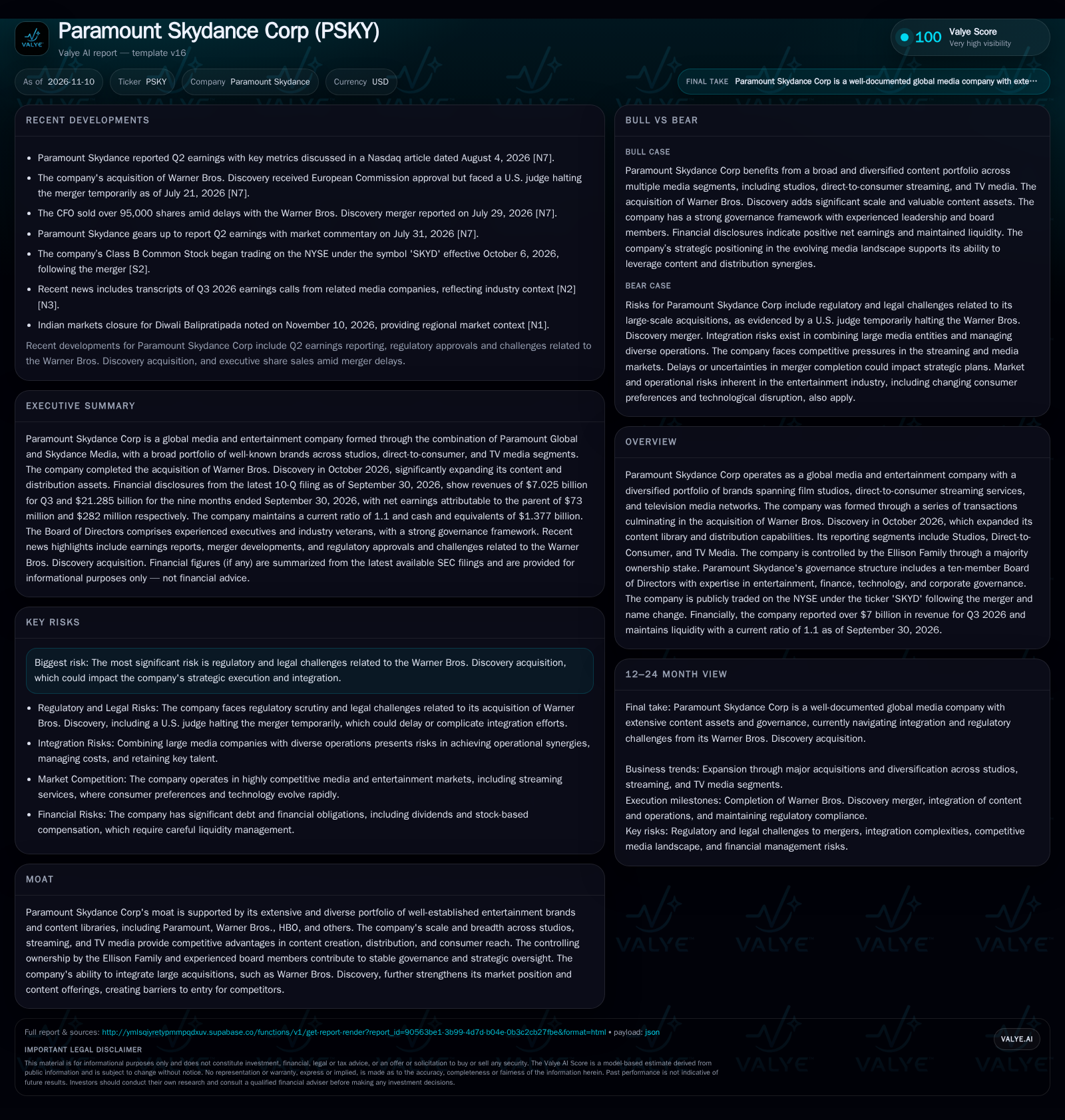
Paramount Skydance (now Skydance Corporation) completed its transformative merger with Warner Bros. Discovery, creating an entertainment giant with $21.3 billion in nine-month revenue and a portfolio spanning film, streaming, and TV. The company posted Q3 net earnings of $73 million, reflecting early integration complexity and scale. The Ellison Family controls 77.5% of voting shares. The thesis now hinges on whether management can extract synergy, manage integration risk, and achieve sustainable profitability amid fierce industry competition and evolving consumer habits. [S2]
Paramount Skydance (now Skydance Corporation) stands at the center of one of the largest consolidations in modern media. With the completion of its Warner Bros. Discovery merger in October 2026, the company’s portfolio now spans iconic studios, streaming platforms, and global TV networks. The latest results—$21.3 billion in nine-month revenue and $282 million in net income—offer a snapshot of both the scale and the integration complexity. The central question is whether this new entity can convert unrivaled content breadth into sustainable operating leverage and competitive resilience, or whether structural and market headwinds will erode the promise of mega-scale.
Merger Milestones and Financial Snapshot Define the New Skydance
Paramount Skydance completed its high-profile merger with Warner Bros. Discovery in October 2026, instantly becoming one of the world’s most diversified media conglomerates. The combined company holds brands such as Paramount, Warner Bros., HBO, CNN, CBS, and Nickelodeon, with content assets and distribution spanning film, direct-to-consumer streaming, and legacy TV networks. For the three months ended September 30, 2026, the company reported $7.025 billion in revenue and $73 million in net earnings attributable to the parent, with nine-month figures at $21.285 billion and $282 million, respectively. The Ellison Family, via Harbor Lights Entertainment, now controls roughly 77.5% of Class A Common Stock, centralizing governance. The company’s balance sheet shows $1.377 billion in cash and a current ratio of 1.1, highlighting liquidity but not significant excess capital. These facts set the stage for a transition period where integration execution and synergy realization are critical. [S2]
How Content Breadth and Platform Scale Could Power Profitability
The business model now rests on monetizing a vast content library across three segments: Studios (film and TV production), Direct-to-Consumer (streaming), and TV Media (broadcast/cable). Revenue streams include theatrical releases, licensing, advertising, and direct subscription fees. At this scale, fixed costs for content creation and technology infrastructure are immense, but so are potential economies: content amortization can be spread across platforms, while digital distribution offers incremental margin on each new subscriber or viewer.
However, the economics of streaming remain challenging industry-wide, with high customer acquisition costs, intense churn, and content spending outpacing average revenue per user (ARPU) growth for many platforms. Legacy TV networks face secular declines in advertising and affiliate fees. The real financial opportunity lies in extracting synergy: reducing duplicative costs, optimizing release windows, and leveraging cross-promotion to maximize audience engagement. Capital requirements are significant, both for ongoing content investment and for integration-related expenditures. If management can rationalize the cost base while maintaining creative output, the model could deliver operating leverage; if not, margins may remain compressed despite headline revenue growth.
Competitive Landscape: Can Scale and IP Outpace Streaming Disruption?
The competitive set includes global streaming giants (Netflix, Disney, Amazon), pure-play studios, and legacy broadcasters. Skydance’s advantage is its unique combination of world-class IP—spanning everything from HBO’s prestige series to Nickelodeon’s children’s content—and multi-channel distribution. This breadth provides resilience against any one segment’s volatility and enables cross-platform monetization.
But scale alone does not guarantee defensibility. Streaming audiences are fickle, and switching costs remain low; content exclusivity is critical, but binge-release models and rapid consumption cycles mean even major franchises can face diminishing marginal returns. Moreover, competitors with deep pockets can outspend on tentpole content or undercut on pricing. The key question is whether Skydance can use its scale to create a differentiated ecosystem—bundling, cross-promotion, exclusive windows—that improves retention and pricing power. Regulatory scrutiny also remains a backdrop, limiting the company’s freedom to pursue further consolidation or aggressive vertical integration.
Synergy Extraction and Franchise Expansion Drive Margin Upside
If Skydance’s management executes a disciplined integration—rationalizing overlapping operations, harmonizing tech stacks, and leveraging its IP across platforms—the company could see substantial margin expansion. Success would be marked by rising operating income, improved net margins, and evidence of cost synergies in SG&A and content amortization. A virtuous cycle could emerge: strong franchises (e.g., DC, Star Trek, Game of Thrones) anchor both streaming and theatrical releases, driving subscriber growth and licensing revenue while dampening churn.
Key evidence for this scenario would include sequential improvement in segment-level operating margins, declining content spend as a percentage of revenue (without loss in subscriber engagement), and above-peer ARPU or retention figures. Announcements of successful cross-platform launches or bundled offerings—such as a unified streaming product or cross-promoted live events—would further validate the thesis.
Integration Complexity and Market Pressures Keep Margins in Check
The most plausible outcome is a mixed picture: headline revenue remains robust due to the sheer scale and diversity of the combined portfolio, but integration costs, ongoing content investment, and competitive pricing keep margins modest. While some synergies are realized—especially in back-office and distribution—customer-facing units may experience only incremental improvement, as the company must continue to spend heavily to defend market share and retain key talent.
Confirming evidence would be stable but only gradually improving operating margins, continued high content spend, and moderate subscriber growth in streaming, offset by ongoing declines in legacy TV. If integration milestones are hit but do not result in step-function margin gains, this would suggest the base scenario is playing out. Persistent dividend payments and steady, if unspectacular, net income would also be consistent with this outcome.
Integration Missteps and Market Shocks Erode Value
The primary risk is that integration proves more costly and disruptive than anticipated: cultural clashes, talent attrition, and IT system incompatibilities lead to missed synergy targets and elevated expenses. Meanwhile, if consumer preferences shift further toward digital-first competitors or if macroeconomic shocks depress advertising and discretionary spending, revenue growth could stall. The company’s financial obligations—including dividends, stock-based compensation, and ongoing debt service—could become more burdensome if cash flow lags.
Downside evidence would include rising SG&A as a percentage of revenue, persistent or widening net losses, missed integration milestones, or reports of major franchise underperformance. A spike in churn rates, stagnant or declining ARPU, or loss of creative talent to competitors would also indicate that the downside scenario is materializing. Any regulatory or legal setback tied to the merger could further constrain strategic options.
Milestones That Will Reveal Whether Skydance’s Mega-Merger Delivers
Quarterly operating margin trends across Studios, Direct-to-Consumer, and TV Media segments—improvement would indicate synergy realization.
Content spend as a percentage of revenue, especially in streaming—declines without loss of engagement would suggest better cost discipline.
Subscriber growth and churn rates for Paramount+, HBO Max, and any unified streaming product—if disclosed, these would reveal competitive traction.
ARPU and retention metrics for streaming platforms—upward trends would support the pricing power thesis.
SG&A trends post-merger—evidence of cost reduction or, conversely, integration friction.
Progress on cross-platform initiatives, such as bundled offerings or shared franchise launches—announcements would serve as near-term proof points.
Talent retention, especially in creative and technology leadership—public disclosures or reported departures would test cultural integration.
Disclaimer: This is research-only, informational analysis and not investment advice. It may include AI-generated interpretation and general industry context. Always verify important details using primary sources.

Comments