
ACRES Commercial Realty’s Internalization: Integration Risks, Strategic Control, and the Stakes for Shareholder Value
After merging with its former external manager and shifting to an internally managed REIT model, ACRES Commercial Realty faces a pivotal transition. The company’s Q3 2026 results highlight both improved revenue and significant operational challenges, underscoring the importance of integration execution, cost discipline, and regulatory compliance as determinants of future value.
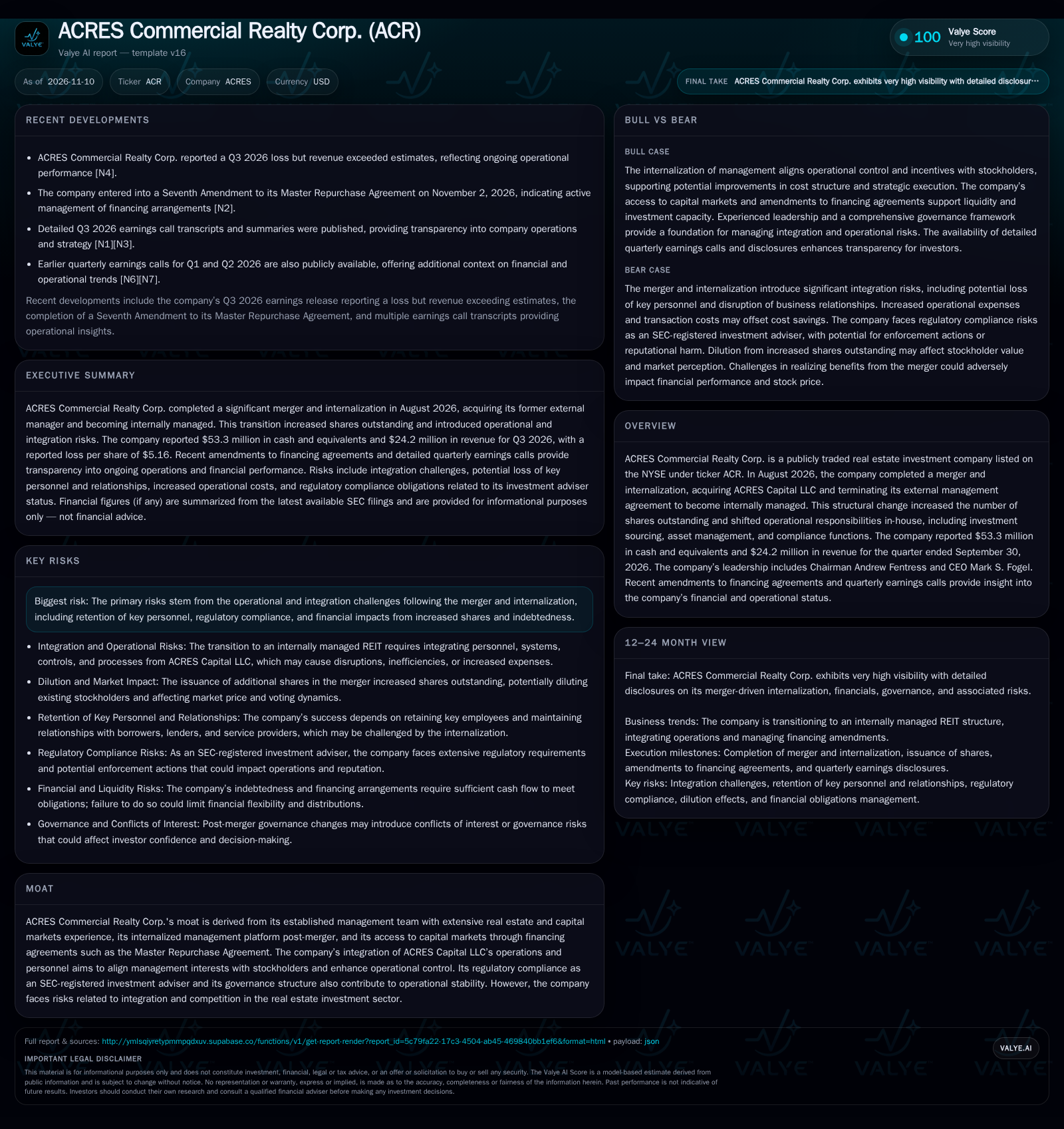
ACRES Commercial Realty’s August 2026 internalization has transformed its management structure, aligning incentives but introducing operational and integration risks. The company’s Q3 2026 revenue surpassed estimates, yet a substantial quarterly loss and share dilution frame a complex path forward. The durability of any cost savings, retention of key talent, and success in regulatory adaptation will determine whether the shift delivers on its promise of improved shareholder alignment and returns. [S2] [N4]
ACRES Commercial Realty Corp.’s strategic transformation—internalizing its management by acquiring ACRES Capital LLC—has fundamentally altered its operational and governance landscape. The move promises improved alignment between management and shareholders and greater control over investment decisions, but it also imposes new challenges. With Q3 2026 revenue beating expectations yet paired with a steep quarterly loss and significant share dilution, the company’s ability to integrate, control costs, and maintain talent will be central to whether this internalization ultimately creates or destroys long-term value.
Merger and Internalization: Redefining the Operating Model
In August 2026, ACRES Commercial Realty executed a merger with ACRES Capital LLC, transitioning from an externally managed to an internally managed REIT. This structural overhaul terminated the prior management agreement and brought all operational functions—including investment sourcing, underwriting, asset management, and compliance—under direct corporate control. To facilitate the transaction, ACRES issued 7.48 million new shares, raising total shares outstanding to 13.45 million and diluting pre-merger stockholders. The Q3 2026 financials reflect this major shift: revenue reached $24.2 million, exceeding analyst estimates, but the company posted a loss per share of -$5.16. The company reported cash and liquidity metrics for the period; these figures do not by themselves establish operating runway, investment capacity, financial flexibility, or financing capacity. The transition has introduced material risks around operational disruption, integration costs, and compliance as a newly internalized entity. [S2] [N4]
Cost Structure, Scale, and the Economics of Internalization
The economics of ACRES Commercial Realty’s business are fundamentally shaped by its transition to internal management. As a REIT focused on originating and managing commercial real estate loans and equity investments, ACRES historically paid management fees to an external advisor, a cost structure that can impede scalability and misalign incentives. Internalization removes this fee drag, but replaces it with a larger fixed cost base: salaries, benefits, compliance costs, and the need to build out internal infrastructure. If integration is smooth and duplicative roles are minimized, the company could theoretically achieve operating leverage as assets under management grow without proportional increases in overhead.
Revenue is driven by the interest income and fees from CRE loans, with profitability hinging on net interest spreads, credit performance, and the efficiency of asset management. However, the immediate post-merger period often sees elevated costs—severance, system integration, consulting, and temporary inefficiencies—which can erode near-term earnings. The Q3 2026 net loss and negative EPS suggest that these transitional costs are significant, and the impact of dilution from new shares raises the bar for per-share value creation. The company’s ability to control fixed costs while scaling its portfolio will be a key determinant of future margin expansion.
Capital needs remain high in CRE lending, with reliance on secured credit lines, repurchase agreements, and periodic access to equity/debt markets. The internalization may improve capital market perception if it results in greater transparency and alignment, but any missteps could have the opposite effect, raising funding costs or limiting access to new capital.
How Internal Management Could Reshape Competitive Dynamics
The move to internal management is intended to better align ACRES’ interests with shareholders and improve responsiveness to market opportunities. In the competitive landscape of middle-market CRE lending, key differentiators include cost of capital, origination relationships, underwriting discipline, and the ability to manage risk through cycles. Externally managed REITs can suffer from agency conflicts and fee leakage, while internalized models may move faster and allocate capital more efficiently—if integration is successful.
However, the company now faces direct competition with both other internally managed REITs and non-bank lenders, many of whom have established origination platforms, broader asset bases, and deeper sponsor relationships. The success of ACRES’ internalization will depend on its ability to retain and motivate the former ACRES Capital team, preserve borrower and lender relationships, and build a scalable platform without excessive overhead. Regulatory compliance as an SEC-registered investment adviser adds complexity and could be a disadvantage if not managed efficiently.
Substitution risk remains high in CRE lending, as borrowers can seek capital from banks, insurance companies, private debt funds, or other REITs. The critical question is whether ACRES’ new structure enables it to price risk more aggressively, underwrite more effectively, or offer superior service compared to these alternatives.
If Integration Unlocks Efficiency: Pathways to Value Creation
The bullish scenario for ACRES hinges on a smooth integration that delivers cost savings, improved strategic control, and retention of key personnel. If the company can eliminate duplicative roles, streamline processes, and fully align management incentives with shareholders, margin expansion is plausible—especially if loan origination volumes recover or grow. The internalized team, now directly employed, could be more agile in capital deployment and risk management, potentially capturing higher-yielding opportunities or managing problem assets more proactively.
Confirmation of this scenario would require evidence of declining operating expenses as a percentage of assets, stable or improving net interest margins, and sustained or increased loan origination volumes. Additional signs would include strong retention of legacy ACRES Capital personnel, minimal client or relationship attrition, and regulatory compliance without costly enforcement actions. If the company demonstrates improved per-share earnings and reinstates or grows its dividend, it would further validate the value of the internalization.
Integration Proceeds with Friction: Gradual Recovery, Mixed Results
The most plausible near-term outcome is that ACRES experiences a period of integration-related friction, with elevated expenses, some staff turnover, and operational inefficiency. Revenue may stabilize or grow modestly, but margin pressure persists due to increased overhead and transitional costs. Over several quarters, the company could gradually realize cost synergies and regain operational stability, but benefits accrue more slowly than hoped.
This scenario would be confirmed by quarterly reports showing persistent but narrowing losses, moderate improvements in expense ratios, and partial retention of key personnel and core business relationships. Regulatory compliance costs may remain high, but not catastrophic. The market may remain skeptical until clear evidence of per-share earnings growth and dividend sustainability emerges. Dilution from the new shares continues to weigh on per-share metrics, and any improvement in valuation is incremental, not dramatic.
Integration Falters: Disruption, Cost Overruns, and Loss of Talent
The adverse scenario is that integration proves more disruptive than anticipated. Key personnel depart, legacy business relationships deteriorate, and operational complexity overwhelms the internal team. Elevated expenses persist for longer than expected, and the company struggles to achieve cost savings or operational efficiencies. Regulatory compliance costs or failures could result in penalties or reputational harm, further undermining business momentum.
Evidence of this scenario would include repeated or widening quarterly losses, negative operating leverage, departures of senior staff, loss of major lending relationships, or material regulatory actions. If asset quality deteriorates and funding costs rise, ACRES may be forced to shrink its portfolio, cut its dividend, or raise capital on unfavorable terms, further diluting shareholders and eroding value.
What Will Determine if Internalization Pays Off for ACRES Shareholders?
Quarterly trends in operating expenses relative to assets or revenue—declining ratios would indicate integration is delivering cost savings.
Staff retention rates among former ACRES Capital personnel, especially at senior and originator levels, if disclosed.
Loan origination volume and quality, with particular focus on credit performance and net interest margin trends post-internalization.
Evidence of successful integration of IT, compliance, and risk management systems, including absence of material control failures or restatements.
Regulatory compliance costs and any SEC examination outcomes or enforcement actions, which could signal execution risk.
Market access and pricing for new debt or equity capital—deterioration could signal lost credibility or increased risk.
Disclaimer: This is research-only, informational analysis and not investment advice. It may include AI-generated interpretation and general industry context. Always verify important details using primary sources.

Comments