
Harrow, Inc.: Ophthalmic Portfolio Expansion, Pipeline Execution, and the Realities of Market Access Pressure
Harrow is pushing to broaden its U.S. ophthalmic drug footprint with new branded launches and a late-stage pipeline, but recurring revenue and margin headwinds from reimbursement challenges and manufacturing dependencies temper the path to sustainable earnings growth.
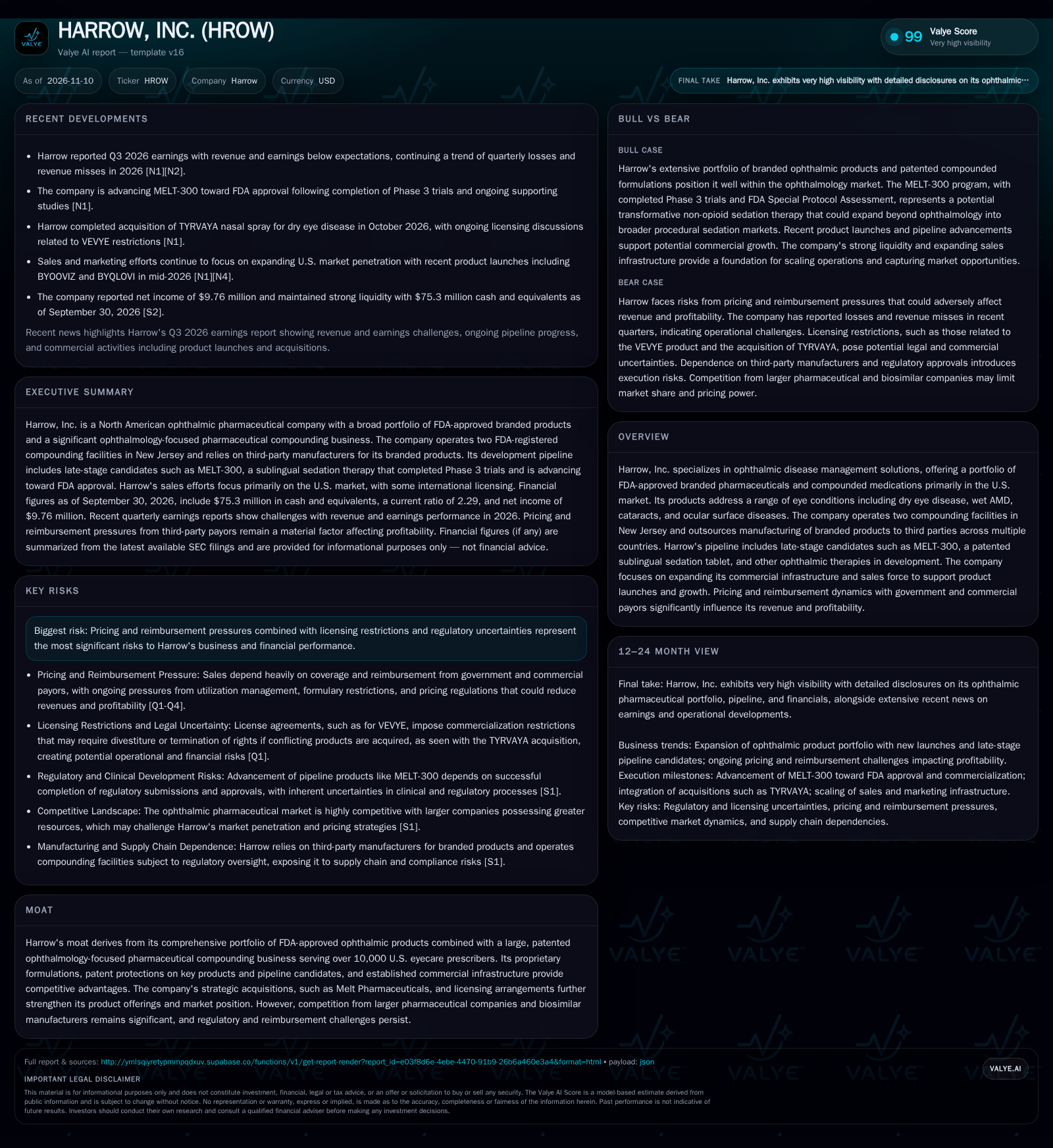
Harrow, Inc. is expanding its branded ophthalmic drug portfolio and compounding business, with recent launches such as BYOOVIZ and BYQLOVI and a late-stage MELT-300 program aiming for non-opioid sedation. However, the company continues to report revenue and earnings below expectations amid persistent pricing and reimbursement pressures, raising questions about long-term profitability and execution risks tied to third-party manufacturing and regulatory hurdles [S1] [N1] [N2] [S2].
Harrow, Inc. is attempting to carve out a durable position in the ophthalmic pharmaceutical market by leveraging a broad portfolio of FDA-approved branded products, a robust compounding business, and a pipeline with late-stage assets like MELT-300. While the company has launched several new products and reported net income in the latest quarter, persistent revenue and earnings misses underscore the challenge of achieving consistent profitability. The crux for Harrow is whether its expanded portfolio and pipeline can offset intensifying reimbursement headwinds and operational dependencies, or whether structural pressures will limit its long-term margin and growth ambitions.
Recent Performance, Product Launches, and the Weight of Market Access
Harrow reported Q3 2026 net income of $9.76 million, a positive bottom-line result, but both revenue and earnings missed consensus expectations, extending a trend of underperformance across 2026 [S2] [N1] [N2]. This underlines ongoing commercial and operational challenges, even as the company expands its product lineup with recent launches such as BYOOVIZ and BYQLOVI in mid-2026 [N1] [N4]. The company reported cash and liquidity metrics for the period; these figures do not by themselves establish operating runway, investment capacity, financial flexibility, or financing capacity. [S2] The key question is whether new products and pipeline advances can translate into sustained revenue growth and margin improvement, or if reimbursement and pricing headwinds will continue to constrain performance.
How Harrow’s Multi-Pronged Model Generates—and Risks—Value
Harrow’s economics are driven by a mix of branded drug sales, compounded formulations, and pipeline-driven future launches. The company owns U.S. rights to a broad portfolio of FDA-approved ophthalmic drugs, while its compounding business serves over 10,000 prescribers with proprietary formulations [S1]. Revenue is generated primarily through direct sales to eyecare professionals, ambulatory surgery centers, and hospitals, with reimbursement from government and commercial payors playing a decisive role in realized prices.
The company does not manufacture its branded products, instead depending on third-party manufacturers in the U.S. and abroad. This arrangement can provide flexibility and limit fixed capital needs, but it also introduces supply chain risk, potential bottlenecks, and less control over cost of goods sold. In contrast, the New Jersey-based compounding facilities (503A/503B) allow for some vertical integration and margin capture on proprietary formulations.
Operating leverage may be limited by the necessity of continual commercial investment (sales force, marketing, medical affairs) to drive uptake of new and existing products in a competitive market. The development pipeline, notably MELT-300, offers the prospect of high-margin, differentiated products if regulatory milestones are achieved, but also demands ongoing R&D spending. With reimbursement pressure and payor scrutiny intensifying in ophthalmology—especially for branded and biosimilar drugs—volume growth may not necessarily translate into proportional profit growth unless Harrow can defend pricing or shift its mix toward higher-margin, less reimbursement-dependent offerings.
Defensible Niches and Structural Disadvantages in Ophthalmic Pharma
Harrow’s competitive positioning is anchored by its breadth of FDA-approved ophthalmic drugs and its large, patented compounding business. The company’s ability to serve a wide spectrum of ocular diseases and its reach across more than 10,000 prescribers provide a base of market access and practitioner relationships [S1]. Patent protections on select products and pipeline candidates offer some insulation from immediate generic or biosimilar competition.
However, the company is exposed to significant counterforces. Larger pharmaceutical companies with deeper resources, established sales channels, and greater pricing leverage compete directly in most ophthalmic drug categories. The biosimilar segment—where Harrow has recently launched BYOOVIZ (ranibizumab-nuna biosimilar) and plans to launch OPUVIZ (aflibercept biosimilar)—is especially prone to price erosion and formulary battles. Furthermore, reimbursement and utilization management by payors can limit uptake, compress margins, and favor entrenched incumbents or lowest-cost suppliers.
Switching costs for prescribers and institutions may be modest outside of proprietary compounded formulations. While Harrow’s compounding business is differentiated by patent coverage and customization, the branded product side is vulnerable to substitution if payors restrict access or if competitors offer better terms. Regulatory and supply chain dependencies add further complexity, especially given the reliance on third-party manufacturing.
What It Would Take for Harrow to Break Out: Pipeline Success and Portfolio Leverage
A favorable trajectory for Harrow would require several reinforcing factors: successful regulatory approval and commercial launch of MELT-300, robust adoption of recent launches like BYOOVIZ and BYQLOVI, and effective defense of pricing and access for key branded products. If MELT-300 achieves FDA approval and demonstrates strong uptake as a non-opioid, non-IV procedural sedation option—especially if it expands beyond ophthalmology into broader outpatient indications—the company could see step-change growth and improved margins due to product differentiation and potential premium pricing [S1].
Sustained growth in the compounding business, underpinned by proprietary formulations and high prescriber loyalty, could further stabilize revenue. If Harrow is able to negotiate favorable reimbursement terms for its branded and biosimilar drugs, or leverage real-world outcomes data to justify premium positioning, the company may mitigate the margin drag from payor pressure.
Evidence confirming this scenario would include above-trend revenue growth following MELT-300 launch, margin expansion despite industry reimbursement headwinds, and explicit disclosure of durable market share gains or formulary wins in high-value drug categories.
Portfolio Expansion Meets Persistent Margin Pressure
The most plausible outlook is that Harrow continues to roll out new branded products and grows its compounding business, but faces ongoing pricing and reimbursement headwinds that constrain margin expansion. Revenue may grow incrementally with recent and planned launches (BYOOVIZ, BYQLOVI, OPUVIZ), but with price realization under pressure, especially in the biosimilar and branded corticosteroid categories [S1].
The pipeline, including MELT-300, could contribute to top-line growth, but regulatory, commercial, and adoption risks remain. Manufacturing transitions and supply chain complexity could create periodic disruptions or cost volatility. Operating expenses are likely to remain elevated due to ongoing commercial and development investments, limiting the pace of earnings improvement.
Confirmation of this scenario would come from steady but unspectacular revenue growth, continued earnings volatility, and management commentary emphasizing reimbursement and payor dynamics as persistent challenges. Failure to materially expand gross or operating margins despite portfolio growth would further support this view.
How Pricing, Payor Pushback, and Supply Chain Stress Could Unwind the Thesis
The adverse scenario is one in which reimbursement pressure intensifies, leading to further price erosion or access restrictions for Harrow’s branded and biosimilar products. If major payors tighten coverage, impose stricter formulary limitations, or drive more aggressive price negotiations, revenue and profitability could decline even as unit volumes grow. This risk is heightened in the biosimilar segment, which is prone to rapid commoditization.
Manufacturing or supply chain disruptions—whether due to third-party partner issues or regulatory non-compliance—could further undermine product availability and increase costs. Delays or failures in regulatory approvals for pipeline assets like MELT-300 would remove a key pillar of future growth. If the compounding business faces regulatory scrutiny or loses patent protection, Harrow could see erosion of its most defensible revenue streams.
Downside evidence would include declining or stagnant revenue despite new launches, contracting gross margins, unexpected product shortages, or adverse regulatory developments affecting either the compounding or branded product businesses.
Factors That Will Determine Whether Harrow Can Deliver Sustainable Growth
Revenue and margin trends following the launch of BYOOVIZ, BYQLOVI, and (if approved) MELT-300: Do these products drive material growth or are pricing pressures too severe?
Updates on MELT-300’s regulatory progress, NDA submission, and FDA review timeline: Timely advancement would support the pipeline-driven upside scenario.
Payor coverage decisions and formulary status for new and existing branded products: A useful metric would be the percentage of commercial and Medicare lives with preferred access, if disclosed.
Gross and operating margin progression over the next several quarters: Improvement, stagnation, or contraction would help test whether portfolio growth is translating into profitability.
Manufacturing and supply chain stability, including any reported disruptions or cost increases as production transitions or new launches occur.
Compounding business performance, including prescriber count and revenue contribution: Continued growth would indicate resilience of Harrow’s differentiated niche.
R&D and SG&A expense trends relative to revenue: Are commercial and development investments yielding sufficient operating leverage, or is cost growth outpacing sales gains?
Any regulatory or legal developments affecting compounding operations or branded product approvals, which could materially alter the risk profile.
Disclaimer: This is research-only, informational analysis and not investment advice. It may include AI-generated interpretation and general industry context. Always verify important details using primary sources.

Comments