
Empire State Realty Trust: NYC Flagship Leverage, Observatory Dynamics, and the Economics of Modernized Urban Real Estate
Empire State Realty Trust’s blend of iconic assets, active portfolio management, and operational discipline faces the twin challenges of New York office market volatility and a shifting tourism landscape. The company’s ability to translate high occupancy, rising Observatory yield, and sustainability investments into durable cash flows remains central to its long-term value proposition.
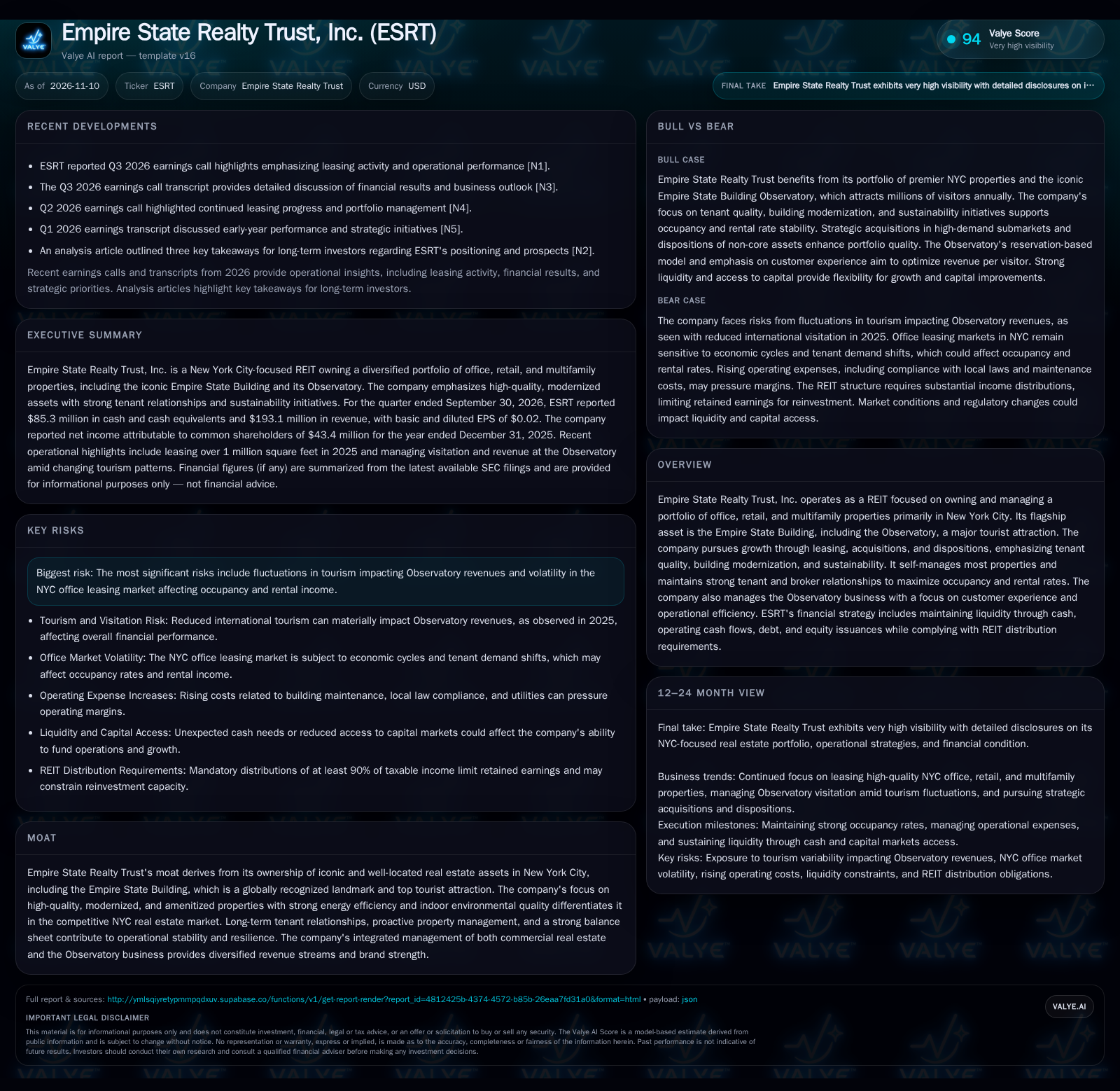
Empire State Realty Trust (ESRT) reported 89.9% Manhattan office occupancy, over 1 million square feet leased in 2025, and a 2.3 million-visitor draw at its flagship Observatory despite a tourism downturn. Operating income fell 14.5% on lower Observatory revenues, but higher revenue per visitor and ongoing portfolio upgrades signal resilience. The key test is whether ESRT can sustain strong tenant demand, optimize its diversified asset base, and mitigate exposure to cyclical tourism and office headwinds. [S1] [S2]
Empire State Realty Trust (ESRT) stands out in New York City’s crowded real estate market with a blend of historic brand, diversified asset classes, and disciplined portfolio management. Anchored by the globally recognized Empire State Building and its Observatory, ESRT’s business model is tested by structural shifts in office demand and volatile international tourism. The company’s recent results—marked by high office occupancy, substantial leasing activity, and resilience in Observatory yield—highlight both the strengths and the evolving risks of its urban-focused REIT strategy. The path forward hinges on ESRT’s ability to sustain strong tenant engagement, optimize asset utilization, and navigate the unpredictable interplay between tourism, urban work patterns, and real estate economics. [S1] [S2]
Recent Leasing, Observatory Performance, and Portfolio Moves Define ESRT’s 2025-2026 Trajectory
Empire State Realty Trust finished 2025 with a Manhattan office occupancy rate of 89.9% (excluding redevelopment properties), underpinned by over 1 million square feet of new leases signed during the year. This level of leasing activity suggests sustained tenant interest in ESRT’s modernized, amenitized office product even as broader NYC office markets remain challenged. [S1]
The Empire State Building Observatory, a core revenue and brand driver, saw visitation decline to 2.3 million in 2025 from 2.6 million in 2024, attributed to lower international tourism. Importantly, revenue per visitor rose, reflecting successful yield management and possibly higher ticket pricing or enhanced offerings. Operating income, however, fell 14.5% year-over-year, with lower Observatory volumes only partially offset by these pricing gains. [S1]
On the portfolio front, ESRT continued its strategic shift with acquisitions of retail and mixed-use assets in Williamsburg and SoHo, and disposals of non-core properties elsewhere in the metro area. This repositioning aims to concentrate capital in high-demand, resilient submarkets and asset types. [S1]
Financially, ESRT reported $85.3 million in cash at Q3 2026 and maintains access to debt and equity markets, but its REIT status mandates high payout ratios, constraining internal reinvestment. [S2] [S1]
How ESRT Monetizes Urban Real Estate and the Observatory Experience
ESRT’s revenue engine is anchored by rental income from office and retail leases, supplemented by the Empire State Building Observatory’s ticket sales and related hospitality. Office and retail leases typically provide multi-year revenue streams, with pricing power dependent on location, asset quality, and market demand. The company’s focus on modernized, energy-efficient buildings may support premium rents and lower tenant churn, though this is tested by hybrid work adoption and competitive supply.
The Observatory business is a distinct, consumer-facing profit center with high fixed costs (staffing, marketing, maintenance) and variable revenues tied to visitation volume and pricing. The 2025 decline in visitor numbers illustrates the volatility of this segment, especially to external shocks like international travel trends. However, rising revenue per visitor indicates that ESRT can flex pricing and/or offer premium experiences to partially offset volume risk.
Operating leverage is structurally high: fixed costs for both real estate and Observatory operations mean that incremental occupancy or ticket sales disproportionately boost margins. Conversely, volume shortfalls (as seen with Observatory visitation) can quickly pressure profits. Capital needs remain significant for ongoing asset modernization, sustainability upgrades, and tenant improvements. The REIT distribution requirement ensures most earnings are paid out, so external funding (debt/equity) remains important for growth and major capex.
Iconic Assets, Tenant Experience, and Location as Sources of Differentiation—But Counterforces Persist
ESRT’s competitive edge stems from its control of landmark, centrally located properties—most notably the Empire State Building, which anchors both its brand and its Observatory business. The focus on modernized, amenitized, and sustainable buildings further differentiates ESRT in a market where tenant requirements increasingly emphasize wellness, flexibility, and energy efficiency.
However, the NYC office and retail landscape remains intensely competitive, with alternative landlords, trophy buildings, and new or recently renovated properties vying for premium tenants. Substitution risk is elevated by the rise of hybrid/remote work, which could reduce aggregate office demand and force greater concessions or capex to attract and retain tenants.
For the Observatory, competition is less about direct substitutes (few attractions match its global profile) and more about broader tourism trends, macroeconomic factors, and shifting leisure preferences. The Observatory’s reservation-only, experience-focused model may help defend pricing, but it cannot fully insulate revenue from global travel shocks or consumer spending downturns.
If Tenant Demand and Tourism Rebound, ESRT’s Operating Leverage and Asset Concentration Could Drive Outperformance
In a favorable scenario, a recovery in international tourism and stable or rising domestic visitation lift Empire State Building Observatory volumes, allowing ESRT to compound recent gains in revenue per visitor. Simultaneously, if hybrid work stabilizes and demand for top-tier, energy-efficient office space in Manhattan rebounds, ESRT could push occupancy above 90% and realize rent growth on renewals and new leases.
These tailwinds, paired with disciplined expense management and successful integration of new acquisitions, could restore or expand operating income margins. The company’s high fixed-cost base would amplify the impact of incremental revenue, potentially driving outsized growth in Core FFO and distributable cash flow.
Confirmation would come from sequential increases in Observatory visitation and ticket yield, rising Manhattan office occupancy, positive leasing spreads, and evidence of rent growth outpacing expense inflation.
Stability Hinges on Mixed Recovery in Tourism and Steady Office Demand
The most plausible near-term outcome is a gradual recovery in international tourism, offset by continued variability in business travel and consumer spending. Domestic visitation and higher revenue per Observatory visitor partially fill the gap, but total Observatory revenues remain below pre-pandemic peaks.
Office leasing holds near current levels, with ESRT’s occupancy hovering around 89–90% as hybrid work persists but demand for quality, modern space remains resilient. Rent growth is modest, with higher operating expenses (utilities, compliance, labor) largely offset by cost controls and sustainability-driven efficiency gains.
Portfolio repositioning continues incrementally, with selective acquisitions and dispositions keeping the asset base aligned with market shifts. Dividend payouts remain consistent with REIT obligations, but major capex or acquisitions require opportunistic access to external capital.
This scenario would be confirmed by stable or slowly rising occupancy and visitation metrics, steady Core FFO, and a relatively flat operating income trend.
Tourism Weakness and Office Market Stress Could Expose the Limits of ESRT’s Model
A more adverse trajectory could emerge if international tourism remains depressed or declines further, dragging Observatory visitation and associated revenues down despite higher per-visitor yields. At the same time, a renewed downturn in NYC office demand—driven by economic weakness, tenant downsizing, or oversupply—could push occupancy below 85%, force greater concessions, and compress rent spreads.
In this environment, ESRT’s high fixed costs would magnify the impact of revenue shortfalls, leading to sharper declines in operating income and Core FFO.
Metrics and Developments That Will Reveal the Resilience of ESRT’s Urban Real Estate Thesis
Monthly and quarterly Empire State Building Observatory visitation totals, with breakdowns by domestic versus international visitors, if disclosed.
Revenue per Observatory visitor and the mix of premium ticket or experience sales, as a test of pricing power and yield management.
Manhattan office occupancy rates and leasing spreads on new and renewed leases, especially compared to submarket benchmarks.
Net effective rent trends and tenant retention rates across the office and retail portfolio, if disclosed.
Operating expense growth versus rent and Observatory revenue growth, as a gauge of margin stability.
Cash flow from operations relative to dividend obligations and capex requirements.
Execution and integration outcomes from recent acquisitions and dispositions, including occupancy and revenue contributions from new assets.
Access to and pricing of external capital (debt/equity raises, credit facility usage), especially if major capex or refinancing needs arise.
Disclaimer: This is research-only, informational analysis and not investment advice. It may include AI-generated interpretation and general industry context. Always verify important details using primary sources.

Comments