
Lantronix: Edge AI Ambitions, Vertical Expansion, and the Realities of Concentration Risk
Lantronix’s strategic push into NDAA-compliant Edge AI and Industrial IoT is building recurring revenue streams and deepening its vertical market presence. Yet, supply chain constraints and customer concentration create material volatility, forcing the company to balance innovation with operational risk.
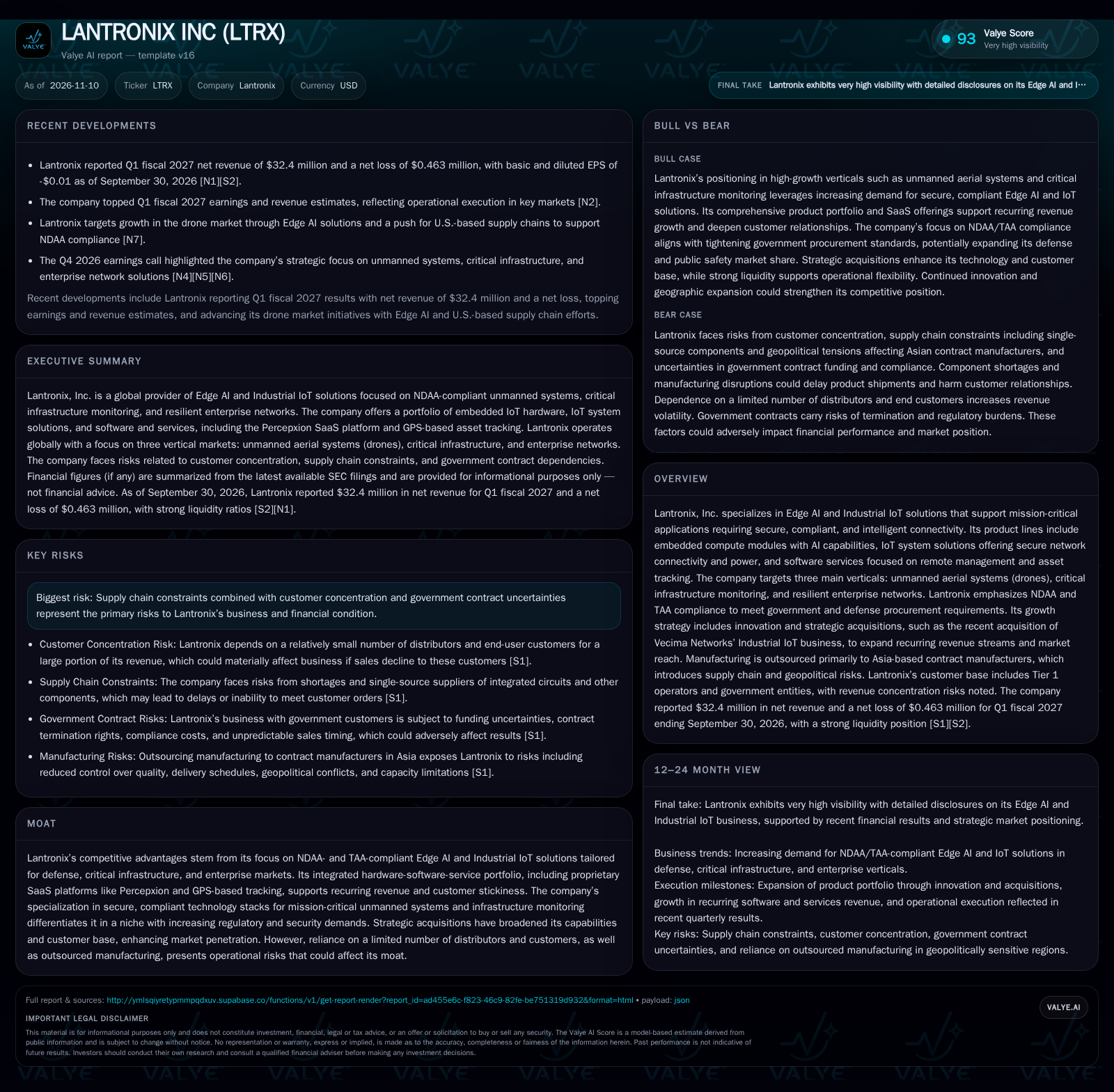
Lantronix’s focus on Edge AI and Industrial IoT for unmanned systems, critical infrastructure, and enterprise networks has driven product and SaaS platform expansion, notably with recent acquisitions. The company’s success depends on converting innovation and compliance leadership into durable, less volatile revenue streams while navigating the uncertainties of defense and infrastructure procurement cycles. [S1] [S2]
Lantronix, Inc. is executing a multi-pronged strategy in Edge AI and Industrial IoT, positioning itself to capitalize on the rising demand for secure, compliant technology in unmanned systems, infrastructure monitoring, and enterprise networks. Recent quarters have seen the company expand its recurring SaaS and services footprint through targeted acquisitions and deepen its focus on NDAA/TAA-compliant solutions for defense and critical infrastructure. The next phase will test whether Lantronix can convert its vertical leadership and software-driven ambitions into more stable, scalable economics—or whether operational vulnerabilities will keep financial performance volatile.
Recent Financials and Strategic Moves Shape Near-Term Trajectory
Lantronix reported $32.4 million in net revenue and a net loss of $0.463 million for Q1 fiscal 2027, with a current ratio of 2.99 and cash ratio of 1.29 as of September 30, 2026 [S2]. The company reported cash and liquidity metrics for the period; these figures do not by themselves establish operating runway, investment capacity, financial flexibility, or financing capacity.
The acquisition of Vecima Networks’ Industrial IoT business and Nero Global Tracking in 2026 has expanded Lantronix’s recurring software and services revenue base [S1]. These moves are intended to reduce revenue cyclicality and deepen customer relationships, particularly in asset tracking and remote management.
A strategic focus on NDAA/TAA-compliant Edge AI solutions for unmanned aerial systems and critical infrastructure is positioning Lantronix to compete for defense and government contracts, where compliance and supply chain security are increasingly non-negotiable [S1].
However, the company’s reliance on a relatively small number of distributors and end customers for a large portion of revenue remains a significant risk, as does its exposure to supply chain constraints and single-source component shortages [S1].
How Recurring Revenue and Product Mix Could Drive Margin Expansion
Lantronix’s economics hinge on a mix of hardware, embedded solutions, and increasingly, software and services. Embedded IoT modules and system solutions are typically sold to OEMs and large enterprise customers, often with project-based or volume-driven pricing. These hardware sales can be lumpy, especially given the company’s customer concentration and exposure to government procurement cycles.
The company’s push into SaaS via platforms like Percepxion and GPS-based asset tracking (amplified by the Nero Global Tracking acquisition) is designed to increase recurring, higher-margin revenue. If Lantronix can successfully migrate more customers to subscription-based management and analytics platforms, operating leverage could improve as incremental software revenue comes with lower variable costs than hardware shipments.
However, the economics of hardware outsourcing are complex. Manufacturing is largely outsourced to Asian contract manufacturers, keeping fixed costs down but exposing Lantronix to component shortages, quality issues, and geopolitical risks. Gross margin may be volatile if supply chain disruptions force spot purchases or limit production volumes.
Compliance, Integration, and Niche Focus: Sources of Potential Advantage and Their Limits
Lantronix’s competitive strength derives from its focus on NDAA- and TAA-compliant technology stacks, a differentiator as U.S. defense and critical infrastructure customers demand secure, traceable supply chains. The integration of edge AI compute, secure connectivity, and remote management—especially for unmanned systems and infrastructure monitoring—creates a sticky value proposition for customers with high regulatory and operational barriers.
Acquisitions have expanded Lantronix’s platform, suggesting a strategy to build an ecosystem that combines hardware, software, and services. If executed well, this could enable cross-selling and higher customer retention, particularly as customers seek end-to-end solutions rather than point products.
However, the company faces formidable competition from both established industrial connectivity vendors and newer entrants in the edge AI and IoT SaaS space. Many rivals have deeper scale, broader distribution, and more diversified customer bases. Furthermore, the company’s reliance on a handful of distributors and large enterprise/government customers makes it vulnerable to competitive displacement or contract churn.
Substitution risk is also present: rapid advances in AI chipsets, cloud-based management, or alternative connectivity solutions could erode differentiation if Lantronix fails to keep its platform current and compliant.
Leveraging Compliance and Platform Integration for Step-Change Recurring Revenue
The most favorable trajectory for Lantronix involves converting its niche compliance and vertical integration into sustained, recurring software and services revenue. If NDAA/TAA compliance drives a wave of defense and infrastructure contract wins—especially as government and critical infrastructure operators refresh legacy systems—Lantronix could see both volume and pricing power improve.
A successful migration of existing hardware customers to SaaS management platforms would increase ARPU and reduce revenue volatility. The recent acquisitions could accelerate this transition if integration is smooth and customer churn remains low.
Upside confirmation would come from disclosed increases in SaaS revenue mix, multi-year government or enterprise contracts, and evidence of cross-selling between hardware and software offerings. Gross margin expansion and improved operating leverage would further validate this scenario.
Falsification would come from continued lumpy hardware sales, limited SaaS adoption, or loss of major customers due to competitive pressure or compliance failures.
Recurring Revenue Grows, But Volatility Persists Amid Customer and Supply Chain Pressures
The most plausible path is that Lantronix continues to grow its recurring software and services revenue, but the overall business remains exposed to volatility. Hardware revenues will likely remain tied to the project-driven purchasing cycles of government and large enterprise customers, with meaningful swings quarter to quarter.
SaaS and services may gradually increase as a share of total revenue, but customer concentration and supply chain risks will continue to drive both operational and financial unpredictability. Manufacturing disruptions or component shortages could delay shipments, while the loss or delay of a single large contract could materially impact results.
Confirmation would come from steady, if uneven, top-line growth, incremental SaaS mix expansion, and continued investment in NDAA/TAA-compliant solutions. Falsification would be seen in declining revenue, margin compression due to supply chain issues, or a major customer loss not offset by new wins.
Supply Chain Shocks or Customer Losses Trigger Operating and Financial Instability
The bear case centers on the interaction between Lantronix’s supply chain fragility and customer concentration. If a key component shortage or geopolitical event disrupts Asian manufacturing partners, Lantronix could face shipment delays, revenue loss, or unplanned cost spikes.
Similarly, if a major distributor or government customer reduces or ends its relationship—whether due to budget cuts, competitive displacement, or contract non-renewal—the company’s revenue base could contract sharply. Government contracts carry the added risk of termination for convenience, making even signed deals less predictable.
Downside confirmation would include missed shipments, negative revenue surprises, inventory write-downs, or public disclosures of major contract losses. Falsification would require evidence of diversified customer wins, new supply chain redundancies, or successful mitigation of component sourcing risks.
What Will Determine Whether Lantronix’s Platform Delivers Durable Value?
The proportion of SaaS and recurring services revenue to total revenue, if disclosed, as a signal of margin and visibility improvement.
Quarterly gross margin trends, especially in the face of supply chain disruptions or mix shifts toward higher-margin software.
Customer concentration metrics—such as revenue share from the top five customers or largest contracts—would help gauge volatility risk.
Disclosure of multi-year, multi-customer contract wins in government, defense, or large enterprise segments.
Evidence of successful integration and cross-selling between acquired platforms (e.g., Nero Global Tracking) and legacy products.
Inventory and accounts receivable swings that might signal demand volatility, shipment delays, or working capital stress.
Updates on supply chain strategies, including alternate sourcing, dual-sourcing initiatives, or reshoring efforts to mitigate geopolitical risks.
Churn rates or retention statistics for software and SaaS customers, if disclosed, to assess recurring revenue stickiness.
Disclaimer: This is research-only, informational analysis and not investment advice. It may include AI-generated interpretation and general industry context. Always verify important details using primary sources.

Comments