
WM Technology’s Marketplace Model: Managing Churn, Margin Pressure, and Regulatory Changes in Cannabis Tech
WM Technology, operator of the Weedmaps platform, faces a changing cannabis market marked by revenue decline, client churn, and industry consolidation.
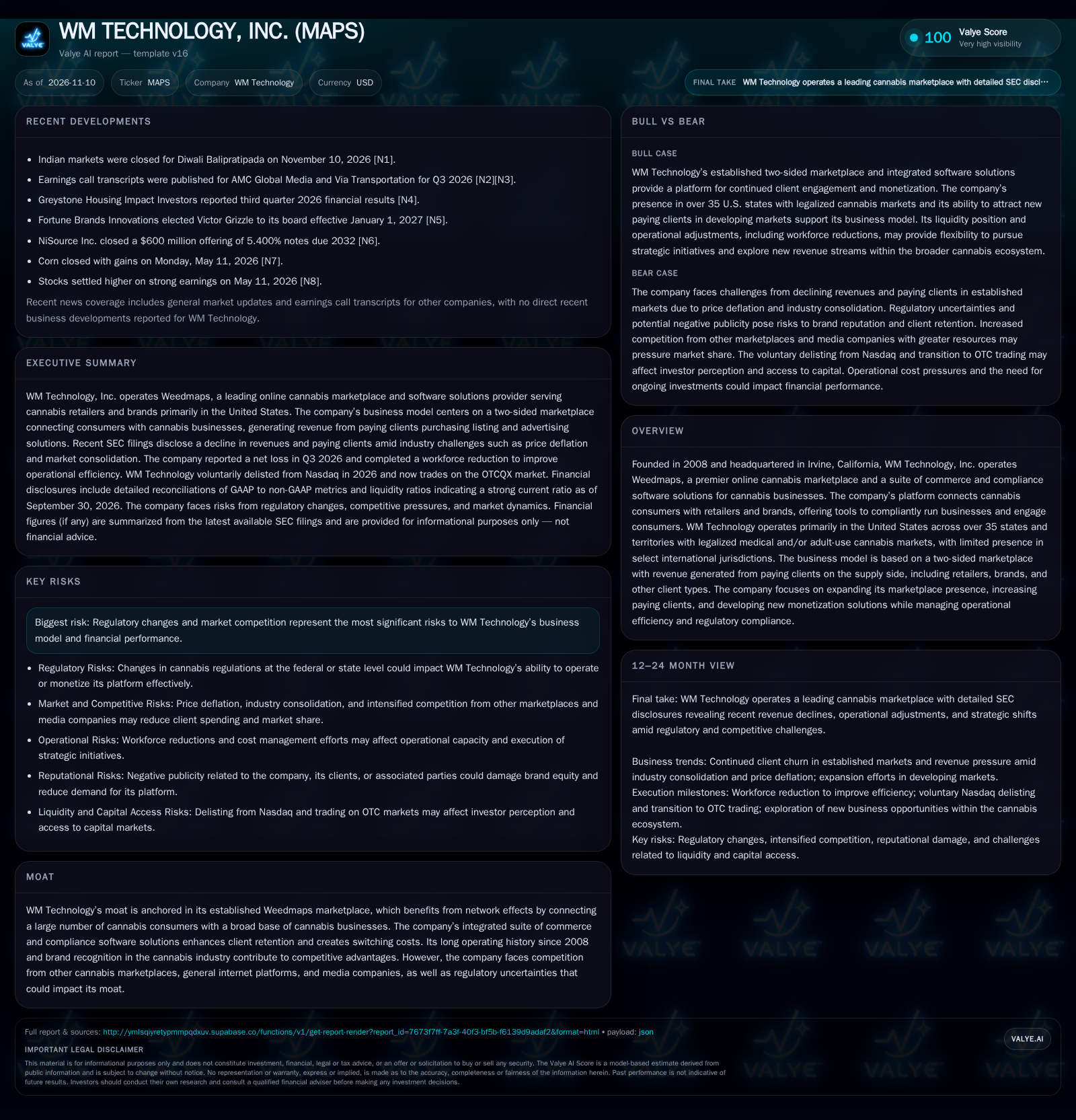
WM Technology, Inc. (MAPS) operates Weedmaps, a leading cannabis marketplace and software provider, primarily in the U.S. The company has seen declining revenues and paying clients amid price deflation and industry consolidation, reporting a net loss in Q3 2026. A recent workforce reduction and Nasdaq delisting reflect an effort to improve efficiency and flexibility. [S1] [S2]
WM Technology, Inc.—best known for its Weedmaps platform—sits at the intersection of cannabis e-commerce and compliance technology. Despite its first-mover status and broad U.S. footprint, the company is contending with shrinking revenues, client attrition, and intensifying competitive and regulatory challenges. Recent moves, including a workforce reduction and voluntary Nasdaq delisting, underscore management’s efforts to adapt to a maturing, consolidating industry landscape.
Recent Revenue Trends and Strategic Adjustments Define the Near-Term View
WM Technology reported Q3 2026 revenues of $38.5 million (down from $42.2 million in the prior year) and a net loss of $5.9 million, compared to net income of $3.6 million a year earlier. Adjusted EBITDA for the quarter dropped sharply to $0.8 million from $7.6 million. These declines reflect both a reduction in average monthly paying clients (from 5,190 at year-end 2025 to 4,899 in September 2026) and ongoing price deflation within the cannabis industry. [S1] [S2]
In response, the company executed a reduction in force during Q3 2026, incurring $2.2 million in severance costs, and voluntarily delisted from Nasdaq, now trading on the OTCQX Best Market. As of September 30, 2026, cash and cash equivalents stood at $50.99 million, with a current ratio of 2.97. These developments indicate a pivot toward operational efficiency and strategic repositioning, but also highlight the pressures that come from a rapidly evolving regulatory and competitive landscape. [S2]
Margin Squeeze and Marketplace Forces in a Deflationary Cannabis Landscape
WM Technology operates a two-sided marketplace model, primarily monetizing cannabis retailers and brands through paid listings, advertising, and software solutions. The platform’s economics hinge on the number of paying business clients, the pricing power over those clients, and the ability to drive consumer engagement that leads to higher value placements.
Recent declines in both paying clients and average monthly revenue per client suggest that industry-wide price deflation and consolidation are eroding pricing power and compressing margins. As cannabis markets mature, larger multi-state operators and consolidators may negotiate lower rates, while smaller participants exit or reduce spend.
The company’s cost structure carries a mix of fixed platform development/maintenance costs and variable sales and marketing expenses. Operating leverage is challenged when client churn and pricing pressure reduce topline growth, forcing management to prioritize cost control, as evidenced by the recent workforce reduction.
Capital needs are moderate given the asset-light, software-driven model, but ongoing investment in compliance, technology upgrades, and new product development is necessary to remain competitive. The company reported cash and liquidity metrics for the period; these figures do not by themselves establish operating runway, investment capacity, financial flexibility, or financing capacity.
Evaluating Network Effects, Software Loyalty, and Risks from Alternative Platforms
Weedmaps’ competitive edge stems from its first-mover advantage, brand recognition, and the network effects inherent in a large-scale two-sided marketplace. The breadth of consumer traffic and retailer participation creates a virtuous cycle—more listings attract more consumers, and vice versa. Integrated compliance and commerce software could further entrench business clients by raising switching costs.
However, these advantages face erosion from several directions. Competing cannabis marketplaces (including vertically integrated dispensary chains’ own digital platforms), general e-commerce aggregators, and digital media companies are all vying for a share of cannabis advertising and e-commerce spend. Industry consolidation may also empower large clients to bypass the platform or negotiate lower rates.
Regulatory uncertainty remains a structural threat: changes in state or federal cannabis policy could either expand addressable markets or restrict them, while also impacting compliance burdens. Negative publicity or legal/regulatory actions could damage brand equity, reducing both consumer and business client loyalty.
Potential Growth from Renewed Client Expansion and Monetization in New Markets
The most favorable outcome for WM Technology would see stabilization in established markets and meaningful client acquisition in newer, developing cannabis markets. Expansion of the Weedmaps for Business suite—especially if it delivers tangible compliance and operational benefits—could create new revenue streams and deepen platform integration.
A return to net client growth, coupled with successful upselling of higher-value software or advertising packages, could offset price deflation and restore positive operating leverage. Evidence of this scenario would include sequential increases in paying clients, rising average revenue per client, and improved gross margins, particularly in states or regions newly opening to legal cannabis commerce.
Further, regulatory liberalization—such as federal cannabis reform—could significantly expand the addressable market and reduce compliance friction, amplifying the company’s growth prospects.
Ongoing Challenges with Client Retention, Cost Controls, and Focused Expansion
The most plausible near-term scenario is continued client churn and revenue pressure in mature markets, with only modest offset from new client wins in developing areas. Price deflation and industry consolidation are likely to persist, limiting the company’s ability to raise prices or expand wallet share with existing clients.
Operational efficiency initiatives—such as the recent workforce reduction—may help preserve margin, but growth will remain challenged unless the company can meaningfully differentiate its platform or unlock new monetization vectors.
Confirmation of this scenario would include continued year-over-year declines in client counts and revenue, relatively stable (but not expanding) margins, and limited progress on new business initiatives. Evidence to the contrary would be a clear inflection in client acquisition or a successful launch of new software modules that drive incremental revenue.
Risks of Continued Revenue Decline and Regulatory Challenges Prompting Restructuring
The adverse scenario would see accelerated revenue and client losses, either due to intensifying price competition, rapid industry consolidation, or regulatory clampdowns that shrink the addressable market. If large retailers increasingly bypass Weedmaps or shift budgets to competing platforms, the network effect could unravel, leading to a negative spiral of declining relevance.
Heightened regulatory scrutiny, negative publicity, or legal action could further damage the brand and deter both consumers and business clients. In this scenario, the company may be forced into additional rounds of cost cutting, scaling back investment in product development, or exploring asset sales or strategic alternatives.
Evidence supporting this scenario would include sharper sequential declines in revenues and paying clients, deteriorating margins despite cost cuts, and negative operating cash flow. Regulatory or legal disclosures indicating increased compliance costs or restrictions would also be confirming signals.
Key Milestones Shaping WM Technology’s Marketplace Resilience and Strategic Response
Quarterly average monthly paying client count: A reversal of recent declines would indicate regained traction and marketplace health. [S2]
Average monthly revenue per paying client: Stabilization or growth in this metric would suggest pricing power or successful upselling, despite industry headwinds. [S2]
Gross margin trends: Improvements could signal successful cost control or higher-value service adoption; sustained compression would raise concern. (If disclosed)
Sequential change in active listing pages: Growth would indicate expanding platform relevance, while declines may signal competitive losses. [S2]
New product launches or adoption rates for Weedmaps for Business modules: Uptake of new software offerings could create incremental revenue streams. (If disclosed)
Expansion into newly legalized states or international markets: Concrete evidence of client wins and monetization in these areas would validate the growth strategy. (If disclosed)
Cash flow from operations: Positive or improving cash flow would provide confidence in the company’s ability to self-fund through industry cycles. (If disclosed)
Disclaimer: This is research-only, informational analysis and not investment advice. It may include AI-generated interpretation and general industry context. Always verify important details using primary sources.

Comments