
UR-Energy’s Ongoing Losses, Development Cycle, and the Economics of Uranium Mining Scale
UR-Energy’s Q3 2026 results highlight the financial tension between advancing uranium development projects and the near-term absence of commercial production scale. With reported liquidity position but persistent net losses, the company’s ability to transition from exploration to profitable operations hinges on uranium price trends, development execution at Shirley Basin, and the eventual realization of operating leverage.
UR-Energy continues to generate revenue but posts substantial net losses as it advances its Shirley Basin project.Despite a reported cash position and reported current ratio, the company remains in an exploration/development phase, expensing significant costs that mask potential future margin improvement. The core question is whether commercial production and uranium market conditions will align to deliver sustainable profitability.
UR-Energy’s third-quarter 2026 results crystallize the classic challenge for pre-scale uranium miners: balancing the capital and labor intensity of bringing new production online with the volatility of uranium market dynamics. Despite reporting $12.4 million in quarterly revenue and maintaining a reported liquidity position cushion, the company’s net loss of $17.7 million underscores the weight of expensed development at its Shirley Basin project, which is nearing operational readiness but has yet to achieve commercial production. The ability to convert this investment into positive operating leverage will define the company’s trajectory as uranium market fundamentals evolve.
Financial Snapshot: Losses Persist as Shirley Basin Nears Transition
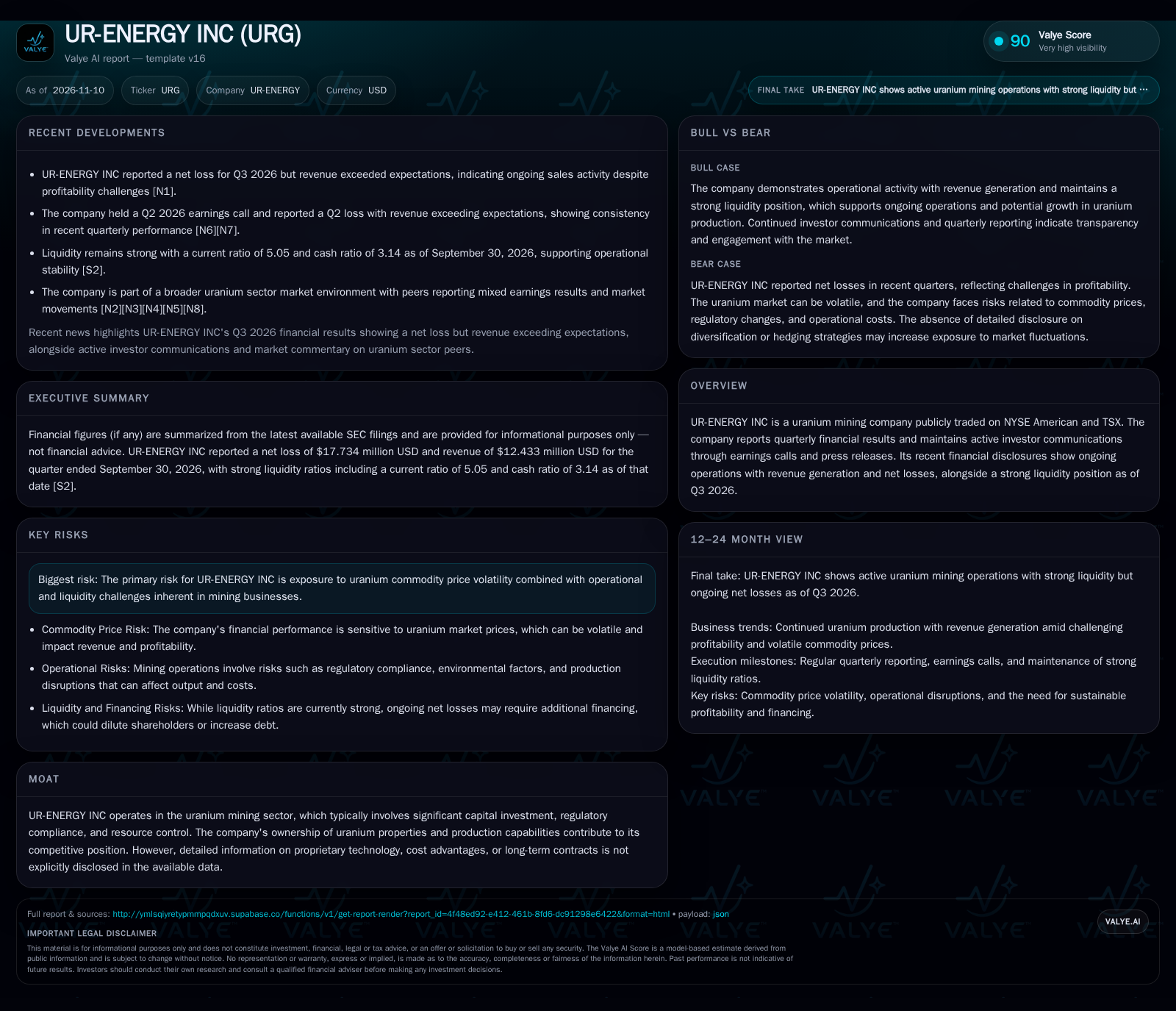
UR-Energy reported $12.43 million in revenue and a net loss of $17.73 million for Q3 2026, continuing a pattern of top-line growth paired with significant bottom-line pressure [S2]. [S2] The Shirley Basin project has completed initial plant construction and begun shipping uranium for processing, but the absence of commercial production means that wellfield, plant, and site administration costs are still being fully expensed [S2]. This accounting treatment inflates reported losses and will persist until the project achieves production status, at which point costs would shift to capitalization and depletion.
Mining Economics Before and After Scale: Fixed Costs and Operating Leverage
UR-Energy’s current cost structure is characterized by high fixed development and operating expenses, much of which is tied to ramping up Shirley Basin. As an exploration-stage issuer, the company expenses development costs, leading to steeper reported losses compared to production-stage peers that capitalize such outlays [S2]. Once commercial production commences, these expenses would shift to inventory and cost of sales via depletion, potentially lowering the apparent cost base and improving gross margins. Uranium mining economics are typically marked by substantial upfront capital and ongoing regulatory, labor, and environmental costs. Revenue is highly sensitive to production volume and spot/contract prices. If UR-Energy can achieve sufficient scale at Shirley Basin, fixed costs may be absorbed over higher output, increasing operating leverage and margin potential—assuming market prices and recovery rates are favorable. However, until commercial production is achieved, the company’s economics remain structurally challenged.
The transition from exploration to production also introduces a shift in risk profile that impacts cost management and capital allocation decisions. During exploration and early development, expenditures are largely discretionary and focused on proving resource viability and infrastructure readiness. Once commercial production begins, the company faces continuous operational risks including ore grade variability, recovery efficiency, and potential regulatory compliance costs that can affect unit costs. These factors create a complex interplay where achieving scale is necessary but not sufficient; consistent operational execution and cost control become critical to realize the full benefits of operating leverage. Additionally, the timing of capital expenditures relative to production ramp influences cash flow dynamics, as upfront investments precede revenue generation.
Resource Control, Regulatory Barriers, and the Realities of Uranium Market Competition
UR-Energy operates in a sector where significant barriers to entry exist: regulatory permitting, environmental compliance, and the capital intensity required to bring a uranium project to commercial scale. Control of uranium resources and the technical ability to develop them are core competitive assets. However, the company faces competition from both established uranium producers with lower unit costs and from alternative nuclear fuel suppliers, including state-backed entities. Price volatility is endemic to uranium markets, driven by geopolitical factors, shifting nuclear policy, and the timing of utility contracting cycles. Without long-term offtake agreements or hedging strategies disclosed, UR-Energy’s realized pricing may be more exposed to spot market swings. The company’s ability to move Shirley Basin into commercial production ahead of less-advanced peers would strengthen its position, but cost discipline and regulatory execution remain critical differentiators.
In the context of uranium market competition, UR-Energy’s strategic positioning also depends on its ability to navigate supply chain constraints and geopolitical influences that affect input costs and market access. For instance, fluctuations in energy prices, labor availability, and materials procurement can disproportionately impact smaller producers with less bargaining power. Moreover, the uranium sector’s cyclical nature means that competitive advantage may be transient if larger producers can rapidly adjust output or if government policies shift toward stockpiling or export controls. Therefore, beyond resource control, maintaining flexible operational structures and diversified market channels could be essential to mitigate competitive pressures and sustain viability through market cycles.
Commercial Production at Shirley Basin Unlocks Margin Expansion
A favorable scenario unfolds if Shirley Basin transitions successfully to commercial production, allowing development costs to be capitalized and spread over higher volumes. This would immediately reduce reported operating losses and could drive positive gross margins, especially if uranium prices remain robust or rise further. The ability to secure long-term contracts at attractive prices, combined with reliable plant performance and production ramp, would further enhance profitability and cash generation. Confirmation of this scenario would include: public disclosure of the commencement of commercial production at Shirley Basin, a reduction in expensed development costs, and evidence of increasing shipment volumes and realized uranium sales prices above cash costs. Sustained improvement in quarterly gross profit and reduced net loss—or a pivot to profitability—would validate the thesis.
Beyond the immediate financial benefits of commercial production, a successful ramp at Shirley Basin could enable UR-Energy to leverage its operational data to optimize recovery rates and reduce per-unit costs over time. This iterative improvement process often leads to enhanced cash margins and strengthens negotiating positions for long-term contracts. Furthermore, demonstrating reliable production performance may attract strategic partnerships or investment, providing additional capital and reducing financing costs. Such developments would compound margin expansion and support a virtuous cycle of reinvestment and growth. However, these outcomes depend on the company’s ability to manage operational complexities and respond agilely to market signals, underscoring the importance of robust project management and market intelligence capabilities.
Development Continues with Gradual Shift Toward Production Economics
The most plausible trajectory is a gradual ramp-up at Shirley Basin, with development costs remaining elevated and expensed into the near term. Revenue may continue to exceed expectations if uranium market conditions are favorable, but net losses are likely to persist until commercial production is formally achieved and costs can be capitalized. The company’s reported liquidity position cushions the transition period, but the window for self-funding narrows as losses accumulate. Evidence supporting this base case would include continued reporting of net losses, incremental progress updates on Shirley Basin operational milestones, and stable or improving liquidity metrics. A shift in cost accounting treatment and a narrowing net loss would signal progress toward production economics.
Extended Pre-Production Phase and Uranium Price Weakness Pressure Liquidity
A bearish scenario materializes if delays in Shirley Basin’s commercial ramp coincide with a downturn in uranium prices, compressing revenue and extending the period of high expensed development costs. This would increase cash burn and could eventually pressure the company’s liquidity, forcing a search for external financing or asset sales under less favorable terms. Regulatory setbacks, operational disruptions, or cost overruns would exacerbate this dynamic. Confirmation would come from persistent or widening net losses, declining cash balances, or management commentary about funding needs. Any equity or debt raise, or a reduction in development activity due to cash constraints, would be negative signals.
Milestones and External Factors That Will Determine UR-Energy’s Next Phase
Announcement of commercial production commencement at Shirley Basin and associated shift in cost capitalization, if disclosed.
Quarterly trends in reported development expense versus capitalized costs, as this would signal the transition from exploration to production economics.
Quarterly revenue growth and realized uranium sales prices, which would test the company’s ability to benefit from uranium market strength.
Cash and short-term investment balances, as persistent net losses could begin to erode the current liquidity cushion.
Updates on operational ramp and plant throughput at Shirley Basin, including production volumes and shipment rates, if disclosed.
Any public disclosure of new long-term supply contracts, offtake agreements, or price hedging mechanisms that could stabilize revenue.
Changes in regulatory status or permitting for Shirley Basin or other properties, which could accelerate or delay production timelines.
Evidence of cost containment or reductions in site administration and labor expenses as project ramp stabilizes.
Disclaimer: This is research-only, informational analysis and not investment advice. It may include AI-generated interpretation and general industry context. Always verify important details using primary sources.

Comments