
Better Home & Finance: Technology Ambition Meets Governance and Profitability Crossroads
Better Home & Finance’s digital mortgage platform aims to disrupt legacy home lending economics, but persistent net losses, leadership upheaval, and Nasdaq compliance issues raise questions about execution and long-term viability.
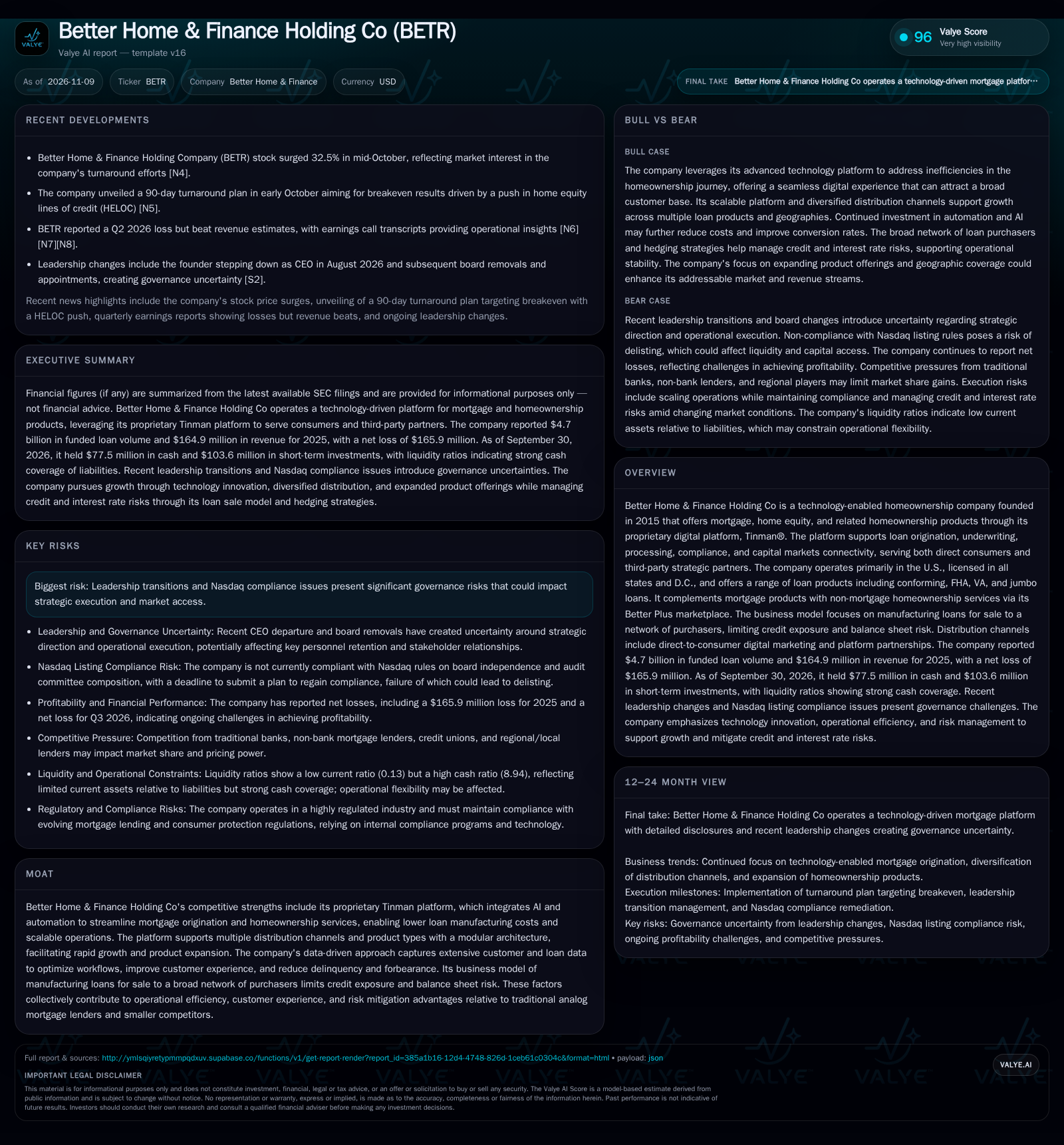
Better Home & Finance leverages its proprietary Tinman platform to streamline mortgage origination and related services, reporting $4.7 billion in 2025 funded loan volume and $164.9 million in revenue, but continues to operate at a net loss. The company has launched a 90-day turnaround plan targeting breakeven, especially with a push into HELOCs, amid recent founder departure and ongoing board and Nasdaq listing challenges. Its digital-first, asset-light model could enable operating leverage if scale and efficiency improve, but competitive and governance risks remain substantial. [S2] [N4] [N5]
Better Home & Finance Holding Co is at a critical inflection point: its Tinman digital platform promises to modernize the mortgage and homeownership experience, but the company remains mired in sizable losses, leadership turnover, and regulatory uncertainty. With a reported $4.7 billion in funded loan volume and $164.9 million in revenue for 2025, Better is betting on automation and a push into home equity products to finally reach breakeven. Yet, the recent CEO departure and board reshuffling, coupled with Nasdaq compliance risks, underscore the fragility of execution and the stakes of achieving sustainable scale in a fiercely competitive market. The next several quarters will test whether technology and operational efficiency can overcome structural industry pressures and internal disruption.
Turnaround Efforts, Leadership Volatility, and Ongoing Losses Define the Present
Better Home & Finance reported $4.7 billion in funded loan volume and $164.9 million in revenue for the year ended December 31, 2025, but remained unprofitable with a net loss of $165.9 million. The company reported cash and liquidity metrics for the period; these figures do not by themselves establish operating runway, investment capacity, financial flexibility, or financing capacity. [S2]
In October 2026, Better launched a 90-day turnaround plan with a stated goal of reaching breakeven, emphasizing growth in home equity lines of credit (HELOCs). [N5] This move follows a period of leadership instability: the founder stepped down as CEO in August, and subsequent board removals and appointments have created uncertainty around strategic direction. [S2]
The company is also addressing non-compliance with Nasdaq listing requirements for board independence and audit committee composition, with a deadline to submit a remediation plan by November 27, 2026. [S2] These governance and regulatory issues add further pressure to an already challenging operating environment.
How the Tinman Platform Seeks to Reshape Mortgage Economics
Better’s core business model is to originate residential mortgages and home equity products through its proprietary Tinman platform, then sell those loans to a network of GSEs, banks, insurance companies, asset managers, and mortgage REITs. This model limits the company’s direct credit exposure and balance sheet risk, with the bulk of revenue coming from loan sale premiums and related fees. [S2]
Tinman automates underwriting, processing, compliance, and capital markets connectivity, aiming to reduce per-loan manufacturing costs through scale and AI-driven workflow optimization. In theory, this should create operating leverage: as volume grows, fixed technology and compliance costs are spread across more loans, and incremental costs per loan decline.
However, the company’s continued net losses indicate that either fixed costs remain too high relative to volume, or that pricing/fee pressure, competitive CAC, or other variable costs offset automation gains. The push into HELOCs represents an attempt to diversify revenue and tap into consumer demand amid a higher-rate environment, but the economics of home equity products can be less attractive if origination costs or churn are high.
Unlike balance-sheet lenders, Better’s capital needs are less about funding loans (as these are typically sold) and more about sustaining technology investment, marketing, regulatory compliance, and partnerships. This asset-light approach, if scaled efficiently, could be economically attractive, but requires persistent volume growth and tight cost control to break the cycle of losses.
Digital Disruption Meets Entrenched Mortgage Competition
Better faces competition on several fronts: traditional banks and credit unions (with deep customer relationships and deposit funding), non-bank mortgage originators (often with scale and aggressive pricing), and regional or local lenders who may offer personalized service or local market expertise. The company’s Tinman platform is positioned as a differentiator, enabling speed, automation, and a digital-first experience that can appeal to tech-savvy borrowers and partners. [S2]
However, the mortgage industry is highly commoditized, with pricing, customer acquisition, and regulatory compliance as persistent battlegrounds. Incumbent banks may subsidize mortgage origination with cross-sell economics, while fintech and digital-native competitors can match or exceed digital experience. Switching frictions for consumers are low—rate, speed, and certainty often trump brand or platform features. For partners, integration depth and reliability may matter, but are not insurmountable barriers.
Better’s asset-light, tech-forward positioning provides some cost and agility advantages, but the real test is whether the platform can sustain lower per-loan costs and faster cycle times without sacrificing compliance or customer satisfaction. The company’s ability to grow third-party origination, monetize non-mortgage services (Better Plus), and maintain a broad purchaser network will determine whether its value proposition translates into durable market share or simply transient volume spikes.
If Automation and HELOC Expansion Drive a Sustainable Profit Turn
The most favorable trajectory for Better involves successful execution of its 90-day turnaround plan: HELOC origination ramps up, leveraging Tinman’s automation to reduce per-loan costs and improve conversion rates. This, combined with continued growth in direct and partner channels, drives loan volume to a level where fixed costs are fully absorbed, and operating leverage turns positive.
If the company can achieve breakeven or better in the next few quarters, and restore board and Nasdaq compliance, it may regain market and investor confidence, enabling further investment in technology and distribution. Evidence confirming this scenario would include: consecutive quarters of narrowing losses or actual profitability, reported improvements in per-loan cost metrics (if disclosed), clear growth in HELOC and non-mortgage product revenue, and stabilization of leadership and governance.
Falsification would occur if HELOC volume fails to materialize, operating costs remain stubbornly high, or further governance issues undermine execution and capital access.
Incremental Efficiency Gains Amid Governance and Margin Pressures
The most plausible near-term outcome is incremental operational improvement but continued financial headwinds. Better may realize some efficiency gains from Tinman and the HELOC push, leading to a modest reduction in quarterly losses, but not full breakeven. Leadership and board instability likely persist through at least the next quarter, with Nasdaq compliance ultimately restored but at the cost of distraction and possible management turnover.
Competitive intensity remains high, limiting pricing power and keeping customer acquisition costs elevated. The company may grow funded loan volume slightly, but margin improvement is gradual, and capital constraints limit aggressive marketing or technology expansion.
Confirmation would come from reported narrowing losses, stabilization of cash and investment balances, and board compliance being achieved by the November deadline. Falsification would be clear if losses widen, cash burn accelerates, or Nasdaq delisting risk materializes.
If Governance Instability and Execution Shortfalls Erode Platform Value
In the adverse scenario, leadership turmoil deepens—key executives or directors depart, strategic direction becomes muddled, and the company fails to regain Nasdaq compliance in time. This could trigger forced delisting, limiting capital access and eroding partner and customer confidence.
Simultaneously, the turnaround plan may stall: HELOC and other product growth underwhelm, while cost cuts undermine service quality or compliance. Competitive pressure forces pricing concessions, further compressing margins.
Evidence confirming this scenario would include further board/executive departures, missed compliance deadlines, accelerating cash burn, and continued or widening net losses. A useful falsification would be stabilization of leadership, restoration of compliance, and at least partial success in cost reduction and product growth.
Testing the Turnaround: What Will Determine Better’s Strategic and Financial Trajectory?
Quarterly trends in funded loan volume—especially the mix between HELOCs and traditional mortgages—will reveal whether the turnaround plan is gaining traction. [N5]
Reported per-loan manufacturing costs or operational efficiency metrics (if disclosed) would help validate the Tinman platform’s ability to drive scale economics.
Progress toward Nasdaq board independence and audit committee compliance by the late November 2026 deadline is essential to avoid delisting risk. [S2]
Leadership continuity or further C-suite/board changes will signal the degree of governance stabilization or ongoing disruption. [S2]
Quarterly net loss trajectory—narrowing losses or a shift to breakeven would support the bull case; persistent or widening losses would support the bear case.
Growth in non-mortgage homeownership service revenue (Better Plus) would suggest progress in product diversification and deeper customer monetization.
Updates on strategic partnerships or third-party channel growth would clarify whether platform distribution is scaling beyond direct-to-consumer.
Disclaimer: This is research-only, informational analysis and not investment advice. It may include AI-generated interpretation and general industry context. Always verify important details using primary sources.

Comments