
AMC Networks: Content Ownership, Legal Overhangs, and the Search for Streaming Scale
AMC Networks faces declining revenues and ongoing legal battles while balancing the economics of legacy cable, targeted streaming, and original content. The company's liquidity and asset mix provide some operational leeway, but durable profit growth likely hinges on navigating litigation, rationalizing costs, and securing a defensible position in a rapidly evolving media landscape.
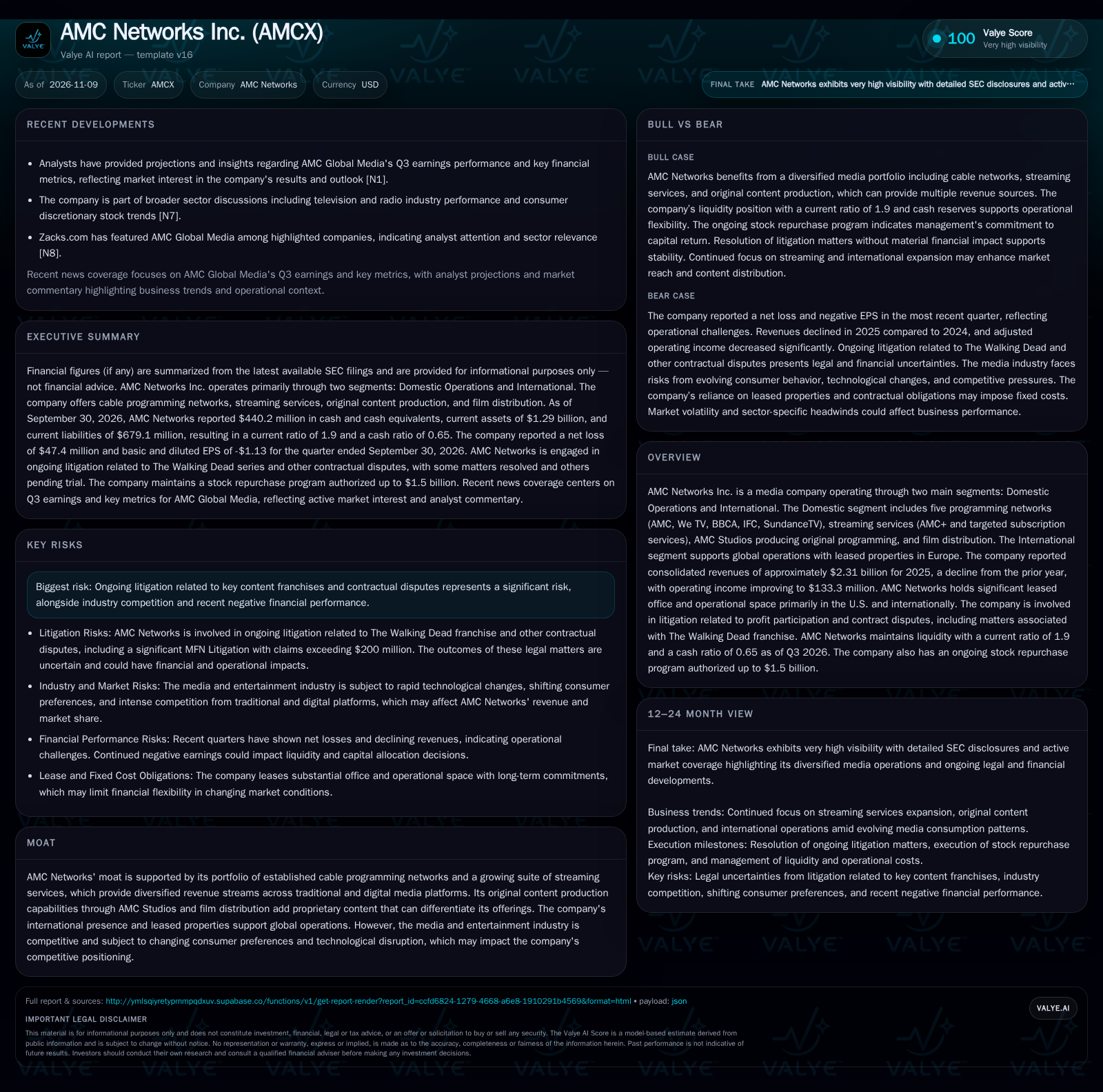
AMC Networks reported lower revenues and a net loss for Q3 2026, with litigation related to The Walking Dead series presenting a major financial wildcard. The key question is whether AMC can stabilize earnings through content differentiation and cost management—or if legal and industry pressures will further erode its economics. [S2]
AMC Networks stands at a crossroads: revenue contraction and ongoing net losses reflect the challenge of sustaining profitability across legacy cable and targeted streaming, just as legal claims tied to its flagship content threaten to overshadow operational progress. With a cash-rich balance sheet and a portfolio spanning traditional networks, specialty streaming, and original content production, AMC must now demonstrate that its diversified model can overcome industry headwinds and litigation overhangs—or risk further erosion of its competitive position and potential financial flexibility. The next 12-24 months will test whether content ownership and capital discipline are enough to deliver durable value in an unforgiving media environment.
Litigation, Losses, and Liquidity: Where AMC Networks Stands Now
AMC Networks reported a net loss of $47.4 million and basic and diluted EPS of -$1.13 for the quarter ended September 30, 2026, continuing a trend of declining financial performance. For full-year 2025, consolidated revenues fell 4.5% to approximately $2.31 billion, with adjusted operating income down nearly 27% versus the prior year. These financial results highlight the dual pressures of secular decline in linear TV and the challenge of scaling new digital revenue streams. [S2]
The company faces legal exposure from ongoing litigation tied to The Walking Dead franchise, including an MFN (Most Favored Nation) dispute with claims exceeding $200 million—an amount that could materially impact future cash flows depending on the outcome. While management asserts these claims are without merit, the trial has been rescheduled to April 2026, keeping risk elevated in the near term. [S2]
On the balance sheet, AMC Networks held $440.2 million in cash and cash equivalents and a current ratio of 1.9 as of Q3 2026. The company reported cash and liquidity metrics for the period; these figures do not by themselves establish operating runway, investment capacity, financial flexibility, or financing capacity. [S2]
How AMC Networks Makes—and Risks—Money Across Platforms
AMC Networks generates revenue through a blend of legacy cable distribution fees, advertising, direct-to-consumer streaming subscriptions, and content licensing. Traditional cable networks provide relatively steady affiliate and ad revenues, but these streams are structurally pressured by cord-cutting and audience fragmentation. The streaming segment, including AMC+ and targeted services like Shudder and Acorn TV, offers potential for growth but faces high customer acquisition costs, churn risk, and the need for continuous investment in original or exclusive content.
The company’s original programming arm, AMC Studios, adds value by creating proprietary IP that can be monetized across both internal and external distribution channels. However, content production is capital-intensive and subject to hit-or-miss economics; a few successful franchises can drive outsized returns, but underperforming originals drain resources. AMC’s film distribution business is a smaller contributor but adds incremental revenue and leverages existing production capabilities.
Fixed costs—including substantial lease obligations through 2033 for office and broadcast space—limit the company’s ability to flex down expenses in response to revenue declines. This structural rigidity amplifies the impact of top-line contraction. Capital needs are driven by ongoing content investment, technology upgrades for streaming, and periodic legal or regulatory outlays. Operating leverage is a double-edged sword: while scale in streaming or content hits could expand margins, ongoing losses and fixed obligations create downside risk if topline recovery stalls. [S2]
Competing for Attention: AMC’s Niche Strategy Versus Industry Giants
AMC Networks operates in a hyper-competitive landscape that includes global streaming giants, diversified media conglomerates, and specialized content providers. The company’s core cable networks (including AMC, BBCA, IFC, and SundanceTV) offer established brand equity, but are increasingly bypassed by younger audiences in favor of on-demand and digital-first platforms.
AMC’s streaming approach targets specific audience segments—such as horror (Shudder), British drama (Acorn TV), and Black-focused content (ALLBLK)—rather than directly challenging broad-based platforms. This niche strategy can foster loyal communities and reduce direct competition with the largest players. However, it also caps potential scale and exposes the company to volatility if any vertical underperforms or faces heightened competition from similar genre-focused offerings.
Original content production, especially successful franchises like The Walking Dead, remains a differentiator. Yet, litigation and profit participation disputes threaten to erode the economic benefits of these hits. International expansion provides optionality, but non-U.S. operations face their own regulatory and market-entry complexities. The ultimate competitive question is whether AMC’s combination of targeted streaming and original IP can deliver enough stickiness and pricing power to offset industry-wide headwinds.
What If Litigation Subsides and Streaming Scale Arrives?
A favorable scenario for AMC Networks would see the resolution of major litigation—particularly the MFN claims related to The Walking Dead—without material financial impact. This would remove a significant overhang, freeing up capital and management attention for strategic initiatives. If the company can stabilize or modestly grow its streaming subscriber base, especially in high-margin niche verticals, the overall revenue mix could shift toward higher-quality, recurring income.
Improved cost discipline—potentially including rationalization of legacy network expenses and more focused content investment—could restore margin expansion. In this scenario, AMC’s original programming continues to generate new franchises, reinforcing the company’s brand and potential licensing opportunities.
Evidence that would confirm this trajectory includes sequential streaming subscriber growth, margin improvement in the streaming segment, and public disclosure of favorable litigation outcomes or settlements. Sustained positive adjusted operating income and renewed content deals with major distributors would also support the bullish case.
Incremental Progress Amid Ongoing Uncertainty
The most plausible path forward for AMC Networks is a period of incremental operational improvement punctuated by continued legal and market uncertainty. Streaming revenue may grow, but likely at a slower pace than industry leaders, and will be offset by ongoing declines in legacy cable. Litigation remains unresolved in the near term, with the risk of financial impact persisting into at least mid-2026.
Cost containment efforts may partially offset fixed obligations, but the company’s ability to meaningfully improve margins will depend on both content performance and the scale of its streaming platforms. International operations offer some diversification, but are unlikely to materially change the financial profile in the short run.
Confirmation of this scenario would come from stable or slightly improving quarterly operating income, continued but modest streaming growth, and no material adverse legal outcomes. Falsification could occur if major litigation results in significant cash outflows or if streaming fails to offset the decline in traditional revenues.
Legal Defeat or Streaming Stagnation Could Trigger Further Erosion
A negative turn in litigation—such as a substantial judgment or unfavorable settlement in the MFN or other Walking Dead-related cases—could materially impair AMC’s liquidity and force management to curtail content investment or seek external financing. Simultaneously, if streaming subscriber growth stalls or churn accelerates, the company risks being trapped with declining legacy revenues and insufficient digital scale.
Fixed lease and operational expenses would exacerbate the impact of revenue shortfalls, limiting the ability to quickly adjust the cost base. In this scenario, AMC could face difficult decisions on asset sales, workforce reductions, or even exploring strategic alternatives under financial duress.
Evidence confirming this downside would include disclosure of large litigation payouts, a sharp drop in cash or current assets, continued or accelerating net losses, and negative trends in streaming subscriber metrics. Lack of new content hits or loss of key distribution partnerships would further validate the bear case.
What Will Determine AMC’s Ability to Restore Sustainable Value?
Resolution and financial terms of the ongoing MFN litigation and other Walking Dead franchise disputes.
Quarterly streaming subscriber growth, churn rates, and ARPU—especially in niche platforms like Shudder, Acorn TV, and AMC+ (if disclosed).
Adjusted operating income and margin trends by segment, with particular focus on the streaming division.
Cash burn rate and changes in cash/current asset balances, especially in the wake of litigation or major investments.
Announcement or execution of cost reduction measures, including lease renegotiations, headcount adjustments, or network rationalization.
Performance and renewal of key content franchises and new original programming launches.
International segment growth rates and profitability, as a test of geographic diversification impact.
Disclaimer: This is research-only, informational analysis and not investment advice. It may include AI-generated interpretation and general industry context. Always verify important details using primary sources.

Comments