
SoundHound AI: Integration Ambitions, Operational Reset, and the Stakes of Voice AI Platform Economics
SoundHound AI’s acquisition of LivePerson, large-scale workforce reduction, and persistent net losses set the stage for a high-stakes transformation. The company’s ability to translate its deep technology stack and patent portfolio into scalable, profitable platform economics—while navigating integration risk and market competition—will define its trajectory toward its 2027 profitability target.
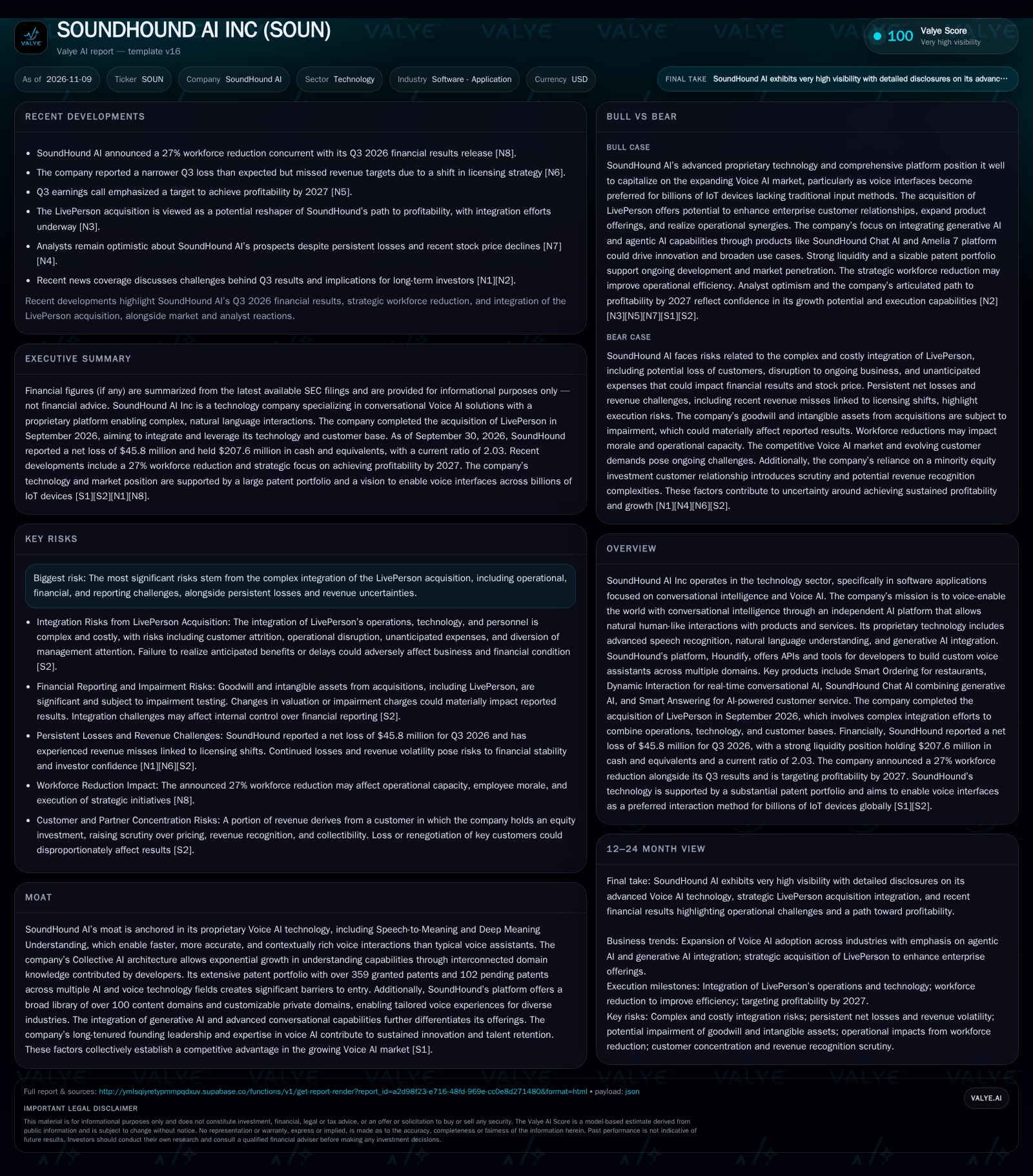
SoundHound AI’s Q3 2026 snapshot reveals a company in transformation: a $45.8M quarterly net loss, $207.6M in cash, a 27% workforce cut, and an ongoing integration of LivePerson. The company’s platform ambitions are anchored by its proprietary Voice AI technology and patent portfolio, but challenges loom around operational execution, customer retention, and extracting value from recent acquisitions. The next 12-24 months will test whether SoundHound can achieve cost discipline and unlock revenue synergies, or whether integration complexity and competitive pressure will stall its path to sustainable profitability. [S2] [N8]
SoundHound AI sits at a pivotal moment: it has just completed the acquisition of LivePerson, initiated a substantial 27% workforce reduction, and continues to report significant net losses. The company’s proprietary Voice AI platform, supported by a deep patent portfolio and a vision for voice as the default interface across billions of IoT devices, positions it to address a rapidly expanding market. However, the integration of LivePerson introduces operational risk, while the ability to scale revenue and achieve its ambitious 2027 profitability target remains unproven. The coming quarters will reveal whether SoundHound can translate its technology leadership into sustainable business economics—or whether internal and external headwinds will force a strategic rethink. [S2] [N8]
A Company in Flux: Integration, Cost Cuts, and Persistent Losses
SoundHound AI’s Q3 2026 results crystallize a company in the midst of operational transformation. The acquisition of LivePerson, closed in September 2026, brings together two independent conversational AI players, promising expanded technology capabilities and access to a broader customer base. This integration, however, is complex and fraught with risk—including the challenges of consolidating sales, technology, and personnel, as well as the potential for customer attrition and unforeseen costs. [S2]
Concurrently, SoundHound announced a dramatic 27% workforce reduction, a move designed to align costs with revenue reality and accelerate the path to profitability. Despite these efforts, the company reported a net loss of $45.8 million for the quarter, underscoring the urgency of its operational reset. The company reported cash and liquidity metrics for the period; these figures do not by themselves establish operating runway, investment capacity, financial flexibility, or financing capacity. [S2] [N8]
Voice AI Platform Economics: Leverage, Synergies, and Monetization Dilemmas
SoundHound’s business model aspires to platform economics, leveraging proprietary Voice AI technology—including Speech-to-Meaning, Deep Meaning Understanding, and generative AI integration—to enable natural language interfaces for automotive, IoT, customer service, and restaurant sectors. Core revenue streams likely derive from licensing, SaaS-like subscription fees, and transaction-based models (such as Smart Ordering in QSR environments). However, the commercial structure—contract lengths, pricing tiers, and customer retention mechanics—remains largely undisclosed, making it difficult to assess the durability or scalability of recurring revenue.
The acquisition of LivePerson is intended to create operational and revenue synergies: cross-selling conversational AI and customer engagement solutions, pooling R&D resources, and streamlining go-to-market efforts. If successful, this could improve gross margins and unlock operating leverage as fixed costs are spread over a larger revenue base. Conversely, integration complexity, overlapping product suites, and customer confusion could dilute these benefits.
SoundHound’s large patent portfolio provides some defensibility and potential for licensing revenue, but the company’s persistent operating losses highlight the challenge of converting technical capability into sustainable unit economics—especially given the capital intensity of AI model development and the need for ongoing sales and customer support investment. The announced workforce reduction may lower the operating expense base, but risks undermining execution and innovation if not carefully managed.
Defending Differentiation in a Crowded Voice AI Landscape
SoundHound’s competitive position is built on proprietary architecture (Speech-to-Meaning, Collective AI), a broad developer toolkit (Houndify APIs, SDKs, and domain libraries), and a substantial patent moat. This positions the company against both horizontal AI platform providers and verticalized voice solution vendors. Major tech platform incumbents offer embedded voice assistants (such as those from large cloud vendors) with deep integration and distribution advantages, while niche competitors may offer highly specialized conversational AI for specific industries.
Switching costs for enterprise and OEM customers—such as automakers, device manufacturers, or quick-service restaurants—could be meaningful if SoundHound’s solutions are deeply embedded or customized. However, the rapid pace of AI innovation and the rise of open-source models could compress differentiation over time. The integration of generative AI (as with SoundHound Chat AI) is a potential differentiator, but generative capabilities are also rapidly commoditizing.
A further challenge arises from customer concentration: the company’s disclosures highlight that a material portion of revenue comes from a customer in which SoundHound holds an equity investment, introducing scrutiny around pricing, collectibility, and revenue quality. Customer retention and expansion into new verticals will be critical to defend and grow share as the market matures.
Synergy Realization and Platform Adoption Fuel a Breakout
In a favorable scenario, SoundHound successfully integrates LivePerson, achieving meaningful cost and revenue synergies. The combined entity leverages its expanded technology stack and customer relationships to win new enterprise deals, particularly in sectors where voice interfaces are becoming mission-critical—such as automotive infotainment, contact centers, and IoT device ecosystems.
If the workforce reduction results in a leaner, more focused organization without undermining core innovation or customer support, operating leverage could accelerate. Platform adoption could be further catalyzed by new product launches, enhanced developer engagement, or successful cross-selling between the legacy SoundHound and LivePerson customer bases.
Evidence that would confirm this scenario includes: sequential improvements in gross margin, sustained growth in contracted ARR or SaaS-like revenue, successful customer wins in new verticals, and management reiterating or accelerating the 2027 profitability target. Rapid expansion of the developer ecosystem or evidence of third-party innovation on Houndify would also support the thesis.
Managing Through Transition: Cost Discipline Meets Integration Complexity
The most plausible path forward sees SoundHound navigating a prolonged integration period with moderate success. Cost reductions from the workforce restructuring help reduce the burn rate, but operational complexity and the challenge of merging sales, technology, and support teams with LivePerson weigh on execution.
Revenue growth is likely to be lumpy, reflecting both the friction of integration and the competitive intensity of the Voice AI market. The company may retain its core customer base but struggle to accelerate adoption in new verticals or geographies until integration milestones are achieved and new joint offerings are fully operational.
Progress toward profitability is incremental, with improvements in operating metrics offset by continued investment in R&D and integration costs. Confirming evidence would include stable or improving customer retention, gradual gross margin expansion, and management maintaining guidance on the 2027 profitability goal. Signs of integration delays, customer churn, or impairment charges on acquired intangibles would challenge this scenario.
Integration Friction, Customer Churn, and Margin Compression Derail Momentum
In an adverse scenario, the integration of LivePerson proves more disruptive and costly than anticipated. Operational missteps—such as the loss of key personnel, duplication of product efforts, or misaligned go-to-market strategies—lead to customer confusion and attrition. The workforce reduction, rather than streamlining operations, results in the loss of critical talent and slows innovation.
Revenue growth stalls or reverses as competitive alternatives gain ground, and the company is forced to discount pricing or increase incentives to retain customers. Margin compression follows as fixed costs remain high relative to sluggish revenue, and the risk of goodwill or intangible asset impairment from the LivePerson acquisition materializes, further pressuring reported results.
Confirming evidence includes: rising customer churn, declining contracted revenue, deterioration in gross margins, public disclosures of integration delays or cost overruns, or impairment charges. Failure to demonstrate progress toward the 2027 profitability goal would reinforce the bear thesis.
Milestones and Metrics That Will Determine SoundHound’s Next Chapter
Progress on LivePerson integration milestones—particularly the consolidation of sales, R&D, and customer support functions—will be critical to assess whether the acquisition is delivering intended synergies.
Quarterly gross margin trends, especially if disclosed by product line or business segment, would clarify the impact of cost reductions and integration on underlying profitability.
Annualized recurring revenue (ARR) or contracted SaaS revenue growth, if disclosed, would provide insight into the scalability and durability of the company’s platform economics.
Customer retention and expansion rates, especially for large enterprise or OEM customers, would help test the quality of SoundHound’s revenue base post-integration.
Updates on impairment testing for goodwill and intangible assets related to the LivePerson deal will be a key signal for acquisition success or failure.
Evidence of customer wins or loss in core verticals (automotive, IoT, customer service) would indicate competitive positioning and execution effectiveness.
Employee turnover and hiring trends post-workforce reduction would shed light on organizational health and the ability to sustain innovation.
Developer ecosystem engagement—such as the number of active developers on Houndify or third-party domain contributions—would help test the platform’s network effect ambitions.
Disclaimer: This is research-only, informational analysis and not investment advice. It may include AI-generated interpretation and general industry context. Always verify important details using primary sources.

Comments