
McEwen Inc.: Copper Ambitions, Portfolio Reshaping, and Mining’s Capital Tightrope
Recent asset sales, a strategic copper focus, and an active approach to capital management define McEwen Inc.’s latest phase. As the company navigates persistent net losses and the capital intensity of mine development, its ability to unlock value from flagship projects like Los Azules and execute disciplined portfolio management will determine whether it can bridge the gap between resource potential and sustainable returns.
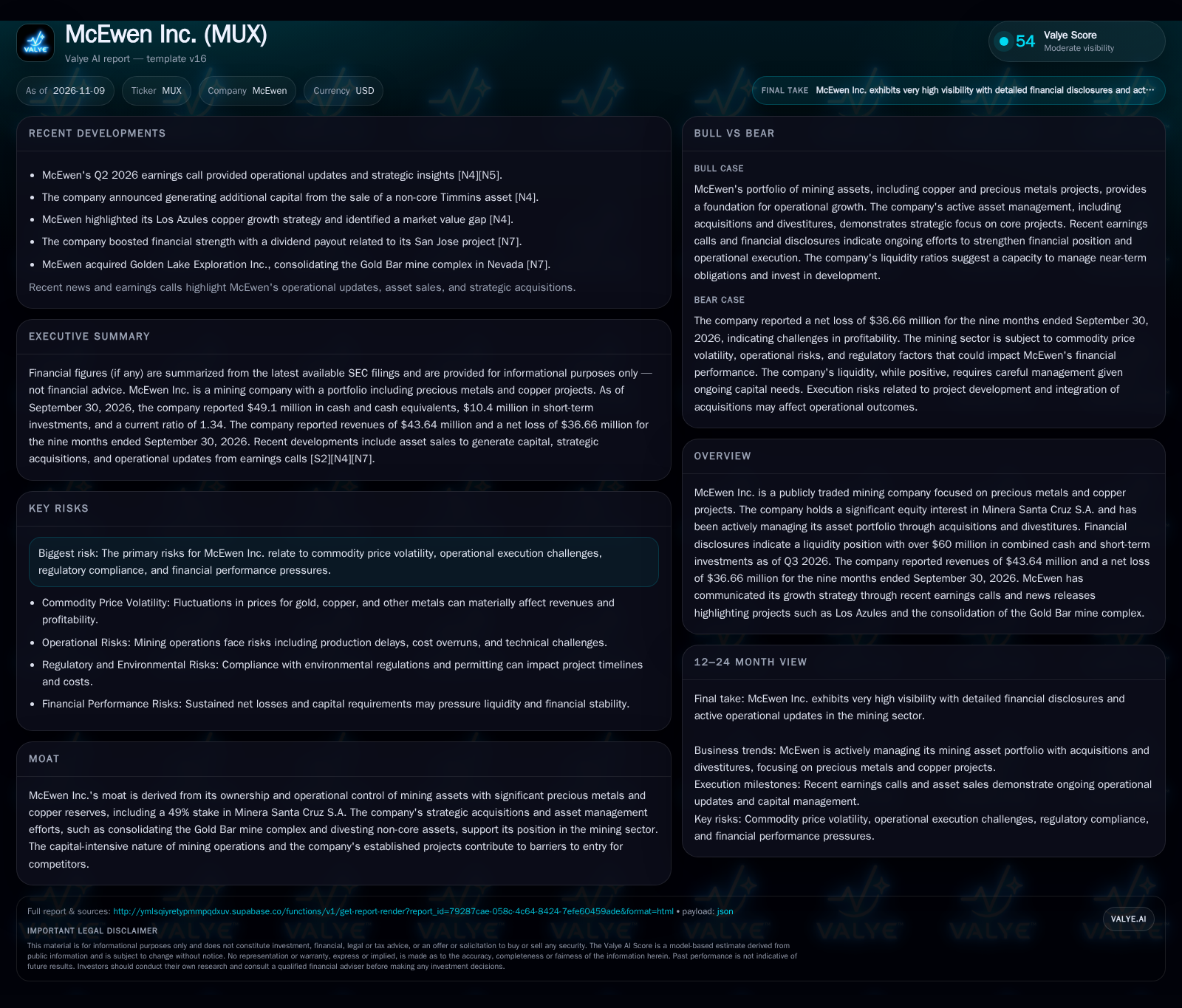
McEwen Inc. is leveraging asset sales and acquisitions to concentrate on high-potential copper and precious metals projects, notably Los Azules and the Gold Bar mine. The company’s strategic focus on project consolidation and capital recycling aims to position it for improved margins if execution risks are managed and commodity prices cooperate. Future performance will hinge on project milestones, capital allocation discipline, and resilience to sector volatility. [S2] [N4] [N7]
McEwen Inc. stands at a pivotal juncture, balancing the promise of its copper and precious metals portfolio against the realities of mining’s capital demands and operational risks. Recent moves—including the sale of non-core assets, consolidation of key projects like Gold Bar, and a renewed emphasis on Los Azules—reflect a company actively reshaping its asset base to unlock higher-margin growth. Yet, persistent net losses and the sector’s exposure to commodity cycles mean that strategic execution and disciplined capital management are critical. The company’s ability to convert resource potential into sustainable value creation will be tested by both internal milestones and external market forces over the coming quarters. [S2] [N4] [N7]
Recent Asset Moves, Copper Focus, and Financial Performance Set the Stage
The company reported cash and liquidity metrics for the period; these figures do not by themselves establish operating runway, investment capacity, financial flexibility, or financing capacity. The company executed the sale of a non-core Timmins asset to generate additional capital and spotlighted its Los Azules copper project as a primary growth focus, while a dividend payout from the San Jose project demonstrated efforts to unlock value from existing holdings. These developments collectively reflect a strategy of portfolio streamlining, capital recycling, and targeted project development, but also highlight the pressure to translate asset potential into sustainable financial performance. [S2] [N4] [N7]
Mining Portfolio Economics: Capital Intensity, Operating Leverage, and the Search for Margin
The core economics of McEwen’s business hinge on the extraction and sale of precious metals and copper, with project-level profitability driven by realized commodity prices, production costs, and the ability to scale output. Mining is inherently capital-intensive: bringing a resource like Los Azules into production requires significant upfront investment in exploration, permitting, infrastructure, and equipment, with returns typically realized only after multi-year development cycles. Variable costs—labor, energy, consumables—are sensitive to inflation and operational disruptions, while fixed costs related to mine development and maintenance can create substantial operating leverage once production ramps.
Revenue variability is largely a function of production volume and realized metal prices, both of which are subject to external market dynamics. Portfolio management—through acquisitions, divestitures, and project prioritization—can help rebalance risk and capital allocation, but also introduces integration and execution risks. The company’s recent asset sales and project consolidations suggest a deliberate attempt to concentrate capital on higher-potential, scalable assets, which, if successful, could improve margin structure and cash flow stability. However, persistent net losses indicate that current operations are not yet generating sufficient returns to cover total costs, underscoring the need for either higher realized prices, cost reductions, or a step-change in production scale.
Positioning in a Crowded Mining Landscape: Scale, Asset Quality, and Barriers to Entry
McEwen’s competitive position is shaped by the quality and scale of its mining assets, particularly its focus on copper (Los Azules) and precious metals. In mining, long-life, low-cost deposits—especially those with significant resource potential—can serve as a durable advantage, offering resilience to commodity price downturns and attracting potential partners or acquirers. The company’s 49% stake in Minera Santa Cruz S.A. and the consolidation of the Gold Bar mine complex provide a foundation, but also require ongoing capital and operational expertise to realize full value.
Barriers to entry in mining are considerable: permitting complexity, environmental regulation, and the sheer scale of required investment limit new competition. However, McEwen faces rivalry from established global mining firms with deeper balance sheets, as well as from junior miners targeting similar resource bases. Substitutes for precious metals are limited, but copper demand is increasingly tied to global electrification and green-energy trends, making project execution and cost control even more important as the sector attracts broader capital interest. The ability to advance projects through development bottlenecks, manage regulatory hurdles, and achieve commercial scale will determine whether McEwen’s current portfolio translates into a lasting competitive edge.
Unlocking Value Through Project Execution and Commodity Tailwinds
A favorable outcome for McEwen would see the company successfully advancing its flagship Los Azules copper project and consolidated Gold Bar mine to larger-scale, lower-cost production, capitalizing on robust copper and gold prices. If Los Azules progresses through permitting and funding milestones on schedule, and if operational improvements at existing sites boost output and reduce cash costs, McEwen could achieve a step-change in margins and cash flow. Further asset sales or joint ventures could unlock additional capital, allowing the company to accelerate development without excessive dilution or debt.
Confirmation of this upside scenario would include: steady progress on Los Azules development milestones (such as permitting approvals, technical studies, and funding agreements); sustained increases in production volumes; declining unit costs; and a return to operating profitability. Evidence would also include disciplined capital allocation—demonstrated by further asset optimization or successful project partnerships—and positive free cash flow generation. Persistent commodity price strength, especially in copper, would amplify the impact.
Disciplined Portfolio Management Amid Ongoing Profitability Pressures
The most plausible trajectory for McEwen is one of continued active portfolio management—recycling capital through selective asset sales and focusing development spending on high-potential projects like Los Azules and Gold Bar—while contending with the sector’s operational and financial headwinds. Production volumes may grow modestly as projects are advanced, but persistent cost pressures and the lag between investment and output could keep margins thin and net losses recurring over the near term.
If commodity prices remain supportive, losses may narrow, but a rapid return to sustained profitability would likely require either a material cost breakthrough or a major production ramp.
Execution Slippage and Commodity Volatility Exacerbate Financial Strains
In a less favorable scenario, McEwen could face project delays, cost overruns, or regulatory setbacks at Los Azules or other key assets, eroding investor confidence and straining liquidity. If copper or gold prices weaken materially, revenue could undershoot expectations, amplifying operating losses and forcing the company to seek dilutive financing or further asset sales at unfavorable terms. Integration missteps following recent acquisitions or the inability to monetize non-core holdings could further exacerbate the situation.
Confirmation would come from missed or revised project milestones, upward revisions to development budgets, or the need for urgent capital raises. External shocks—such as adverse regulatory rulings or environmental incidents—could accelerate downside risks.
Milestones That Will Shape McEwen’s Transition from Resource Holder to Value Creator
Progress on Los Azules project milestones, including permitting, technical studies, and funding agreements, would be a leading indicator of future growth potential.
Production volume and cash cost trends at the Gold Bar mine and other core assets, if disclosed, will clarify whether operational improvements are translating to margin expansion.
The pace and terms of additional asset sales, joint ventures, or project partnerships will reveal management’s ability to recycle capital and avoid excessive dilution.
Sustained positive or negative net cash flow from operating activities would provide a direct read on the company’s ability to fund development internally.
Commodity price movements—particularly copper and gold—remain external swing factors that could materially alter revenue and margin trajectories.
Any regulatory, environmental, or permitting developments affecting flagship projects would serve as early signals of potential delays or cost impacts.
Disclosure of cost overrun events or integration challenges following recent acquisitions would help test the robustness of McEwen’s capital allocation discipline.
Disclaimer: This is research-only, informational analysis and not investment advice. It may include AI-generated interpretation and general industry context. Always verify important details using primary sources.

Comments