
Archer Aviation’s Next Phase: Scaling eVTOL Ambitions from Prototype to Urban Air Mobility Networks
Archer Aviation stands at a pivotal juncture as it transitions from development to early commercial activity, with substantial liquidity and a headline $6 billion order book. The company's challenge now centers on certification, production ramp-up, and proving that urban air mobility can become a scalable, defensible business rather than a speculative technology bet.
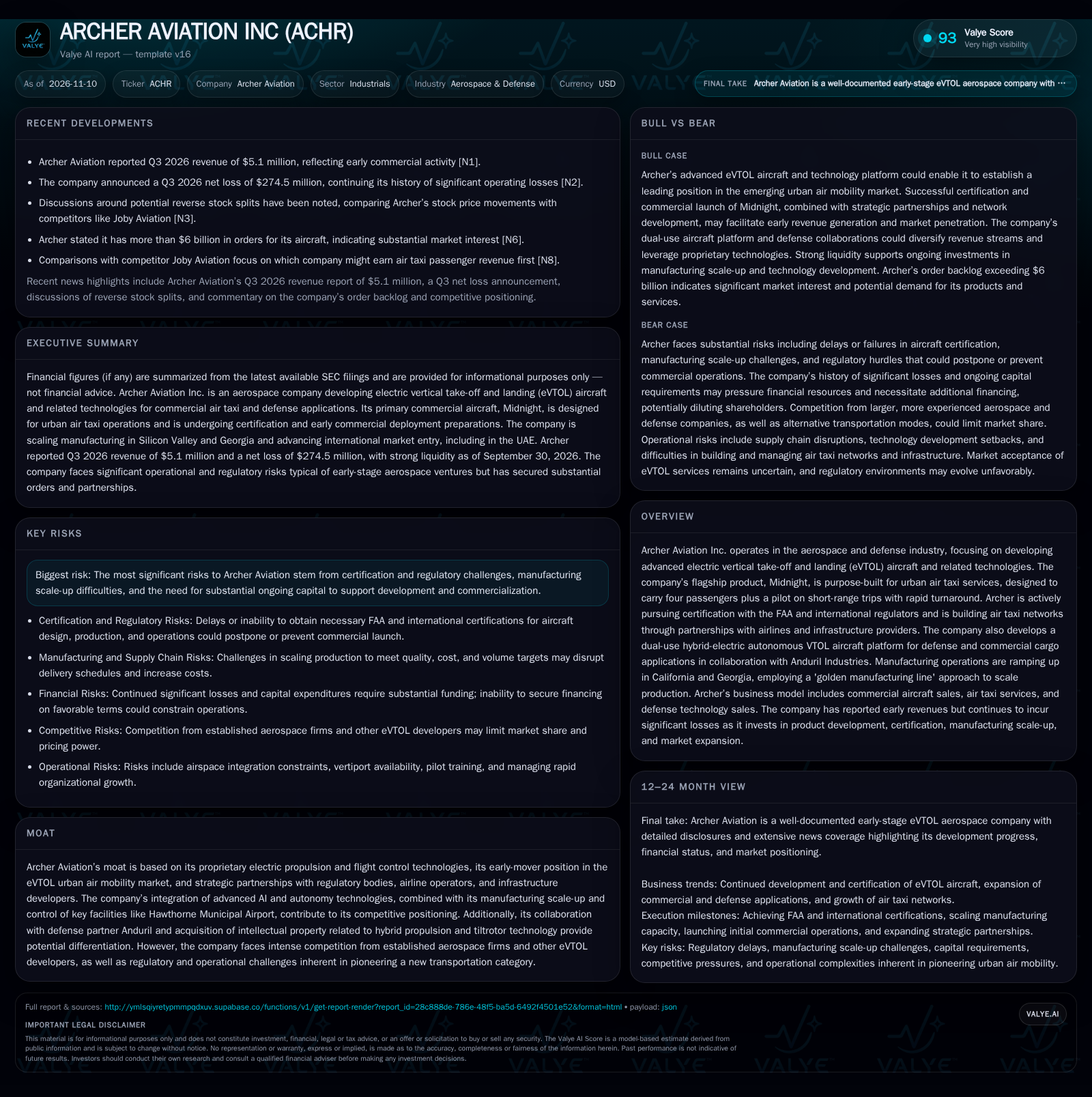
Archer Aviation reported $5.1 million in Q3 2026 revenue and a $274.5 million quarterly loss, while holding $785 million in cash and over $6 billion in stated aircraft orders. The company is pursuing FAA certification for its flagship eVTOL, Midnight, scaling manufacturing, and building partnerships for urban air taxi networks in the U.S. and internationally. The next phase depends on converting early orders into operating deployments, navigating regulatory and manufacturing hurdles, and demonstrating real-world demand and economics for electric air mobility. [S2] [N1] [N6]
Archer Aviation’s journey from prototype developer to potential urban air mobility operator is entering a critical phase. With a $6 billion headline order book, nearly $800 million in cash, and regulatory processes underway, Archer has positioned itself as a notable early-mover in the eVTOL space. Yet, the company’s ability to translate technical progress and market interest into sustainable business economics will be tested by certification timelines, manufacturing scale, infrastructure readiness, and the real-world willingness of cities, partners, and passengers to embrace electric air taxis. The next two years may determine whether Archer’s ambitions result in a durable business or remain an expensive experiment in aerospace innovation.
Early Revenues, Significant Losses, and a reported cash position Define Archer’s Current State
Archer Aviation reported $5.1 million in Q3 2026 revenue, which marks the beginning of its commercial activity but remains modest relative to its scale of investment. The company’s net loss for the quarter was $274.5 million, continuing a pattern of large operating losses that have accumulated to around $2.3 billion since inception. As of September 30, 2026, Archer held $785.1 million in cash and equivalents, with current assets of $1.456 billion and current liabilities of $181.6 million, yielding a current ratio of 8.02. The company also claims more than $6 billion in orders for its aircraft, highlighting market interest but not yet guaranteeing near-term revenue conversion. [S2] [N1] [N6]
From Prototype to Profit: The Economics of eVTOL and Air Taxi Operations
Archer’s business model is built around multiple revenue streams: initial aircraft sales, long-term air taxi operations, and dual-use platforms for defense and cargo applications. The flagship Midnight aircraft is designed for short-range, high-frequency urban routes, aiming to optimize utilization and minimize turnaround time. The commercial mechanics are likely to involve a mix of direct sales to operators (reflected in the current $6 billion order book), potential revenue-sharing agreements for air taxi services, and defense contracts for hybrid-electric autonomous platforms. However, the path to profitability hinges on several factors: achieving high production volumes to drive down unit costs, securing regulatory approval to operate at scale, and proving that urban air taxi demand is robust and price-elastic enough to cover capital and operating expenses.
Fixed costs are substantial—driven by R&D, certification, manufacturing infrastructure, and regulatory compliance—while variable costs will include battery replacements, maintenance, pilot/crew, and vertiport access fees. If utilization rates are high and aircraft reliability is proven, operating leverage could be significant as incremental passengers and flights drive higher margins. Conversely, low adoption, underutilization, or operational bottlenecks could leave the model structurally unprofitable.
Competitive Dynamics: Early Mover Status Amid Industry Giants and Alternative Modes
Archer’s competitive position is defined by its early-mover advantage in eVTOL design, proprietary electric propulsion and flight control technology, and a strategy of partnering with airlines and infrastructure providers to build air taxi networks. The acquisition of Hawthorne Municipal Airport as an operational hub and partnerships in the UAE demonstrate a commitment to both domestic and international market entry. However, the company faces formidable competition from established aerospace and defense firms—many of which have deeper resources, existing certification experience, and global supply chains—as well as from direct eVTOL peers.
Substitution risk is also high: ground-based alternatives such as ride-hailing, public transport, and even autonomous vehicles compete directly with the urban air taxi use case on both price and convenience. Archer’s ability to carve out defensible market share will depend on regulatory leadership, network effects from early city deployments, and the ability to achieve reliable, safe, and affordable operations before larger incumbents or fast followers catch up. Any delays in certification or manufacturing could erode its first-mover advantage.
What Success Looks Like: Certification, Rapid Scale, and Network Effects
In an upside scenario, Archer secures timely FAA and international certifications for Midnight, enabling the rapid commencement of commercial operations in major cities. Manufacturing ramps efficiently—leveraging the 'golden line' for early builds and transitioning smoothly to high-volume production in Georgia and California. The $6 billion in stated orders begin to convert into revenue at a meaningful pace, with anchor partners launching scheduled air taxi routes and urban commuters embracing the new modality for short-range travel.
Network effects could emerge if Archer’s aircraft become the potentially leading standard across multiple metropolitan areas, attracting additional operators and infrastructure investment. Defense and cargo variants, developed with Anduril, open new markets and provide revenue diversification. Evidence confirming this scenario would include sequential acceleration in recognized revenue, announcements of successful regulatory milestones, new city launches, and third-party validation of both aircraft safety and passenger experience.
Integration Challenges and Gradual Market Validation
The most plausible scenario is one of incremental progress: Archer continues to advance through certification processes while ramping production at a controlled pace. Initial deployments are limited in scale—perhaps a handful of routes in partnership with select airlines and infrastructure providers—serving as proof-of-concept rather than mass-market service. Revenue grows, but the majority of the $6 billion order book remains non-binding or contingent on regulatory milestones and operational validation.
Adoption is gradual as cities, regulators, and consumers adapt to the reality of urban air mobility, with demand constrained by price, vertiport availability, and public perceptions of safety. Manufacturing scale-up faces typical aerospace industry hiccups—supply chain issues, cost overruns, and yield challenges—but not existential setbacks. Cash burn remains high, necessitating eventual new capital, but the company demonstrates enough technical and commercial progress to justify continued investment. Confirmation would come from steady increases in recognized revenue and production, as well as regulatory progress and expanding city partnerships.
Regulatory Delays, Capital Strain, and Competitive Catch-up Could Derail Momentum
In a downside scenario, Archer encounters significant delays in FAA or international certification, stalling commercial deployments and eroding partner and customer confidence. Manufacturing ramp-up proves more difficult than expected, with cost overruns, supplier setbacks, or technology integration issues driving further losses. The $6 billion in orders prove less durable than hoped—comprised largely of non-binding agreements or subject to customer deferrals as regulatory and operational risks mount.
At the same time, competitors—whether incumbent aerospace majors or other eVTOL startups—secure earlier or more expansive certifications, win key city contracts, or offer more attractive economics to operators. Evidence confirming this scenario would include missed certification milestones, rising quarterly losses without revenue inflection, order cancellations or deferrals, and negative shifts in partner engagement.
Milestones That Will Determine Archer’s Trajectory in Urban Air Mobility
Sequential updates on FAA and international certification progress for Midnight and related platforms—regulatory approval is the gating factor for revenue scale.
Quarterly recognized revenue growth and the conversion rate of the $6 billion order book into binding contracts and deliveries, if disclosed.
Manufacturing throughput and yield metrics from California and Georgia facilities—a useful metric would be aircraft produced per quarter and cost per unit.
Announcements of new city launches, vertiport infrastructure partnerships, and expansion of operational urban air taxi networks.
Evidence of recurring revenue from air taxi operations (e.g., passenger flights, utilization rates, or service contracts), if disclosed.
Updates on the Anduril defense partnership, including progress in dual-use platform development and any awarded contracts.
Disclosures of additional capital raises, changes in cash burn rate, or new financing terms that impact financial runway.
Customer and public adoption metrics—such as pilot program ridership, retention rates, or NPS scores—would help test the thesis if disclosed.
Disclaimer: This is research-only, informational analysis and not investment advice. It may include AI-generated interpretation and general industry context. Always verify important details using primary sources.

Comments