
BitGo’s Institutional Crypto Platform: Regulatory Leverage, Treasury Exposure, and Executional Crossroads
BitGo’s transformation into a federally chartered trust bank and its expanding platform offerings have positioned it at the center of institutional digital asset infrastructure. However, leadership churn, tight liquidity ratios, and exposure to Bitcoin price swings introduce operational and financial complexity as the company seeks to deepen its moat and scale its network effects.
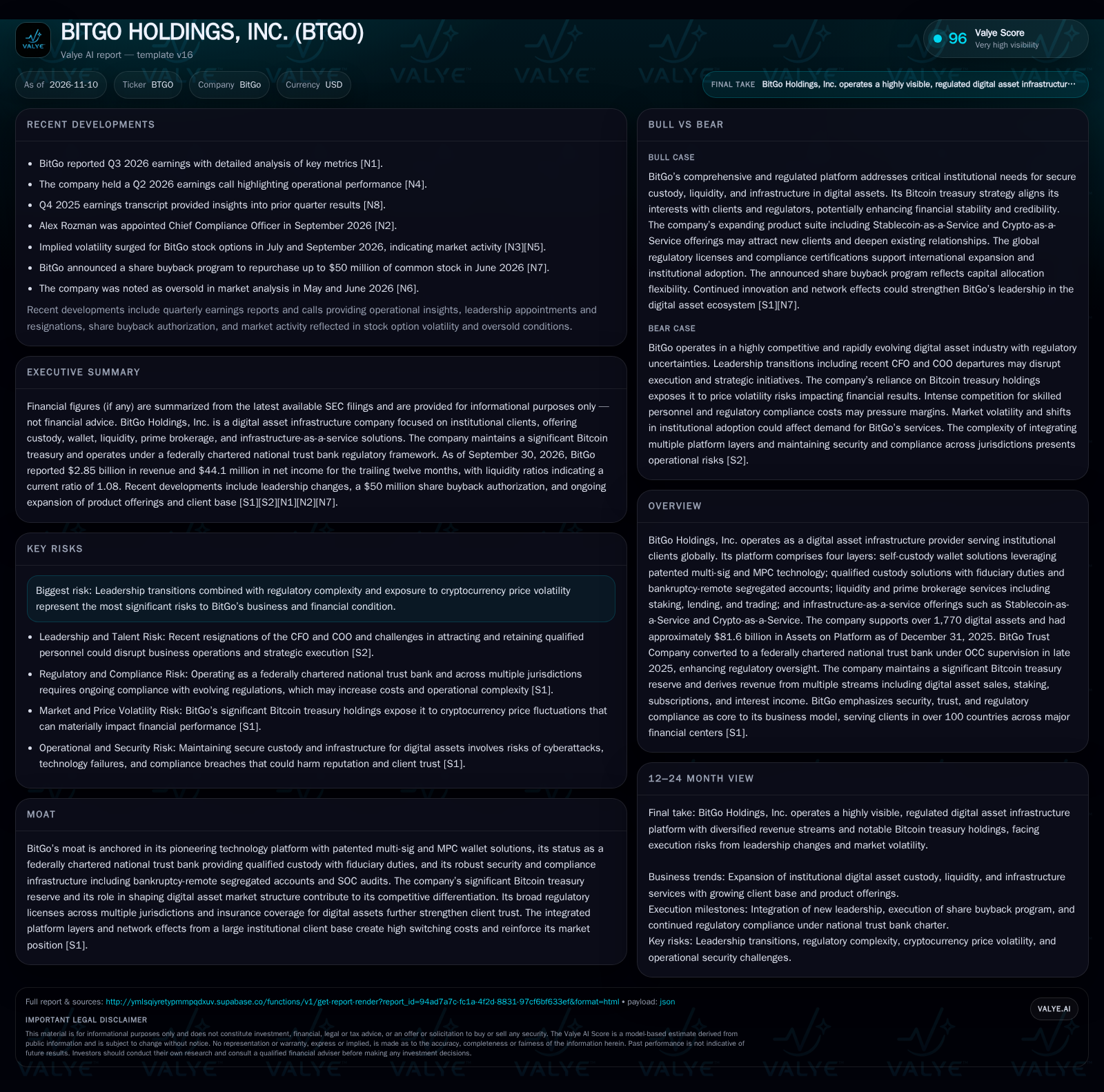
BitGo Holdings, Inc. operates a multi-layered digital asset platform for institutional clients, combining custody, prime brokerage, and infrastructure-as-a-service under a federally chartered trust bank structure. The company’s notable Bitcoin treasury, global regulatory reach, and diversified revenues underpin its ambitions but create new risks tied to crypto market volatility and leadership transitions. The next phase will test BitGo’s ability to translate platform breadth and regulatory credibility into durable profit growth while managing execution and market hazards. [S1] [S2]
BitGo Holdings, Inc. stands at a pivotal moment in the institutional digital asset infrastructure race. Its evolution into a federally chartered trust bank and the breadth of its custody, prime brokerage, and infrastructure-as-a-service platform have enabled rapid growth and a global client footprint. However, this scale-up brings new vulnerabilities: operational complexity from leadership turnover, exposure to the volatility of its sizable Bitcoin treasury, and liquidity ratios that leave little margin for error. As institutional adoption of digital assets remains volatile and regulatory regimes continue to evolve, BitGo’s ability to maintain trust, grow its network, and execute on its multi-pronged business model will be decisive for its next chapter.
Recent Milestones and Pressures: Regulation, Treasury, and Leadership Flux
BitGo’s conversion to a federally chartered national trust bank in December 2025 marked a material shift in its regulatory positioning, granting it a uniform U.S. compliance framework and federal oversight—key factors for servicing institutional clients with heightened risk and legal requirements [S1]. This move distinguishes BitGo from competitors operating under state licenses or less stringent regimes.
On the financial front, as of September 30, 2026, BitGo reported $2.85 billion in revenue and $44.1 million in net income for the trailing twelve months, with $81.6 billion in Assets on Platform and a Bitcoin treasury of 1,673 BTC ($146.4 million) [S1] [S2]. These figures evidence the company’s scale and embeddedness in the institutional crypto ecosystem.
Leadership volatility has emerged as a risk, with the appointment of Alex Rozman as Chief Compliance Officer in September 2026 and the resignation of both the CFO and COO during Q3 2026, leaving execution and continuity in flux [N2] [S2].
Revenue Streams, Cost Structures, and the Levers of Scale
BitGo’s business model is built on diversified revenue streams: digital asset sales from trading, staking services, subscription and service fees for wallet and lending products, Stablecoin-as-a-Service, and interest income from cash and equivalents [S1]. This multi-layered approach is designed to capture value across the institutional digital asset lifecycle and reduce dependence on any single activity.
The economics of digital asset infrastructure are characterized by a high proportion of technology-driven fixed costs (platform development, security/compliance, regulatory licensing), with variable costs tied to transaction volume, assets under custody, and servicing. If BitGo achieves further scale—by onboarding more institutions, assets, and transaction flow—operating leverage could improve as incremental revenue outpaces fixed overhead.
However, this model also introduces capital intensity for regulatory compliance and technology upgrades, as well as exposure to crypto market cycles that affect trading and staking volumes. The company’s significant Bitcoin treasury, while aligning interests with crypto-native clients and serving as regulatory reserve capital, creates direct P&L exposure to Bitcoin price swings, which can amplify earnings volatility.
BitGo’s ability to monetize infrastructure-as-a-service offerings (e.g., Stablecoin-as-a-Service, Crypto-as-a-Service) may hinge on the pace of institutional adoption and the company’s success in embedding these services into client workflows. Margins on these services could be higher than core custody or trading, but require upfront investment and ongoing integration with evolving blockchain protocols.
Defensible Moats and Evolving Threats in Institutional Crypto Infrastructure
BitGo’s competitive edge is rooted in several factors: a federally chartered trust bank license, patented multi-sig and MPC wallet technology, regulatory compliance (including SOC 1/2 audits and $250 million insurance coverage), and a broad platform supporting over 1,770 digital assets [S1]. This positions BitGo as a trusted partner for institutions demanding rigorous security, segregation of assets, and regulatory clarity.
Network effects are plausible: as the platform attracts more clients and assets, liquidity deepens and utility grows, reinforcing BitGo’s value proposition and increasing switching costs for clients embedded in its ecosystem. However, these network effects are not immune to disruption if competitors match regulatory status, technology, or service breadth.
The competitive landscape includes specialized crypto custodians, legacy financial institutions entering digital assets, and emerging fintechs offering custody, trading, or prime brokerage functions. Some may pursue regulatory parity or form partnerships to overcome BitGo’s current advantages. Moreover, open-source custody solutions and advances in decentralized finance (DeFi) could, over time, reduce the perceived need for centralized institutional intermediaries.
BitGo’s moat could be tested if regulatory requirements shift, if technology standards evolve beyond its patented approaches, or if client trust is undermined by operational missteps or security incidents.
Virtuous Cycle: Deeper Network Effects and Premium Monetization
An upside scenario involves BitGo successfully leveraging its regulatory status and technology stack to become the default infrastructure provider for a growing share of institutional digital asset flows. As more institutions onboard, network effects accelerate: asset volumes increase, liquidity improves, and the platform’s utility for trading, lending, and complex digital asset management deepens.
This could allow BitGo to command premium pricing for advanced infrastructure services (such as Stablecoin-as-a-Service), cross-sell to existing clients, and expand margins as fixed costs are spread over a larger base. Regulatory clarity could attract risk-averse capital allocators—such as pension funds and insurers—who have so far stayed on the digital asset sidelines.
Confirmation would come from sharply rising Assets on Platform, increasing client counts (especially among large traditional institutions), higher average revenue per user, and evidence of margin expansion driven by infrastructure and subscription fees rather than transactional volatility. Evidence of successful product launches, integration of new protocols, and stable or improving leadership would further support the bull case.
Platform Growth Amid Executional and Market Volatility
The most plausible scenario is one of continued, but uneven, growth. BitGo’s platform attracts additional institutional clients, supported by its regulatory credentials and platform breadth. Assets on Platform and revenue grow, but at a rate moderated by crypto market cycles and the pace of institutional adoption.
Leadership turnover introduces execution risk, potentially slowing product rollouts or strategic initiatives.
Market volatility—especially swings in Bitcoin and other major crypto prices—creates variability in trading and staking revenues, and periodically impacts the value of BitGo’s treasury. Regulatory complexity remains a constant operational burden, but BitGo’s established compliance framework provides some protection against sudden adverse changes.
This scenario would be confirmed by steady, if unspectacular, growth in Assets on Platform and client count, moderate but positive net income, and evidence that new product launches and regulatory milestones are achieved on schedule despite leadership transitions.
Adverse Spiral: Execution Slips, Treasury Volatility, and Eroded Trust
A downside scenario is triggered if leadership instability undermines operational execution—slowing product development, weakening compliance oversight, or damaging institutional relationships. If BitGo is unable to maintain or grow its client base, network effects begin to unravel, and competitors or new entrants capture share by matching regulatory status or undercutting on service.
Sharp declines in Bitcoin prices would directly erode the value of BitGo’s treasury, potentially pressuring capital ratios or regulatory reserve requirements. This could also dampen trading and staking volumes, compressing revenues while fixed costs remain high.
Loss of trust among key institutional clients—whether through a compliance breach, service outage, or market event—could significantly accelerate outflows and damage BitGo’s reputation.
Confirmation would include declining or stagnant Assets on Platform, shrinking client count, negative or highly volatile net income, and evidence of delayed or failed product launches. Deterioration in liquidity metrics or any regulatory sanction would further corroborate this scenario.
Milestones and Metrics That Will Shape BitGo’s Institutional Trajectory
The absolute and relative growth in Assets on Platform, especially in the top institutional client segment, would help confirm whether BitGo is capturing incremental market share or losing ground.
Net new client additions and churn rates—if disclosed—would indicate the strength of BitGo’s network effects and customer retention.
Revenue mix by segment (trading, staking, subscriptions, infrastructure-as-a-service) would clarify the sustainability and volatility of earnings streams.
Margin trends, both gross and operating, would test whether BitGo is achieving operating leverage as scale increases.
Updates on leadership stability, especially permanent appointments to the CFO and COO roles, would shed light on executional continuity.
Bitcoin price sensitivity analysis and treasury management disclosures would help gauge the impact of crypto market swings on financial health.
Regulatory developments—such as new federal guidance, international licensing wins, or compliance incidents—would materially affect BitGo’s risk profile and market access.
Evidence of successful product launches, new protocol integrations, or large client wins in Stablecoin-as-a-Service or Crypto-as-a-Service would support the thesis of platform breadth driving premium monetization.
Disclaimer: This is research-only, informational analysis and not investment advice. It may include AI-generated interpretation and general industry context. Always verify important details using primary sources.

Comments