
GMR Solutions Inc.: Scale, Reimbursement Leverage, and the Economics of National EMS Integration
GMR Solutions Inc. operates as the largest provider of emergency medical services in the U.S., combining a national footprint, diversified payor mix, and a massive clinical workforce. Its Q3 2026 results reflect ongoing revenue growth and margin management, but the company’s ultimate value hinges on its ability to optimize reimbursement rates, manage cost inflation, and maintain critical relationships across healthcare and government channels.
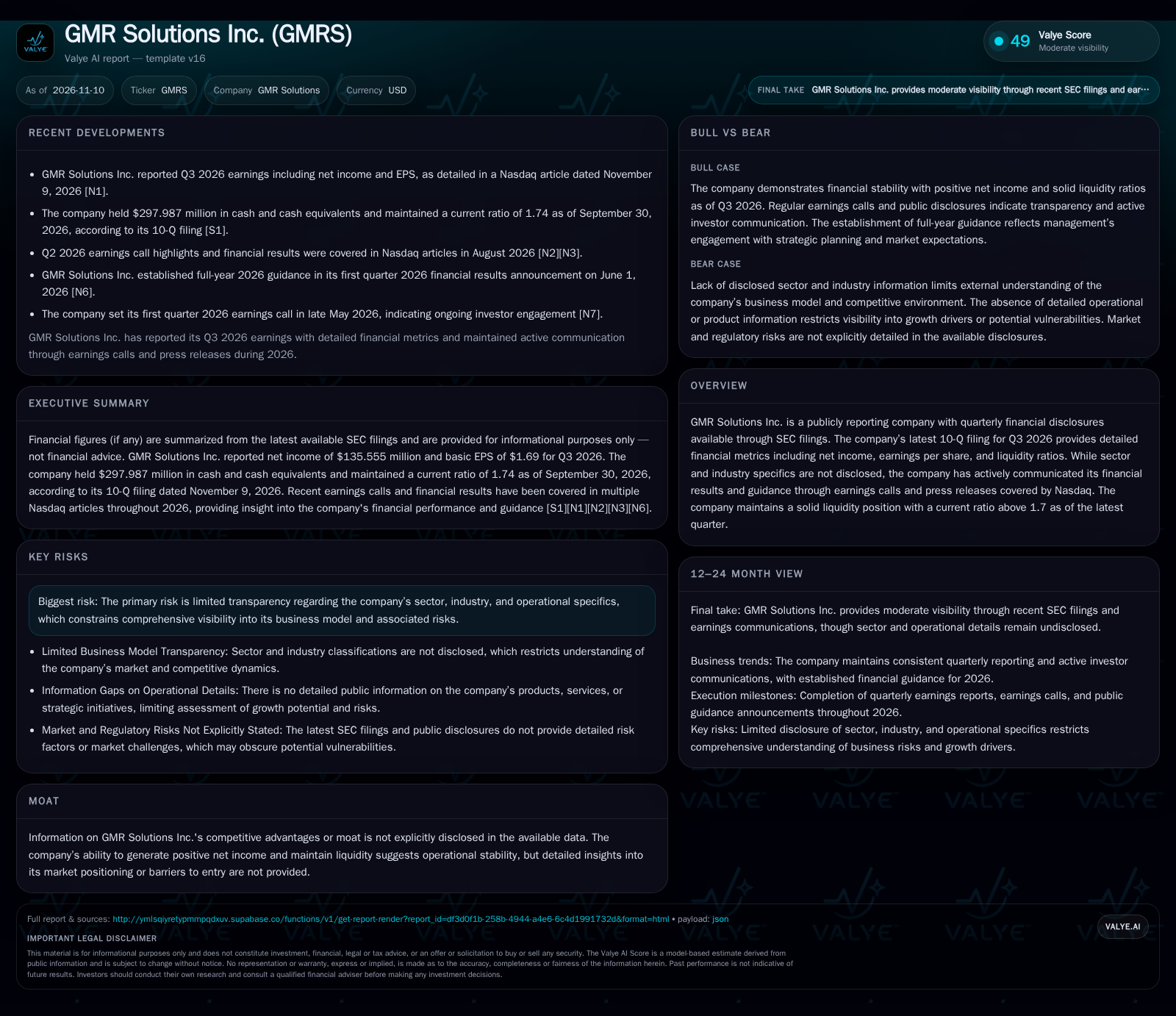
GMR Solutions Inc. reported Q3 2026 net income of $135.6 million on $1.6 billion in revenue, reflecting 5.9% year-over-year growth. As the largest U.S. EMS provider, GMR leverages scale and integrated air/ground operations, but faces ongoing pressure from reimbursement, payor mix, and labor costs. [S1]
GMR Solutions Inc. stands at the nexus of scale, operational complexity, and healthcare economics as the nation’s largest emergency medical services provider. In Q3 2026, the company delivered $1.6 billion in revenue and strong net income, reflecting not just volume but the intricate interplay of reimbursement mechanics, payor mix, and national reach. Yet, beneath these headline figures, GMR’s business model is deeply shaped by regulatory headwinds, cost inflation, and the challenge of integrating air and ground EMS across rural and urban landscapes. The company’s ability to sustain growth and profitability will hinge on its execution in optimizing reimbursements, controlling costs, and adapting to shifts in public health funding and policy. [S1]
Recent Financial Results Spotlight Growth and Scale
For the third quarter of 2026, GMR Solutions Inc. reported revenue of $1.6 billion, representing a 5.9% increase from the prior year period, and net income of $135.6 million. Basic earnings per share were $1.69, with diluted EPS at $0.56. The company reported cash and liquidity metrics for the period; these figures do not by themselves establish operating runway, investment capacity, financial flexibility, or financing capacity. These results underscore GMR’s continued ability to generate profit at scale, even as it operates in a sector marked by reimbursement complexity and labor intensity. [S1]
Operationally, GMR’s unique position as the largest U.S. EMS provider—serving over 5.5 million patients annually across 1,400 counties—highlights the breadth of its clinical footprint and the demands of integrating both air and ground response networks. This national reach not only drives volume but also exposes the company to a wide spectrum of payor and regulatory environments, amplifying both opportunity and risk. [S1]
How GMR’s Revenue Model Ties to Reimbursement, Volume, and Cost Discipline
GMR’s economics are fundamentally driven by patient transport volume and the net reimbursement per transport. The company recognizes revenue at the point of service, but ultimate collection depends on payor mix—private insurance, Medicare, Medicaid, and self-pay—each with distinct rates and collection risks. Fee-for-service revenue is subject to contractual adjustments, discounts for uninsured patients, and the realities of collection cycles. [S1]
Operating leverage is substantial: labor (notably its 24,000 clinicians and 34,000 total employees) is the largest cost, followed by fuel, maintenance, insurance, and administrative overhead. Fixed costs—such as fleet maintenance and technology infrastructure—are high, but scale enables some spreading of these costs across a large base. However, wage inflation, clinician shortages, and rising insurance premiums can compress margins rapidly if reimbursement does not keep pace.
GMR’s capital needs are ongoing, with requirements for fleet renewal, safety investments, and technology upgrades.
National Integration Creates Both Moat and Exposure
GMR’s fully integrated national model—encompassing both air and ground EMS across rural and urban markets—gives it a scale advantage that smaller regional players cannot easily replicate. This scale supports data aggregation (over 80 million patient records), negotiation leverage with payors, and the ability to serve large government and health system contracts. [S1]
Yet, barriers to entry are not absolute. Regional EMS providers, hospital-owned ambulance services, and non-emergency transport companies compete for local contracts and can sometimes operate with lower overhead. Technology-driven alternatives, such as telehealth triage or rideshare partnerships for non-emergent care, could erode some lower-acuity volume over time.
GMR’s moat is reinforced by its longstanding relationships with municipalities, health systems, and federal agencies, but these contracts are often subject to rebidding, regulatory scrutiny, and funding volatility. The company’s ability to maintain these relationships—while adapting to shifting payor and regulatory demands—will shape its long-term competitive position.
If Reimbursement Improves and Scale Drives Margin Expansion
The most favorable scenario for GMR involves a combination of rising reimbursement rates (especially from government payors), continued volume growth, and successful cost containment. If legislative changes or new contracts improve Medicare/Medicaid rates or introduce supplemental funding for EMS readiness, GMR’s scale would allow incremental revenue to translate efficiently into profit.
Further, if the company leverages its data assets to secure value-based care contracts—demonstrating reduced hospitalizations or improved outcomes—it could unlock new revenue streams beyond traditional transport. Confirmation of this scenario would come from rising net revenue per transport, margin expansion despite wage inflation, and new multi-year contracts with health systems or government entities.
A falsification would be stagnant or declining reimbursement rates, or evidence that incremental scale is offset by rising costs or regulatory headwinds.
Sustained Growth, Margin Management, and Navigating External Volatility
The most plausible path for GMR is continued moderate revenue growth driven by stable or gradually increasing patient volumes, offset by ongoing cost pressure from labor and insurance. Reimbursement rates are likely to remain mixed, with occasional gains from renegotiated contracts or supplemental government funding, but persistent headwinds from payor mix shifts and policy uncertainty.
This scenario would be confirmed by steady quarterly revenue and net income, stable or improving collection rates, and a lack of disruptive contract losses. It would be challenged by sharp increases in labor costs not matched by reimbursement, or by adverse regulatory changes to EMS funding.
When Cost Inflation and Payor Mix Shift Undermine Profitability
A more adverse outcome would result from a combination of rising labor and insurance costs, a shift toward lower-reimbursing payors (e.g., greater Medicaid/uninsured volume), and flat or declining patient volumes. In this scenario, GMR’s fixed cost base becomes a liability, as incremental revenue fails to cover rising expenses, leading to margin compression or even losses.
Additional risk comes from potential cuts to public health funding or adverse regulatory changes that reduce reimbursement for EMS services. Contract losses, particularly with large municipalities or health systems, would further exacerbate top-line pressure.
Evidence for this scenario would include declining net income despite stable or rising revenue, deteriorating cash flow, and announcements of major contract rebids or losses. Falsification would require clear demonstration of cost containment, reimbursement stability, or new high-margin service lines.
What Will Shape GMR’s Strategic Value Over the Next Cycle?
Net reimbursement per patient transport: A useful metric would be the trend in net collection per transport, which directly reflects pricing power, payor mix, and collection efficiency.
Patient transport volume growth or decline: If disclosed, quarterly changes in emergent and non-emergent transport volumes would indicate underlying demand and competitive positioning.
Labor cost inflation and clinician retention: Trends in average wage per clinician and workforce turnover would help test margin resilience.
Contract wins/renewals with major municipalities, health systems, or federal agencies: New or renewed multi-year agreements would signal competitive strength and revenue visibility.
Changes in payor mix: Shifts toward Medicaid, Medicare, or uninsured patients would affect collection risk and average reimbursement rates.
Supplemental government funding or regulatory changes: Announcements of new EMS funding streams or changes to reimbursement policy would materially impact the business.
Cash flow from operations and capital expenditure trends: If disclosed, these would clarify the sustainability of fleet investments and technology upgrades.
Evidence of new service lines or value-based care contracts: Announcements regarding partnerships, technology-enabled care navigation, or outcome-based reimbursement could change the revenue mix and margin profile.
Disclaimer: This is research-only, informational analysis and not investment advice. It may include AI-generated interpretation and general industry context. Always verify important details using primary sources.

Comments