
Trade Desk at a Crossroads: Margin Pressure, Platform Differentiation, and the Stakes of Competitive Scale
Trade Desk’s AI-driven platform, high client retention, and omnichannel innovation have secured its position in the programmatic advertising value chain, but recent margin compression and volatile results underscore the risks of client concentration and intensifying competition. The company’s ability to balance platform enhancement with profitability and defend its buy-side independence will define its next chapter.
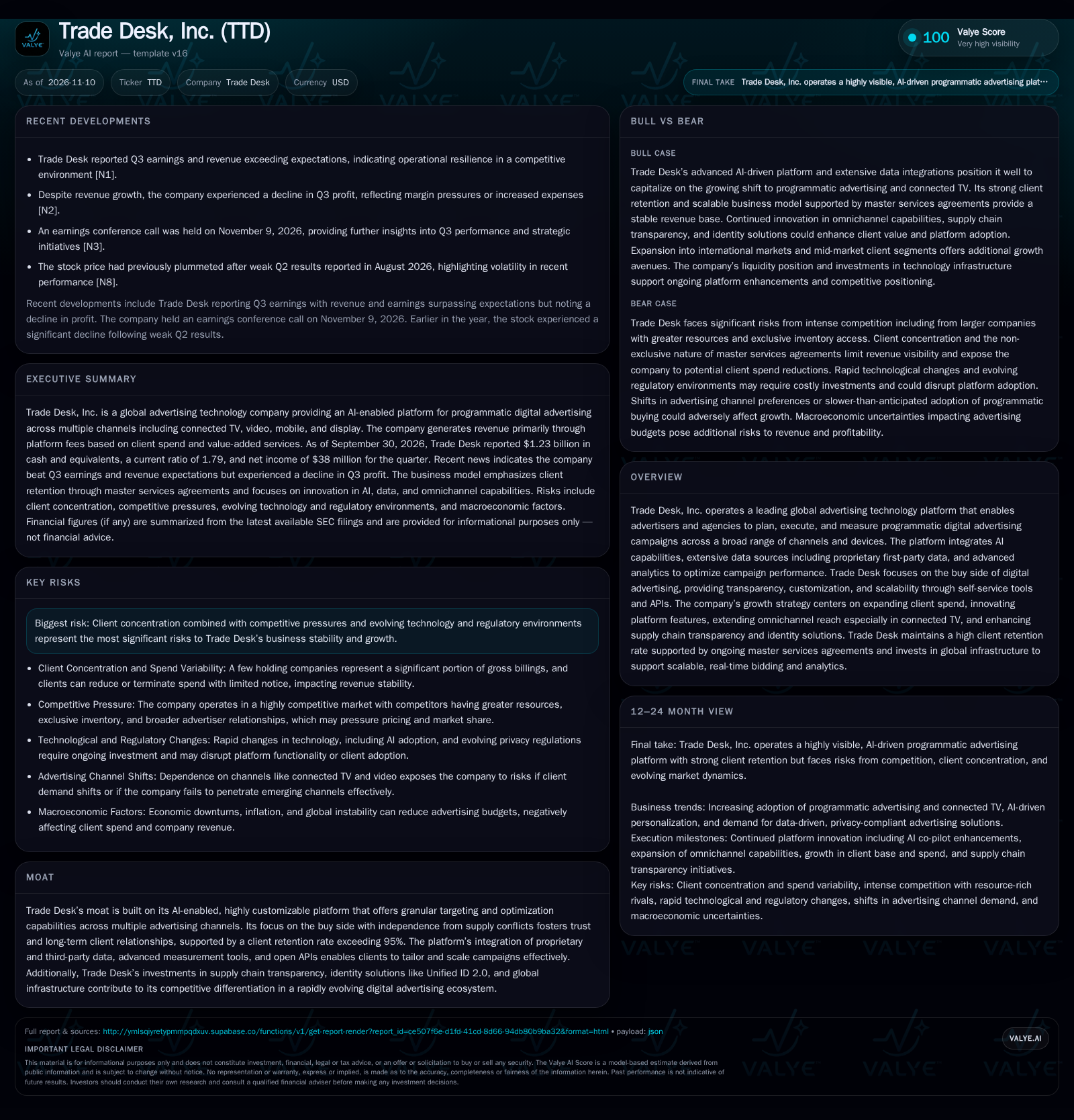
Trade Desk beat Q3 2026 revenue expectations and maintains a >95% client retention rate, but profit declined amid competitive and margin pressures. The company’s AI-enabled platform and focus on buy-side transparency remain key differentiators, yet its exposure to large clients and evolving regulatory and technology landscapes create ongoing risks. The next phase hinges on Trade Desk’s ability to drive deeper client spend and sustain innovation while navigating growing industry complexity. [S1] [S2] [N1] [N2]
Trade Desk stands at a pivotal moment in digital advertising: its AI-powered programmatic platform continues to attract and retain leading advertisers, achieving revenue outperformance in Q3 2026. Yet, a simultaneous decline in profit exposes the company’s vulnerability to margin compression, client concentration, and the intensifying battle for buy-side ad budgets. With a highly customizable, data-rich platform and a reputation for independence, Trade Desk’s strategic challenge is to convert these strengths into durable economic advantage amid mounting competitive, regulatory, and channel-shift pressures. The company’s next phase will likely be defined by its ability to deepen client engagement and maintain innovation velocity without sacrificing profitability. [S1] [S2] [N1] [N2]
Profitability Pressures Surface Despite Revenue Beat: Recent Results in Focus
Trade Desk reported Q3 2026 earnings and revenue that exceeded market expectations, demonstrating resilience in driving top-line performance even as broader digital ad spending faced macro headwinds. However, the company simultaneously posted a decline in net profit, with net income for the quarter at $38.05 million and EPS of $0.08, suggesting that increased expenses or margin pressures are offsetting revenue growth. [S2] [N1] [N2]
Client retention remains a core strength, with rates exceeding 95% for over a decade, underpinned by flexible master services agreements. Yet, this retention is not synonymous with contracted recurring revenue; clients retain discretion over their spend and can reduce or terminate activity with limited notice, exposing the company to spend volatility. [S1]
However, recent stock price swings following weak Q2 results highlight market sensitivity to execution risks and client spend dynamics. [S2] [N8]
How Trade Desk’s Platform Economics Scale—and Where Margin Compression Lurks
Trade Desk primarily generates revenue through platform fees tied to a percentage of client spend, complemented by value-added services such as data integrations and advanced analytics. The self-service, AI-enabled platform is designed for scalability: incremental spend can be processed with relatively modest increases in variable cost, suggesting inherent operating leverage as client budgets grow. However, the company’s cost structure includes ongoing investments in data infrastructure, AI development, and global hosting, as well as sales and support for expanding the client base and omnichannel reach. [S1]
Recent profit declines despite revenue growth suggest that additional operating costs—potentially from expanding into new channels, international markets, or enhancing supply chain transparency—are absorbing incremental gross profit. The risk is that as Trade Desk competes for larger, more sophisticated clients and differentiates on features, it may face higher client acquisition and retention costs or need to invest in exclusive data, inventory integrations, or compliance measures, compressing margins. If platform fees face downward pressure from competitive pricing or client bargaining power, the mix of revenue could shift toward lower-margin services, challenging the company’s ability to translate revenue growth into sustainable profit expansion.
Defending the Buy-Side: Trade Desk’s Differentiation and the Threat of Scale Rivals
Trade Desk’s core differentiation lies in its buy-side focus and independence, positioning itself as an objective partner for advertisers in contrast to vertically integrated platforms that also serve publishers. Its AI co-pilot, granular targeting, and open API architecture allow for deep customization, and the integration of both proprietary and third-party data enhances campaign precision. These features, along with support for connected TV (CTV) and omnichannel buying, have established Trade Desk as a preferred partner for agencies and brands seeking transparency and flexibility. [S1]
However, the competitive backdrop is intensifying. Large technology and platform companies—often with exclusive inventory access and greater resources—are expanding their programmatic offerings, potentially leveraging closed ecosystems and first-party data advantages. Trade Desk’s value proposition depends on maintaining open access to high-quality inventory and continuing to innovate on identity and measurement solutions as privacy regulations evolve. If competitors succeed in locking up key inventory or undercutting on fees, Trade Desk may face pressure on both client acquisition and retention.
What Could Unlock Accelerated Growth: Deeper Share of Wallet and Omnichannel Adoption
The most favorable scenario for Trade Desk is one in which programmatic and CTV adoption accelerates, and the company successfully captures a greater share of existing and new clients’ digital ad spend. Confirmation of this case would come from sustained double-digit revenue growth outpacing broader digital ad market trends, increased average client spend, and evidence of expanding mid-market and international adoption. Enhanced platform stickiness could be signaled by new feature launches—such as advanced AI optimization, proprietary data solutions, or identity frameworks—driving higher client engagement and deeper integration into advertiser workflows. [S1]
If Trade Desk achieves continued margin expansion alongside revenue growth—potentially by automating more campaign management or leveraging data partnerships to enhance pricing power—this would confirm that platform investments are yielding operating leverage rather than being absorbed by competitive cost escalation. Clear evidence would include improved gross and operating margins, steady or improved client retention rates, and a rising proportion of spend from emerging channels like CTV and retail media.
Sustaining Growth Amid Competition: The Most Likely Trajectory
The most plausible scenario is that Trade Desk continues to grow revenue at a rate modestly above the broader programmatic market, leveraging its AI-driven platform and buy-side independence to retain existing clients and gradually win new business, particularly in CTV and international markets. However, margin expansion is likely to be incremental at best, as competitive forces and ongoing investment requirements offset potential operating leverage gains.
Evidence supporting this trajectory would include continued high client retention (above 95%), stable or slightly improving operating margins, and revenue growth in-line with or moderately above industry averages. If disclosed, metrics such as average client spend, channel mix (especially CTV growth), and the proportion of revenue from value-added services would help corroborate this scenario. Signs of ongoing product innovation and successful adaptation to regulatory changes—without major disruption to client campaign performance—would further validate the base case.
Where the Model Could Break: Client Spend Volatility and Competitive Erosion
An adverse scenario would be triggered if one or more large clients significantly reduce or terminate spend, exposing Trade Desk’s revenue to abrupt declines due to client concentration and the non-exclusive, flexible nature of master services agreements. This risk is amplified if competitors secure exclusive inventory, offer materially lower fees, or bundle services in ways that erode Trade Desk’s value proposition.
Additional downside could come from regulatory changes—such as new privacy or data usage restrictions—that disrupt data access or targeting capabilities, requiring costly platform overhauls or resulting in client campaigns underperforming benchmarks. Macroeconomic shocks that prompt advertisers to cut budgets would further compound revenue and profit pressures. Evidence for this scenario would include sequential revenue declines, deteriorating client retention, margin contraction, and negative commentary on competitive losses or regulatory headwinds.
Milestones and Metrics That Will Clarify Trade Desk’s Strategic Posture
Client retention rate trends: Any sustained decline from the >95% historical rate, if disclosed, would signal erosion of platform stickiness or competitive displacement.
Average client spend and channel mix: Increases in average spend and higher share from CTV and retail media would validate deeper client integration and omnichannel success, if disclosed.
Gross and operating margin trajectory: Margin expansion would suggest that platform investments and scale are translating into improved profitability; margin compression would indicate competitive or cost pressure.
Revenue concentration metrics: Shifts in the proportion of revenue from top clients, if disclosed, would clarify the risk of client concentration and sudden spend variability.
Product innovation cadence: Announcements of new AI features, data partnerships, or identity solutions—along with adoption rates—would indicate ongoing differentiation.
Platform usage and engagement: Growth in active users, API calls, or volume of campaigns managed would signal platform health, if disclosed.
Regulatory adaptation: Updates on compliance with changing privacy and data regulations, and any associated impact on targeting or measurement capabilities, would help test resilience.
International and mid-market expansion: Revenue growth or client additions in these segments, if disclosed, would demonstrate success in diversifying the customer base.
Disclaimer: This is research-only, informational analysis and not investment advice. It may include AI-generated interpretation and general industry context. Always verify important details using primary sources.

Comments