
Microvast’s Battery Ambitions Collide with Liquidity Realities and Customer Concentration
Microvast’s vertically integrated battery platform offers advanced technology and a broad chemistry portfolio, but extreme liquidity pressure, high debt maturities, and uncertain customer demand now threaten its ability to execute. The company’s future depends on urgent financial restructuring and restoring commercial visibility.
Substantial debt maturities and customer concentration risk compound the challenge, with management actively pursuing cost reductions, asset sales, and debt restructuring. The coming quarters hinge on financial stabilization and the company’s ability to secure new orders against a backdrop of industry competition and evolving electrification demand. [S2]
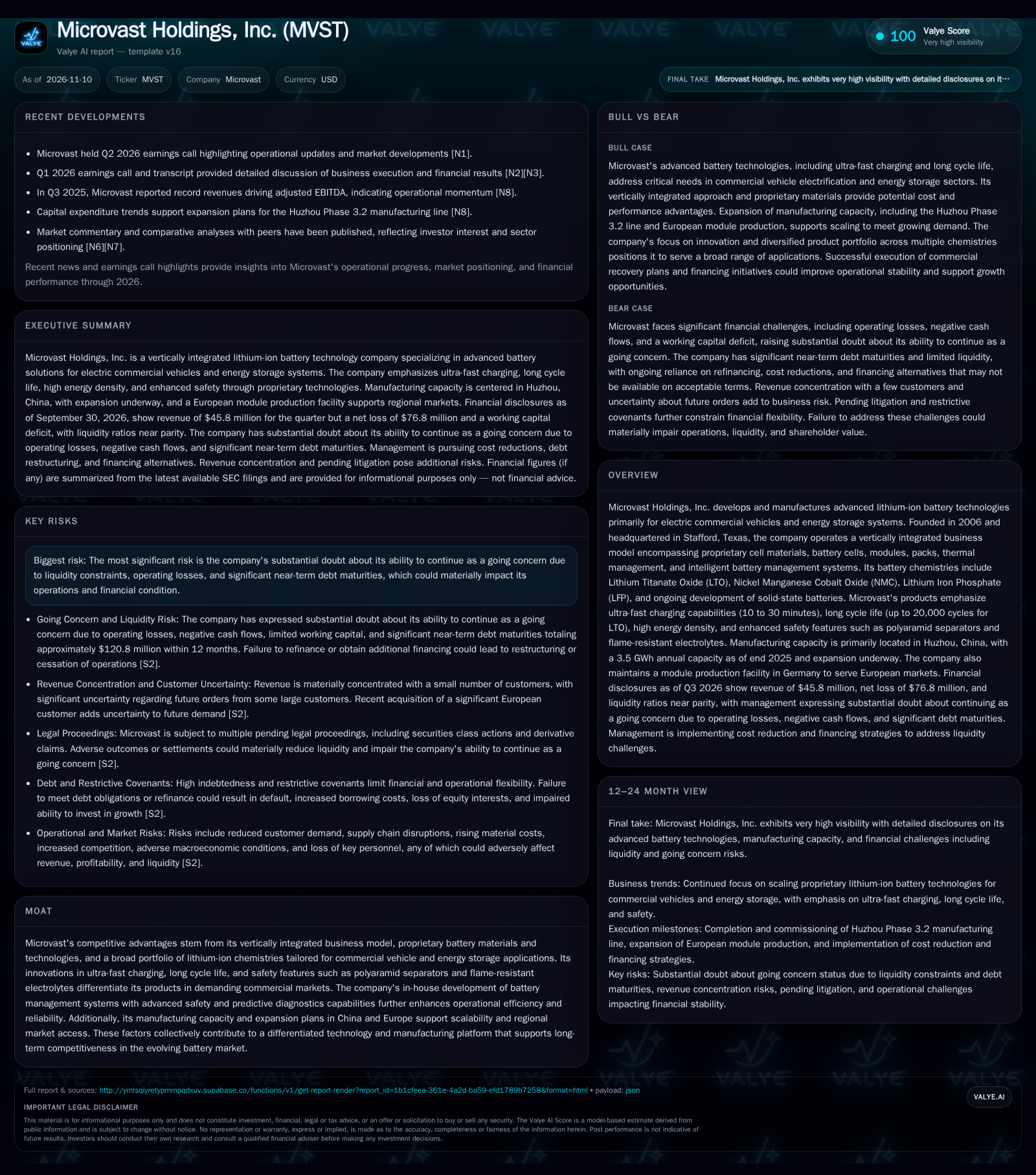
Microvast Holdings, Inc. sits at the intersection of advanced battery innovation and acute financial distress. Its vertically integrated platform, spanning proprietary materials to full battery systems, positions it to serve the electrification wave in commercial vehicles and energy storage. Yet as of Q3 2026, the company’s balance sheet is under severe strain: a working capital deficit, negative cash flows, and $120.8 million in near-term debt maturities raise urgent questions about survival. With revenue heavily reliant on a handful of customers and order visibility clouded by recent customer M&A, Microvast’s future now depends less on technology differentiation and more on resolving existential funding and commercial risks. [S2]
Liquidity Crisis and Customer Risk Drive Strategic Urgency
As of September 30, 2026, Microvast reported $45.8 million in quarterly revenue but a net loss of $76.8 million, with current assets ($352.7 million) barely covering current liabilities ($355.8 million) and a working capital deficit of $3.1 million. The company reported cash and liquidity metrics for the period; these figures do not by themselves establish operating runway, investment capacity, financial flexibility, or financing capacity. Critically, $120.8 million in debt matures within the next 12 months, prompting management to express substantial doubt about Microvast’s ability to continue as a going concern. [S2]
To address these risks, Microvast is pursuing cost reductions, debt restructuring, asset sales, and alternative financing. However, revenue is highly concentrated among a few customers, and order visibility is further clouded by the recent acquisition of a major European customer—raising the stakes for both financial and commercial recovery. [S2]
How Vertically Integrated Battery Manufacturing Shapes Profit Levers and Cash Needs
Microvast’s vertically integrated model—from cathode/anode materials to modules, packs, and battery management systems—offers the potential for cost control, quality assurance, and technology differentiation. In theory, this should allow for better margin capture compared to pure assemblers or chemistry licensees. However, vertical integration also drives up fixed costs and capital requirements, especially as the company scales manufacturing (3.5 GWh annual capacity as of end 2025, with further expansion underway in China and Europe). [S1]
The business is acutely sensitive to volume and mix: high utilization of capacity could drive operating leverage, but underutilization may exacerbate losses due to the fixed cost base. In commercial batteries, pricing power is generally limited by intense competition and customer bargaining power, especially with large fleet and OEM buyers. Product mix between cell chemistries (LTO, NMC, LFP) and end-markets (vehicles vs. ESS) could influence gross margins, but the current evidence does not specify relative profitability. R&D and manufacturing expansion are capital-intensive, and ongoing negative cash flows and debt service obligations further strain the ability to invest for growth or weather market shocks. [S1] [S2]
The capital intensity inherent in vertical integration also introduces a complex interplay between investment timing and market demand cycles. For Microvast, committing to manufacturing scale before securing stable, long-term contracts increases exposure to underutilization risks, which can erode margins and strain liquidity. Conversely, a more modular or outsourced approach could offer flexibility but might sacrifice some control over quality and innovation. Therefore, the company's strategic choice to vertically integrate amplifies the importance of accurate demand forecasting and flexible capacity management. Failure to align production scale with actual order flow could exacerbate financial distress, particularly under competitive pricing pressures.
Advanced Chemistries and Integration vs. Global Battery Giants and Local Entrants
Microvast’s technology platform emphasizes ultra-fast charging, long cycle life (up to 20,000 cycles for LTO), high energy density, and enhanced safety—critical attributes for commercial vehicles and demanding ESS applications. Proprietary innovations like polyaramid separators and flame-resistant electrolytes could offer some differentiation, and in-house BMS with digital twin diagnostics may support reliability and fleet management. [S1]
However, the company faces formidable competition across every segment. Global battery giants—especially those in China, South Korea, and Japan—enjoy massive scale, deep customer relationships, and integrated supply chains. Emerging regional players and new chemistries (including solid-state) add further substitution risk. As a smaller player, Microvast’s ability to win large, recurring contracts is challenged by both technology risk and customer preference for scale and financial stability. The company’s revenue concentration and uncertain order pipeline further weaken its negotiating position.
In addition to scale and technology, supply chain resilience is a critical competitive factor in battery manufacturing. Microvast’s vertical integration potentially offers greater control over raw material sourcing and component quality, which can mitigate risks from global supply disruptions or commodity price volatility. However, this advantage is conditional on efficient supply chain management and cost control. If Microvast cannot leverage its integration to reduce input costs or ensure timely delivery, it may face margin compression relative to competitors who benefit from larger purchasing power or more diversified supplier networks. Thus, the company's competitive positioning depends not only on technology but also on operational execution and supply chain agility.
Restructuring and New Orders Could Catalyze a Turnaround
The most favorable scenario for Microvast hinges on successful execution of cost reductions, debt restructuring, and new financing—stabilizing the balance sheet and extending runway. If management can secure additional non-dilutive funding or favorable refinancing, the company could avoid a liquidity-driven restructuring and preserve operational continuity. [S2]
Commercially, a rebound in orders from existing or new large customers—particularly in Europe or from new ESS deployments—could drive higher capacity utilization, improved gross margins, and positive operating leverage. Evidence for this scenario would include new customer wins, multi-year contract announcements, or a material uptick in order backlog (if disclosed), alongside resolution of near-term debt maturities and improved working capital. Conversely, failure to secure such wins or to restructure debt on acceptable terms would falsify the upside.
A successful turnaround would also require Microvast to demonstrate scalability in its technology and operational processes. Beyond securing new orders, the company must efficiently ramp production without compromising quality or incurring disproportionate incremental costs. This scalability is essential to achieving the operating leverage needed to improve profitability. Moreover, sustaining customer confidence through transparent communication and delivery reliability could help mitigate concentration risk by attracting a broader customer base. If Microvast can align its financial restructuring with operational improvements and customer diversification, it may transform its current vulnerabilities into a platform for sustainable growth.
Financial Restructuring and Commercial Uncertainty Define the Most Likely Path
Given the acute liquidity risk, the most plausible scenario is that Microvast enters some form of financial restructuring—whether via debt renegotiation, asset sales, or a dilutive equity raise. Operations may continue at a limited scale, but uncertainty around customer orders and revenue concentration will likely persist. [S2]
Management’s cost reduction and commercial recovery plans may slow cash burn, but without a step-change in order visibility or a major new financing, the company will remain in a precarious position. Confirmation of this scenario would involve ongoing negative cash flows, incremental but insufficient customer wins, and periodic updates on restructuring negotiations. Falsification would require either a rapid return to positive operating cash flow or a transformative order/contract pipeline.
Liquidity Exhaustion or Customer Attrition Could Trigger Distressed Outcomes
The adverse scenario involves Microvast exhausting its liquidity before successful restructuring or new financing can be secured. In this event, the company could be forced into a formal restructuring, asset liquidation, or even cessation of operations. [S2]
Additional downside risk comes from customer attrition: if uncertainty over Microvast’s financial stability prompts key customers to switch suppliers or delay orders, the revenue base could shrink further, accelerating the negative cash flow spiral. Confirmation would come from missed debt payments, abrupt plant shutdowns, or disclosures of lost customer relationships and order cancellations.
Milestones That Will Shape Microvast’s Survival and Strategic Direction
Resolution or extension of the $120.8 million in near-term debt maturities—watch for announcements on refinancing, restructuring, or covenant waivers. [S2]
Disclosure of new multi-year customer contracts or material order wins, especially with diversified customers or in new geographies, would help test commercial recovery.
Quarterly trends in order backlog, if disclosed, and any commentary on future order pipeline or customer concentration.
Updates on cost reduction progress and the impact on operating cash flow and gross margin trajectory.
Evidence of asset sales, joint ventures, or strategic partnerships that could provide non-dilutive financing or unlock new markets.
Resolution of pending legal proceedings and any material settlements or judgments that could further impair liquidity. [S2]
Progress on manufacturing expansion (commissioning of new capacity in China/Europe) and its impact on utilization rates and fixed cost absorption.
Disclaimer: This is research-only, informational analysis and not investment advice. It may include AI-generated interpretation and general industry context. Always verify important details using primary sources.

Comments