
Helix Energy Solutions: Navigating Cyclical Headwinds and Integration After Hornbeck Merger
Helix Energy Solutions is at a strategic crossroads: integrating a major acquisition, expanding into renewables, and contending with persistent losses in a volatile offshore services market. With a specialized asset base and a reported liquidity position, the company’s path forward hinges on operational leverage, customer capital cycles, and execution on both oil & gas and renewables fronts.
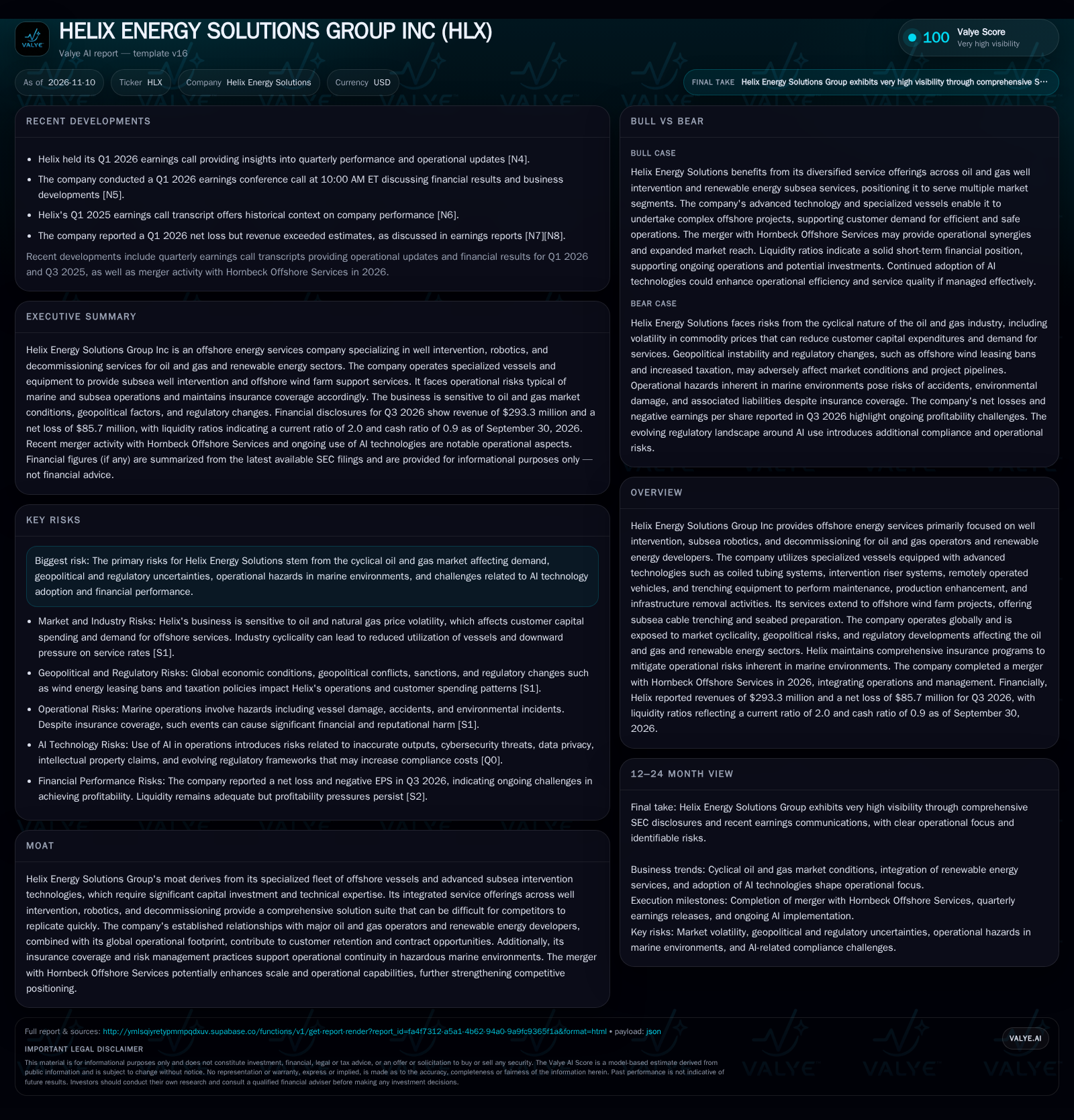
Helix Energy Solutions reported a net loss of $85.7 million on revenue of $293.3 million for Q3 2026, despite maintaining a current ratio of 2.0 and cash of $471.6 million. The recent merger with Hornbeck Offshore aims to broaden scale and service reach, but profitability remains elusive amid cyclical energy markets and regulatory uncertainties. Integration success, project mix, and customer capital spending are likely to determine whether Helix can capture margin expansion or faces continued pressure.
Helix Energy Solutions Group stands at a pivotal moment, attempting to integrate its transformative Hornbeck Offshore Services merger while facing sustained net losses and industry cyclicality. The company’s unique position—straddling both oil & gas and renewable offshore services—offers potential diversification, but also exposes Helix to the dual uncertainties of commodity price swings and evolving regulatory regimes.
Recent Performance and Strategic Moves Define Helix’s Starting Point
Helix Energy Solutions reported $293.3 million in revenue and a net loss of $85.7 million for the quarter ended September 30, 2026 [S2]. The company reported a current ratio of 2.0 for the period. [S2] The 2026 merger with Hornbeck Offshore Services marked a significant expansion in fleet scale and operational scope, with integration and associated management incentives underway [S2]. These factors collectively set the stage for Helix’s near-term trajectory: the company must extract value from an expanded asset base, address persistent losses, and position itself in a market sensitive to both oil & gas and renewable energy cycles.
How Helix’s Capital-Intensive Model Amplifies Cyclical Risks and Rewards
Helix’s economics are driven by high fixed costs—primarily capital tied up in specialized vessels, subsea robotics, and intervention equipment. Revenue depends on vessel utilization rates, project complexity, and the mix of well intervention, decommissioning, and renewables-related work. Pricing power is often limited by competition and customer capital discipline, especially when oil and gas prices are volatile. Variable costs, such as crew, fuel, and maintenance, are meaningful but do not scale down as quickly as revenue in downturns, creating significant operating leverage.
The merger with Hornbeck potentially brings cost synergies through fleet rationalization and improved vessel deployment, but also adds integration expenses and complexity. Recertification and major maintenance are recurring capital outlays, with regulatory requirements dictating periodic drydockings and upgrades. The company reported cash and liquidity metrics for the period; these figures do not by themselves establish operating runway, investment capacity, financial flexibility, or financing capacity. [S2]
The capital-intensive nature of Helix's business model means that breakeven points are highly sensitive to utilization rates. Even small fluctuations in demand can disproportionately impact profitability due to the high fixed cost base. This dynamic incentivizes the company to pursue long-term contracts and multi-year agreements that can stabilize revenue streams and mitigate the volatility inherent in spot market pricing. Additionally, the interplay between maintenance cycles and operational scheduling can create periods of underutilization that compress margins, underscoring the importance of efficient fleet management and proactive asset deployment strategies.
Furthermore, Helix's exposure to both traditional oil and gas and the emerging renewables sector introduces complexity in capital allocation decisions. Investments in vessels or technology optimized for offshore wind may have different utilization profiles and risk characteristics compared to those serving fossil fuel projects. The company must therefore balance the timing and scale of capital expenditures against uncertain demand trajectories in each segment, with an eye toward maximizing return on invested capital. This balancing act is complicated by potential regulatory shifts that could accelerate or delay project pipelines, affecting the payback period and overall project economics.
Specialization, Scale, and Technology: Sources and Limits of Differentiation
Helix’s moat rests on its fleet of specialized intervention vessels, advanced subsea robotics, and the technical expertise required to deliver complex offshore projects. These capabilities are not easily replicated, creating barriers to entry for smaller or less specialized competitors. The company’s ability to serve both oil & gas and offshore wind projects broadens its addressable market and could support customer diversification.
However, the competitive landscape includes large diversified oilfield service companies, regional marine contractors, and emerging players focused on renewables. Pricing remains competitive, especially in commoditized decommissioning and lower-complexity well intervention. The extent to which Helix can leverage its asset base across both fossil and renewable segments—and extract premium pricing for complex projects—will determine whether its differentiation translates to superior returns.
Switching costs for customers are moderate: while technical complexity and safety records matter, contract terms, day rates, and vessel availability still drive procurement decisions. The risk of substitution rises if energy transition accelerates or if modular, lower-cost alternatives emerge in subsea robotics or wind farm support.
Synergy Realization and Market Recovery Could Unlock Margin Upside
If Helix achieves meaningful operational synergies from the Hornbeck merger—such as higher fleet utilization, reduced overhead, and improved bargaining power with suppliers—fixed costs could be spread over a larger revenue base, driving operating leverage and potential margin expansion. A rebound in oil and gas capital spending, combined with secular growth in offshore wind installation and decommissioning, could further boost vessel utilization and pricing.
Early signs of this scenario would include sustained increases in utilization rates, positive EBITDA and net income trends, and evidence of cross-selling or new contract wins that leverage the combined entity’s scale. Additional confirmation would come from management commentary on realized cost savings and improved project economics. This pathway would be challenged or falsified if integration costs remain high, utilization fails to improve, or customer spending remains subdued despite a broader market recovery.
Mixed Project Mix, Cyclical Demand, and Integration Friction: The Most Likely Outcome
The most plausible near-term scenario is one of gradual improvement offset by persistent headwinds. Helix could see modest gains in vessel utilization and project backlog as oil and gas customers cautiously increase spending, while offshore wind and decommissioning projects provide a partial offset to fossil market volatility. Integration with Hornbeck may yield some cost efficiencies, but realization could be slower and less substantial than hoped, with one-time integration costs and organizational friction weighing on margins.
This scenario would be confirmed by flat-to-mid-single-digit revenue growth, continued but narrowing net losses, and management guidance that emphasizes incremental progress rather than transformational change. If disclosed, metrics such as contract backlog, utilization rates by segment, and realized synergy run-rate would help test this baseline thesis.
Persistent Losses and Market Weakness Could Force Strategic Retrenchment
In an adverse scenario, oil and gas capital spending could stagnate or decline further, while regulatory delays or opposition slow offshore wind project pipelines. Vessel utilization would remain depressed, fixed costs would continue to weigh heavily, and integration with Hornbeck could prove more expensive or disruptive than anticipated. In this outcome, Helix could face ongoing net losses, potential asset impairments, and pressure to divest non-core assets or further restructure operations.
Evidence for this scenario would include a sustained decline in revenue, widening net losses, negative operating cash flow, and management actions such as fleet downsizing, asset write-downs, or changes in executive leadership. External signals such as customer project cancellations or adverse regulatory decisions would further support this downside case.
Milestones and Metrics That Will Shape Helix’s Post-Merger Trajectory
Quarterly vessel utilization rates by segment: If disclosed, rising utilization—especially in high-margin well intervention and renewables—would signal operational leverage and market demand.
Realized cost synergies from Hornbeck integration: Management updates on synergy capture, integration costs, and organizational streamlining would clarify merger value.
Contract backlog and new award announcements: Growth in backlog, particularly for multi-year or renewables-related contracts, would indicate demand visibility and competitive wins.
Revenue and margin trends by business line: Disaggregated financials would help assess mix shifts, pricing power, and the impact of project complexity on profitability.
Operating cash flow and capex discipline: Sustained positive operating cash flow and prudent capital expenditure would support financial resilience and investment capacity.
Regulatory developments in offshore wind and oil & gas: Changes in leasing, permitting, or taxation policies could materially affect project pipelines and customer spending.
Customer capital spending outlooks and project delays: Industry reports or disclosed customer guidance would help track the health of Helix’s end markets.
AI technology adoption outcomes: If disclosed, operational efficiency gains or compliance issues related to AI deployment could impact future cost structure and risk profile.
Disclaimer: This is research-only, informational analysis and not investment advice. It may include AI-generated interpretation and general industry context. Always verify important details using primary sources.

Comments