
Array Technologies at a Crossroads: Technology Moat, Merger Disruption, and the Stakes of Patent Expiry
Array Technologies’ patented tracker designs, recent portfolio expansion, and pending Shoals merger place it at the center of utility-scale solar’s next phase. The company’s ability to sustain differentiation as patent protections expire, integrate acquisitions, and navigate regulatory and market headwinds will shape its future economics and competitive standing.
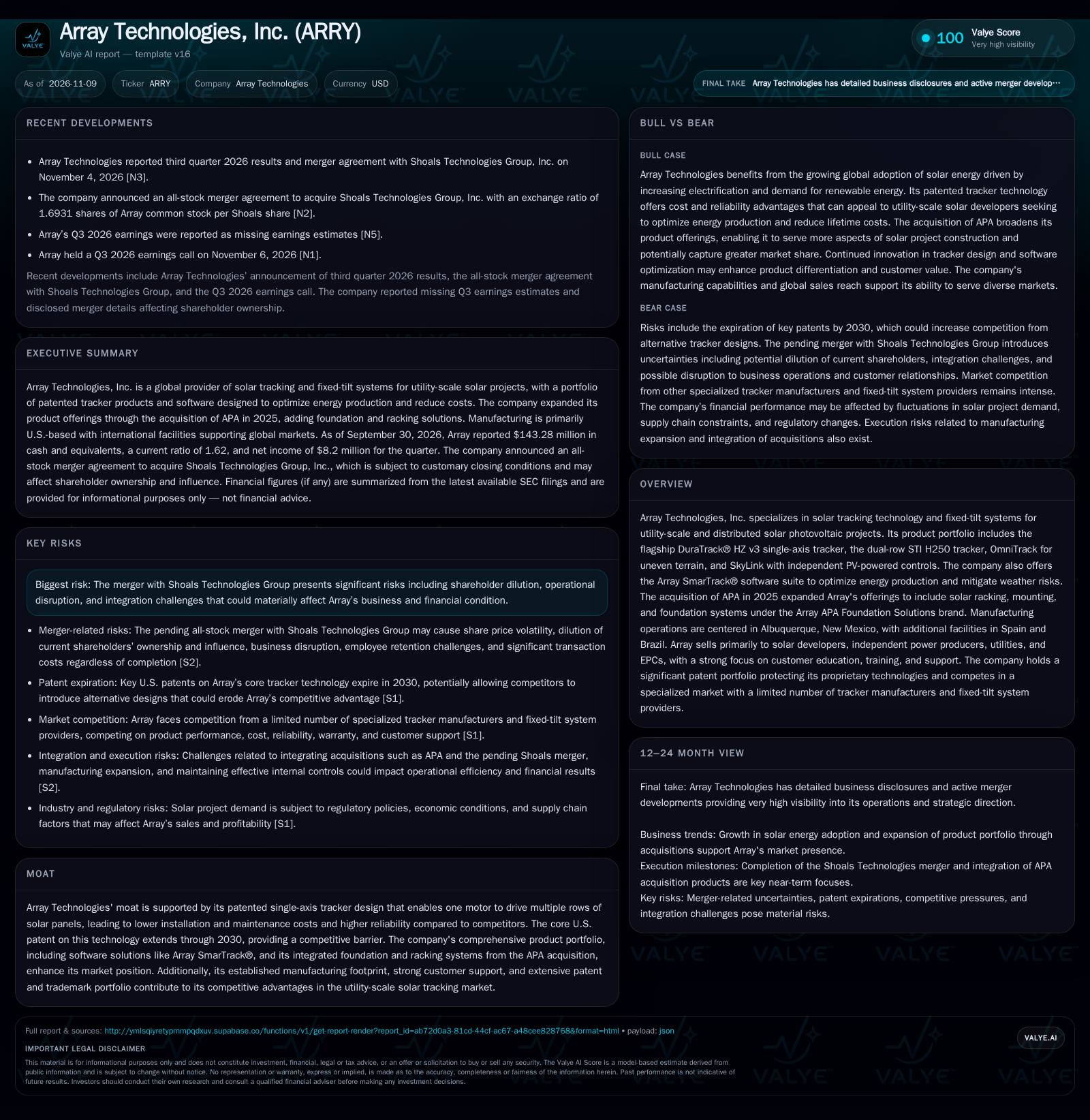
Array Technologies sits at a pivotal juncture, combining a robust patent-protected product portfolio with significant merger and patent-expiry risks. While its single-motor tracker design and software suite have underpinned its competitive edge, the upcoming expiration of core patents and the disruptive Shoals merger could reshape its market position. Integration execution, regulatory changes, and the pace of global solar deployments will be critical levers for future value creation or erosion. [S1] [S2] [N3]
Array Technologies, Inc. has long been recognized for its patented single-axis solar tracker systems, which enable cost-effective and reliable energy capture for utility-scale solar developers. Now, with a recently announced all-stock merger with Shoals Technologies, a broadened product portfolio following the APA acquisition, and the looming expiration of core patents by 2030, Array faces a complex mix of opportunity and risk. The company’s ability to leverage its engineering strengths, manage integration, and adapt to shifting regulatory and competitive environments will define its future economics as the solar industry itself transitions toward greater scale and maturity.
Merger, Missed Estimates, and Patent Timelines: The Most Material Developments
Array Technologies’ most significant current development is its pending all-stock merger with Shoals Technologies Group, announced in November 2026. This transaction will see Shoals stockholders own a majority of the combined entity, reducing current Array shareholders’ influence and introducing both integration complexity and dilution risk. The merger is subject to customary closing conditions, including regulatory and stockholder approvals. [S2] [N3]
Operationally, Array reported Q3 2026 net income of $8.2 million, with a cash position of $143.28 million and a current ratio of 1.62. Despite these positive balance-sheet metrics, the company missed earnings estimates in Q3, highlighting ongoing margin and demand pressures. [S2] [N5]
Strategically, the company’s core U.S. patent on its single-motor, multi-row tracker design—the foundation of its product differentiation—expires in 2030. This sunset could alter the competitive landscape and compress Array’s economic moat. [S1]
How Array Makes Money: Tracker Economics, Software, and the Role of Integration
Array’s primary revenue is generated from the sale of solar tracking systems and fixed-tilt mounting solutions to developers, utilities, and EPCs. The company’s patented DuraTrack® HZ v3 system uses a unique mechanical design—one motor driving multiple rows—which reduces installation and maintenance costs relative to designs requiring a motor per row. This structure historically allowed Array to capture premium pricing or defend margins through lower lifecycle costs for customers. [S1]
With the APA acquisition, Array now offers foundation, racking, and mounting products, extending its addressable market and creating cross-selling opportunities. The integration of hardware with the SmarTrack® software suite enables optimization of energy production, potentially supporting service and software revenue streams, though the exact commercial mechanics (e.g., subscription, one-time, or bundled pricing) are not specified in the report.
Array’s manufacturing model combines in-house production (primarily in Albuquerque, NM) with outsourced component supply, using drop-shipping to sites for working capital efficiency. This hybrid approach helps manage fixed cost leverage while mitigating some inventory risks.
Capital needs are moderate for manufacturing expansion and R&D, but the company’s future funding requirements could increase if integration costs from the Shoals merger or post-patent-competition compress margins. Operating leverage exists given the fixed cost base in manufacturing, but is sensitive to project volume and supply chain stability.
Defending the Moat: Patent Barriers, Product Breadth, and the Onset of Substitution
Array’s competitive position has been anchored by its patented tracker design, which delivers cost and reliability advantages. The patent, preventing competitors from using a single-motor, multi-row approach, is effective through 2030, after which rivals may introduce similar architectures. The company also differentiates through its broader product portfolio (trackers, racking, software, foundation systems) and strong customer support, but faces direct competition from a small group of specialized tracker and fixed-tilt providers. [S1]
The APA acquisition and expanded field services add switching frictions, as customers may benefit from integrated procurement and support. However, as patent protection lapses, switching costs could decline if competitors successfully mimic Array’s core design.
Technological substitution risk is moderate: while fixed-tilt systems are still used in certain geographies or site conditions, the majority of U.S. utility-scale solar now deploys trackers. New tracker designs or software-driven optimization from competitors could erode Array’s differentiation, particularly if software alone becomes the primary source of incremental yield.
Leveraging Integration and Innovation to Sustain Premium Economics
A favorable scenario for Array sees successful integration of Shoals and APA, creating a vertically integrated supplier for utility-scale solar BOS (balance-of-system) solutions. If Array can cross-sell trackers, mounting, wiring, and software as a bundled solution, it may create sticky customer relationships and defend pricing power—even as its core patent expires.
Further, if the company’s R&D pipeline produces new patented designs or software features that remain ahead of rivals, Array could extend its innovation cycle and maintain a performance or reliability edge. Favorable regulatory environments (e.g., extensions of solar tax credits or supportive trade policy) could also boost project volumes and offset competitive pressures.
Evidence for this scenario would include: margin stabilization or expansion post-merger, rising attach rates for software or integrated solutions, new patent filings or product launches, and customer wins tied to the expanded offering.
Patent Expiry and Integration Challenges Reshape Economics, but Core Demand Persists
The most plausible medium-term outcome is that Array retains a meaningful share of utility-scale tracker projects, but faces margin compression as patent expiry enables competitors to match its core design. The Shoals merger, while expanding product breadth, introduces integration risk and could dilute focus or distract management, at least in the near term.
Array’s ability to cross-sell its full suite and maintain customer relationships will be tested as rivals enter with similar mechanical solutions. The company may offset some price pressure with cost reductions, supply chain optimizations, or incremental software/service revenue, but overall profitability could trend lower.
Confirmation of this scenario would be persistent market share but declining gross margins, integration-related one-time costs, and steady—if less differentiated—project wins. Falsification would be either a rapid loss of major customers or sustained margin expansion despite patent expiry.
Margin Erosion and Disruption: When Patent Expiry and Merger Execution Collide
A negative scenario emerges if patent expiry in 2030 triggers an aggressive influx of competitors with similar tracker designs, leading to price wars and rapid margin erosion. Simultaneously, if the Shoals merger results in operational disruption, cultural misalignment, or customer confusion, Array could lose strategic focus and see project delays or cancellations.
External shocks—such as adverse regulatory changes (e.g., ITC sunset, new import restrictions), supply chain disruptions, or a downturn in solar project financing—could amplify these risks, leaving Array unable to cover fixed costs or invest in innovation.
Evidence supporting this scenario would include: sharp declines in gross margin, loss of key customer contracts, significant merger-related write-offs, or material reductions in project backlog.
Milestones and Metrics That Will Shape Array’s Post-Merger and Patent-Expiry Trajectory
Gross margin trends, particularly after the Shoals merger closes and as patent expiry approaches, will signal the success of integration and competitive defense.
Attach rates and revenue contribution from software (SmarTrack®) and integrated solutions—if disclosed—would help test Array’s ability to create recurring or higher-margin streams.
Market share in U.S. and international tracker deployments, relative to peer group, will reflect competitive resilience as barriers to entry fall.
New patent filings, product launches, or announced R&D breakthroughs would indicate ongoing innovation and the potential to extend differentiation.
Integration milestones, such as realized cost synergies, cross-selling wins, or employee retention post-merger, are critical for value capture.
Customer concentration and contract renewal rates—if disclosed—will highlight the stickiness of Array’s expanded platform.
Regulatory or policy developments impacting solar project economics (e.g., ITC extensions, tariff changes) could materially alter demand and pricing power.
Supply chain stability, especially the ability to maintain component flow and manufacturing cost control, will remain a core operational risk.
Disclaimer: This is research-only, informational analysis and not investment advice. It may include AI-generated interpretation and general industry context. Always verify important details using primary sources.

Comments