
Coronado Global Resources: Cost Improvements Outpace Price Headwinds, but Regulatory and Market Risks Intensify
Despite operational advances and cost reductions, Coronado Global Resources faces mounting pressure from falling coal prices, regulatory obligations, and evolving financial assurance requirements.
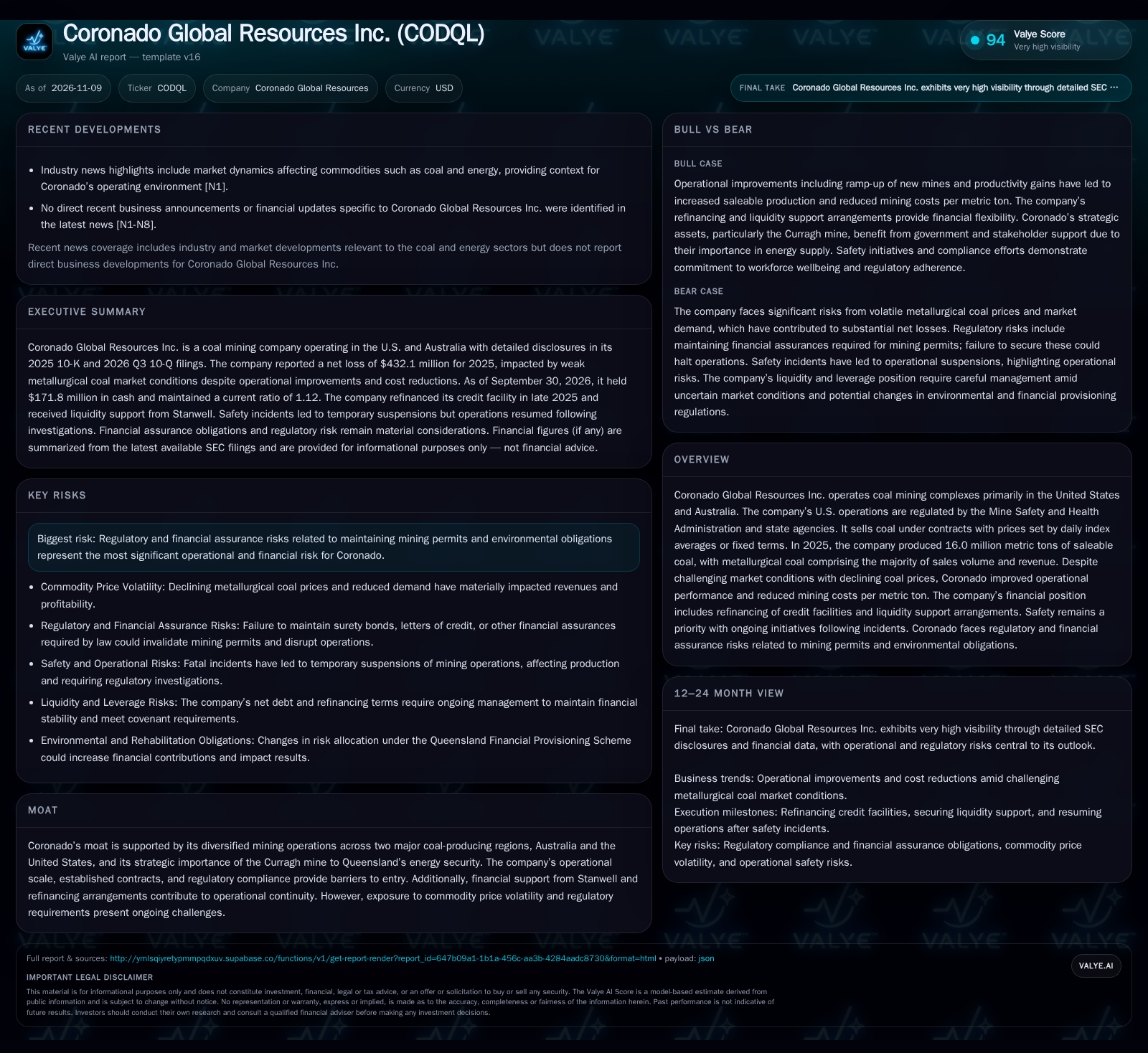
Coronado Global Resources achieved lower mining costs and increased production in 2025, but steep declines in metallurgical coal prices drove a swing to a $432 million net loss. The company’s financial stability now depends on external support, strict regulatory compliance, and market conditions. Regulatory obligations and volatile pricing remain major risks, even as operational execution improves. [S1] [S2]
Coronado Global Resources Inc. is navigating a period of significant strain: operational efficiency gains and cost reductions have not been enough to offset the impact of a sharp drop in metallurgical coal prices, resulting in a major net loss for 2025. As environmental and financial assurance rules tighten, and with commodity markets still volatile, Coronado’s long-term trajectory is increasingly shaped by its capacity to adapt to forces largely outside its direct control.
Operational Gains Collide with Commodity Price Slump and Regulatory Demands
Coronado Global Resources increased saleable coal production to 16.0 million metric tons in 2025, up from the prior year as new mines like Mammoth Underground ramped and productivity initiatives took hold. Despite these operational improvements and a $9.9 per metric ton reduction in mining costs, total revenues fell sharply to $1.92 billion—a $524 million decline—driven primarily by lower average realized metallurgical coal prices and slightly reduced sales volumes. The company reported a net loss of $432.1 million for 2025, a substantial deterioration from the previous year, underscoring the outsized impact of commodity prices on profitability. The company reported a current ratio of 1.12 for the period. The company also faces rising pressure from regulatory and financial assurance obligations, particularly for its Curragh mine in Australia, which has been designated 'moderate-high' risk by Queensland authorities and requires annual contributions to the Financial Provisioning Scheme rather than full bonding. [S1] [S2]
Unit Economics in a Price-Driven Business: Fixed Costs, Margin Compression, and Leverage Dynamics
Coronado’s business model is shaped by the high fixed-cost structure typical of large-scale mining, where economies of scale are critical but profitability is highly sensitive to commodity price swings. While the company successfully reduced mining costs per metric ton (down to $97.5 in 2025), the price of metallurgical coal—a key input for steelmaking—dropped faster, compressing gross margins and swinging the enterprise into a net loss. The company’s revenue mix is heavily weighted to metallurgical coal, with contract prices set by daily index averages, quarterly, or annual fixed rates, exposing it to both spot and contract pricing volatility. Operational leverage can work both ways: productivity gains and the ramp-up of new mines can amplify profits during strong markets, but when prices fall, fixed costs and debt service quickly erode earnings. The refinancing of Coronado’s credit facility in late 2025, with interest rates ranging from 9% to 12% and stricter covenants, raises the hurdle for future profitability and heightens the cost of capital. Capital needs remain significant, not only for sustaining operations and safety compliance but also for fulfilling environmental and rehabilitation obligations, which may increase if regulatory risk assessments shift unfavorably. [S1] [S2]
Strategic Assets, Regional Exposure, and the Limits of Scale in a Volatile Market
Coronado’s competitive position is anchored by its diversified mining footprint across two major coal-producing regions—the United States and Australia—and by the strategic importance of the Curragh mine to Queensland’s energy security. This geographic and operational spread provides some buffer against localized disruptions and regulatory shifts. The company benefits from established customer relationships and long-term contracts that can help smooth revenue in certain periods. However, the commoditized nature of metallurgical coal means Coronado has limited pricing power and is vulnerable to global supply-demand imbalances, substitution by alternative steelmaking processes, and shifts in energy policy. Peer competitors include other large coal producers operating in the U.S. and Australia as well as global mining conglomerates with diversified portfolios. While scale and stakeholder support (notably from Stanwell) offer temporary advantages, the long-term moat is challenged by tightening environmental standards, financial assurance requirements, and the secular trend toward decarbonization in steel. The company’s exposure to commodity price cycles and regulatory scrutiny is higher than diversified miners with broader product mixes.
How a Market Rebound and Regulatory Stability Could Restore Profitability
The most favorable scenario for Coronado would combine a rebound in global metallurgical coal prices with continued operational discipline and regulatory stability. If steel demand in Asia or other key markets recovers, spot and contract coal prices could rise, restoring gross margins and reversing recent losses. Coronado’s cost base, now structurally lower per metric ton, would allow improved operating leverage, translating price gains quickly into profit. Continued productivity improvements and avoidance of major safety or operational disruptions would reinforce this trajectory. Regulatory risk would need to remain stable, with no adverse changes to financial assurance requirements or environmental liabilities. Evidence for this scenario would include sustained increases in realized coal prices, renewed multi-year customer contracts at higher price points, and stable or declining regulatory contributions for the Curragh mine. A return to positive net income and free cash flow, alongside resumed or increased dividend distributions (subject to liquidity requirements), would further confirm a positive inflection.
Navigating Margin Pressure: Cost Control Offsets, but Price and Regulation Remain Headwinds
The most plausible path forward is one where Coronado continues to manage costs and maintain operational improvements but faces ongoing headwinds from subdued metallurgical coal prices and persistent regulatory obligations. Production is likely to remain stable or grow modestly as new mines mature, but pricing power will be limited unless there is a sustained market recovery. The company will need to actively manage its balance sheet, debt service, and liquidity, relying on external support when necessary. Confirming evidence for this scenario would be flat or modestly rising production volumes, stable but unexceptional realized prices, continued cost discipline, and periodic reliance on liquidity support arrangements. Net income may fluctuate around break-even, with dividends paid only when cash cushions exceed required thresholds. Any significant regulatory or market shocks could tip the balance toward further losses.
Regulatory or Market Shocks Could Trigger Operational Disruption and Financial Distress
In an adverse scenario, further declines in global metallurgical coal prices or a tightening of regulatory and financial assurance requirements could push Coronado into deeper losses and threaten operational continuity. A significant increase in required contributions to the Queensland Financial Provisioning Scheme or loss of surety bonds could invalidate mining permits and force curtailment or suspension of the Curragh mine—a key asset. Additional safety incidents, environmental liabilities, or unexpected operational disruptions could further erode cash flow and trigger covenant breaches on the company’s credit facility. Evidence of this downside would include falling realized prices, sharp increases in regulatory or financial assurance costs, warnings about permit status or mine viability, and a rapid deterioration in liquidity metrics. Forced asset sales, mine closures, or a halt in dividend payments would signal severe distress.
What Will Determine Coronado’s Next Chapter: Concrete Tests for the Thesis
Sustained realized metallurgical coal prices and evidence of contract renewals at higher price points would help test the company’s ability to recover margins.
Production volumes and cost per metric ton, especially at new or recently ramped mines, are critical for validating operational improvement claims.
Trends in annual contributions to the Queensland Financial Provisioning Scheme and any changes in the risk allocation for the Curragh mine would indicate regulatory pressure.
Disclosure of covenant compliance or waivers under the new credit facility would clarify potential financial flexibility and risk of distress.
Updates on safety performance, particularly after recent incidents, will show whether operational risks are being effectively managed.
Evidence of continued or expanded liquidity support arrangements from Stanwell or other stakeholders would suggest ongoing need for external backing.
Any material changes to financial assurance obligations, permit status, or environmental liabilities would be key early warnings for operational and financial risk.
Disclaimer: This is research-only, informational analysis and not investment advice. It may include AI-generated interpretation and general industry context. Always verify important details using primary sources.

Comments