
General Purpose Acquisition Corp.: SPAC Mechanics, Timing Stakes, and the Unwritten Value Path
With its IPO completed and trust-generated net income reported, General Purpose Acquisition Corp. (GPAC) now faces the defining challenge for any SPAC: converting its financial structure and regulatory flexibility into a value-creating business combination—before time and transfer restrictions run out.
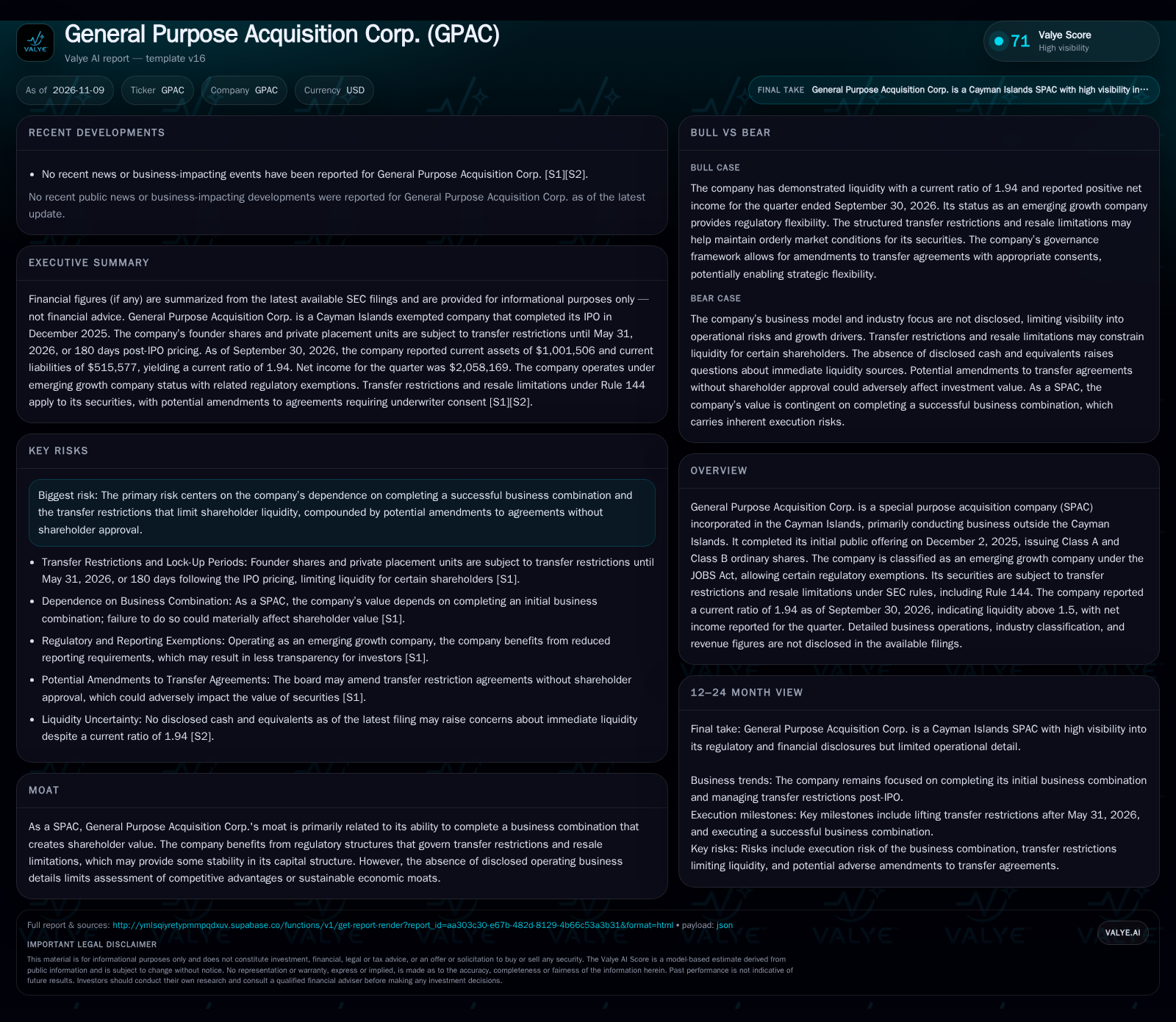
General Purpose Acquisition Corp. (GPAC) is a blank check company with no operating revenues but positive net income from trust account interest. Its current ratio stands at 1.94, but no cash or equivalents are disclosed. The company’s securities remain under transfer restrictions, and its ultimate value depends on executing a successful business combination—a process subject to dilution, regulatory, and timing risks. The next six to twelve months will be critical as lock-ups expire and GPAC seeks a deal to justify its public listing and trust structure. [S1] [S2]
General Purpose Acquisition Corp. (GPAC) sits at a classic SPAC crossroads: flush with trust account proceeds, governed by the lock-up and regulatory constraints typical of recent blank check listings, and yet still without an operating business or disclosed acquisition target. With positive net income driven solely by interest earned on trust assets, the company’s financials reflect the peculiar economics of the SPAC model—where value is latent, dependent on the successful completion of a merger or acquisition. The next phase for GPAC will be shaped by how it navigates regulatory flexibility, transfer restrictions, and the high-stakes search for a suitable business combination before sponsor incentives and shareholder patience run thin.
IPO Completion, Trust Account Earnings, and Transfer Restrictions Shape the Immediate Landscape
GPAC’s initial public offering closed on December 2, 2025, resulting in the issuance of 23.6 million Class A and 5.75 million Class B ordinary shares. As of September 30, 2026, the company reported net income of $2,058,169 for the quarter, drawn exclusively from interest earned on trust account assets, as it has not yet completed a business combination or generated operating revenues. The reported current assets of $1,001,506 against current liabilities of $515,577 produce a current ratio of 1.94. However, the absence of disclosed cash or cash equivalents raises questions about immediate liquidity outside the trust structure. Meanwhile, founder shares and private placement units remain under transfer restrictions until at least May 31, 2026, or 180 days post-IPO, limiting the tradability of a significant portion of GPAC’s outstanding equity [S1] [S2].
SPAC Value Mechanics: Trust Account, Dilution, and the Economics of the Business Combination
GPAC’s current financials reflect the typical SPAC lifecycle: interest income from funds held in trust and ongoing administrative expenses, with no revenue from operations. The core economic engine for any SPAC is the eventual merger or acquisition, whereby trust proceeds are combined with additional financing (debt, equity, or both) to acquire a target. The economics for public shareholders depend on the quality of the target, the valuation at which the deal is struck, and the dilution from additional share issuance or sponsor warrants. If a deal is not consummated within the SPAC’s permitted time window—typically 18-24 months post-IPO—funds are returned to public shareholders, and the sponsor’s investment is lost.
GPAC benefits from emerging growth company status, reducing compliance costs and potentially accelerating the deal timeline, but also limiting investor transparency. The company’s ability to amend transfer restrictions with underwriter consent may provide flexibility to facilitate a deal or incentivize key parties. However, any acquisition will likely involve substantial dilution (if new shares are issued to the target or PIPE investors) and may require debt financing, introducing leverage and potential risk. The company reported cash and liquidity metrics for the period; these figures do not by themselves establish operating runway, investment capacity, financial flexibility, or financing capacity. [S1] [S2]
SPAC Competition: The Race for Attractive Targets and the Challenge of Sponsor Reputation
GPAC operates in a crowded SPAC market where competition for attractive acquisition targets is intense. Hundreds of SPACs vie for a finite pool of high-quality private companies willing to go public via merger. In this environment, sponsor reputation, deal structuring flexibility, and the ability to move quickly are key differentiators. GPAC’s ability to amend transfer restrictions may offer an edge in tailoring incentives or accelerating deal closure, but there is no evidence yet of a proprietary sourcing advantage, sector focus, or unique sponsor credentials.
The SPAC’s regulatory structure—especially lock-ups, resale restrictions, and the latitude to amend agreements—can help maintain order and stability during the deal process, but may also deter some targets seeking immediate liquidity or sponsor alignment. As the SPAC universe matures, targets increasingly compare SPAC offers to traditional IPOs, direct listings, or strategic sales, raising the bar for deal quality and sponsor credibility. GPAC’s ultimate competitive position will become visible only once a target is identified and deal terms are disclosed.
How a Successful Business Combination Could Unlock Value for Shareholders
The most favorable scenario is one in which GPAC identifies and closes a merger with a high-growth, well-managed private company at an attractive valuation. In this case, the trust account is deployed efficiently, and additional capital (PIPE or debt) is raised on favorable terms, minimizing dilution for public shareholders. Emerging growth company status streamlines regulatory hurdles, and the board’s power to amend transfer restrictions enables tailored alignment with new management or investors.
Evidence that would confirm this scenario includes a timely announcement of a definitive merger agreement, clear disclosure of target company financials and growth prospects, PIPE financing commitments that validate deal quality, and positive market reaction as lock-ups expire and liquidity improves. A successful deal would see the combined entity trading at a premium to trust value, with sustained aftermarket support.
Most Plausible Outcome: Extended Search, Dilution Trade-Offs, and Market Skepticism
The median outcome for GPAC is a drawn-out search for a suitable target, with deal terms reflecting the competitive SPAC landscape. In this scenario, the company may announce a combination with a mid-tier or late-stage private company—potentially at a valuation that requires significant dilution or additional incentives to close. Transfer restrictions may be amended to facilitate the deal, but shareholder liquidity remains constrained until lock-ups expire.
Confirmation of this scenario would come from prolonged periods without a deal announcement, followed by a merger involving heavy dilution for public shareholders or PIPE investors at a discount to trust value. Market reaction would likely be muted or negative, with shares trading near or below trust redemption value. If disclosed, higher redemption rates and limited aftermarket support would further support this base case.
Adverse Path: Failure to Close a Deal and the Return of Trust Assets
The principal risk is that GPAC fails to secure a business combination within the permitted time frame. In this scenario, the trust account is liquidated and proceeds are returned to public shareholders, with the sponsor’s investment and efforts effectively written off. Shareholders experience opportunity cost, and the sponsor loses its at-risk capital and potential upside. Transfer restrictions become moot, and the public listing is unwound.
Confirmation would come from repeated extensions, unsuccessful negotiations, or regulatory hurdles that prevent deal closure. High redemption rates, withdrawal of PIPE commitments (if any), or adverse changes in regulatory or market conditions would further signal this downside path. A lack of substantive merger announcements as deadlines approach would be a key early warning.
Milestones and Triggers That Will Define GPAC’s Value-Creation Trajectory
Announcement of a definitive business combination agreement, including disclosure of the target company’s financials, sector, and deal terms.
Level of dilution to public shareholders from new share issuance, PIPE investments, or warrant exercises—if disclosed.
Expiration or early amendment of transfer restrictions and lock-up periods, and their impact on share liquidity and sponsor alignment.
Shareholder redemption rates at the time of business combination announcement and closing—if disclosed.
Market price of GPAC shares relative to trust redemption value during and after the deal process.
PIPE financing commitments and participation by credible institutional investors, which would validate deal quality—if disclosed.
Any regulatory or legal challenges to the proposed business combination or changes in SEC/SPAC rules that could affect the timeline or structure.
Disclaimer: This is research-only, informational analysis and not investment advice. It may include AI-generated interpretation and general industry context. Always verify important details using primary sources.

Comments