
Berkshire Hathaway 2026: Conglomerate Economics, Capital Allocation, and the Stakes of Multi-Sector Exposure
Berkshire Hathaway’s latest results highlight the scale and adaptability of its diversified model, with substantial quarterly earnings and broad industry exposure. The focus now turns to how its capital allocation, insurance float, and sector mix position it for the next cycle of economic and commodity volatility.
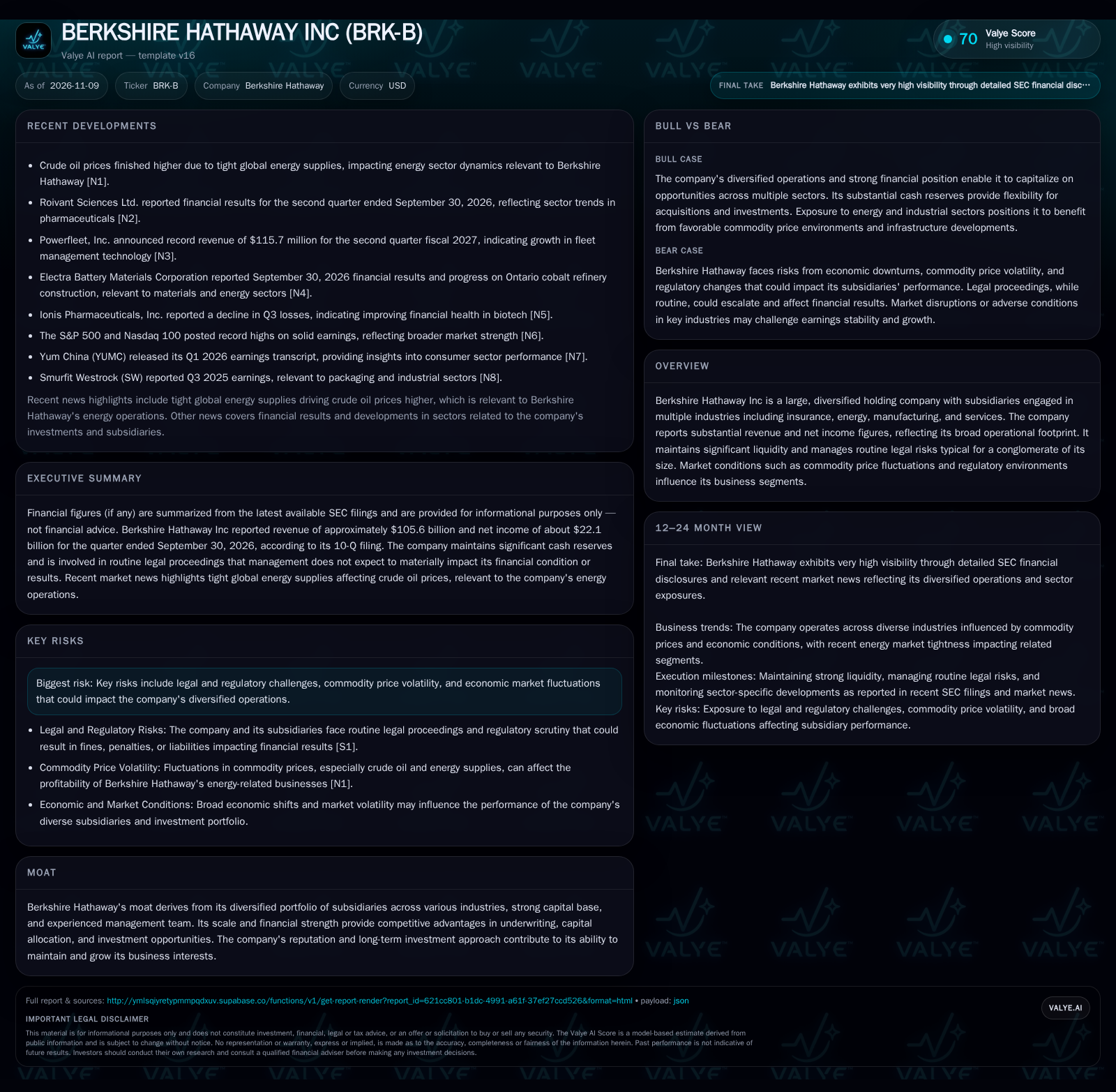
Berkshire Hathaway reported $105.6 billion in revenue and $22.1 billion in net income for the September 2026 quarter, reflecting the earnings power of a large, diversified conglomerate [S2].
Berkshire Hathaway’s latest financials reinforce its status as one of the world’s most formidable conglomerates, generating over $105 billion in quarterly revenue and more than $22 billion in net income as of September 2026 [S2]. The company’s diverse portfolio—spanning insurance, energy, manufacturing, and services—offers both insulation and leverage to shifting economic and sectoral trends. With substantial cash reserves and a reputation for disciplined capital deployment, Berkshire faces mounting questions about the sources and sustainability of future returns as market cycles evolve and the bar for outperformance rises.
Recent Results Reveal Earnings Power and Sector Breadth
Berkshire Hathaway reported revenue of approximately $105.6 billion and net income of about $22.1 billion for the quarter ended September 30, 2026, reinforcing its position as a high-earning diversified conglomerate [S2]. These figures highlight the underlying profitability and scale generated by its broad portfolio of subsidiaries across insurance, energy, manufacturing, and services. The company’s operating results reflect both the resilience and the complexity of managing exposure to multiple sectors, where industry-specific cycles and macroeconomic shifts can have outsized impacts.
The company’s multi-sector exposure is particularly relevant given recent market dynamics, such as tight global energy supplies affecting crude oil prices—a factor that can materially influence Berkshire’s energy and industrial businesses. While management considers ongoing legal proceedings to be routine and not material to financial results [S1], the real focus is on how Berkshire’s sector mix and capital base position it for future volatility and opportunity.
How Berkshire’s Conglomerate Structure Creates—and Constrains—Value
Berkshire Hathaway’s business model is built on the aggregation of wholly-owned operating subsidiaries and a large portfolio of investments, primarily funded through insurance float. The insurance operations generate substantial underwriting profits and provide investable capital at low or negative effective cost, which has historically allowed Berkshire to pursue opportunistic acquisitions and investments across industries. This creates a unique blend of recurring insurance income, variable returns from equity and fixed-income investments, and cash flow from operating businesses.
However, the conglomerate structure also introduces complexity and potential inefficiencies. While insurance float offers a structural cost-of-capital advantage, the challenge is deploying large and growing pools of capital at rates of return that exceed Berkshire’s own cost of capital—especially as the company’s size limits the set of potential deals that can move the needle. Fixed costs are significant at the holding-company level, but many subsidiaries operate with substantial operating leverage, amplifying both the upside and downside of sector cycles. The company’s ability to generate free cash flow and reinvest at attractive rates is central to its long-term value creation.
The conglomerate’s capital allocation discipline is critical in balancing the tension between deploying capital internally to subsidiaries versus external investments or share repurchases. Given the scale of Berkshire’s capital base, incremental returns diminish as the company exhausts high-return opportunities, making the marginal cost of capital an essential consideration. This dynamic necessitates a rigorous evaluation framework to prioritize investments that not only generate absolute returns above the cost of capital but also complement or diversify existing operations to mitigate correlated risks across the portfolio.
Moreover, the conglomerate structure can obscure granular performance signals, as strong results in one segment may mask weaknesses elsewhere, complicating capital allocation decisions. Effective internal capital markets require transparency and alignment of incentives across subsidiaries to avoid suboptimal reinvestment or cash hoarding. The interplay between decentralized operational autonomy and centralized capital deployment strategy shapes the company’s ability to adapt to shifting economic conditions and sector-specific disruptions, influencing long-term value creation.
Scale, Reputation, and Sector Mix: Where Berkshire Holds—and Yields—Edge
Berkshire Hathaway’s principal competitive advantages stem from its scale, reputation, and capital allocation discipline. Its insurance subsidiaries benefit from underwriting expertise, brand trust, and the capacity to absorb large risks, enabling access to float at attractive terms. In sectors like energy and manufacturing, Berkshire’s financial strength allows for patient investment and the ability to weather downturns, outlasting less-capitalized competitors.
However, the conglomerate faces counterforces. In insurance, competition from global carriers and insurtech entrants puts pressure on margins. In industrials and energy, Berkshire competes with both sector specialists and other diversified conglomerates, while also facing the risk of technological disruption and regulatory change. The company’s broad sector exposure means that it is rarely the lowest-cost or most innovative player in any single vertical, but its diversified model provides resilience that pure-plays may lack.
Berkshire’s reputation and scale also afford it negotiating leverage in capital markets and supplier relationships, which can translate into cost advantages and preferential access to deal flow. However, these advantages depend on maintaining a strong credit profile and operational stability. The conglomerate’s broad sector mix provides diversification benefits, but it also exposes the company to regulatory and technological risks unique to each industry, requiring sophisticated risk management and scenario planning capabilities to anticipate and respond to emerging threats and opportunities.
In addition, Berkshire’s capital allocation discipline is a competitive moat, as it mitigates the risk of value-destroying acquisitions common among conglomerates lacking stringent investment criteria. The company’s ability to deploy insurance float effectively hinges on underwriting discipline and market conditions; increased competition or shifts in risk profiles could compress margins and reduce the cost advantage of this capital source. Consequently, ongoing monitoring of underwriting performance and float dynamics is essential to sustaining the conglomerate’s competitive edge and potential financial flexibility.
What Could Drive Outperformance: Opportunistic Deployments and Sector Tailwinds
The most favorable scenario for Berkshire hinges on a combination of disciplined capital deployment, strong insurance profitability, and tailwinds in key sectors such as energy and industrials. If insurance operations continue to generate underwriting profits and float grows at low cost, Berkshire could reinvest these funds into high-return opportunities—such as distressed assets during downturns or secular winners in infrastructure and renewables.
Confirmation would come from evidence of large, accretive acquisitions or investments, a sustained improvement in insurance combined ratios, and robust profit growth in energy or industrial subsidiaries during periods of favorable commodity pricing. Additional signs would include an increase in per-share intrinsic value at a rate above the S&P 500 and clear articulation of capital allocation priorities by management.
A Plausible Outlook: Earnings Resilience Amid Macro Crosscurrents
The most likely trajectory is that Berkshire maintains robust earnings and cash flow, with performance varying by subsidiary as macroeconomic and sector-specific conditions evolve. Insurance remains a steady source of float and profits, but returns may moderate as competition intensifies and the opportunity set for large-scale investments narrows. Energy and industrial operations contribute meaningfully, but are subject to commodity and regulatory cycles.
This scenario would be confirmed by stable (but not accelerating) growth in revenue and net income, modest incremental capital deployment, and continued emphasis on risk management and balance-sheet strength. Falsification would come from a sustained deterioration in insurance profitability, a lack of meaningful reinvestment opportunities, or a significant earnings decline in core subsidiaries.
How Macro Shocks or Capital Deployment Missteps Could Pressure Results
Adverse outcomes for Berkshire could arise from a combination of macroeconomic downturns, insurance losses, and suboptimal capital allocation. A sharp decline in equity markets would impair the value of Berkshire’s investment portfolio, while sustained low interest rates could erode investment income. Major insurance catastrophes or persistent underwriting losses would reduce float and strain capital.
Downside would be confirmed by a marked drop in reported net income and book value per share, negative insurance combined ratios, and evidence of large investments or acquisitions that subsequently underperform.
Benchmarks for Testing Berkshire’s Capital Allocation and Sector Exposure Thesis
Reported insurance combined ratios and trends in policy float—if disclosed—would help indicate underwriting discipline and the cost of capital.
Size, timing, and sector focus of new acquisitions or major investments will reveal management’s confidence and opportunity set.
Revenue and profit growth in energy and industrial subsidiaries, particularly in relation to commodity price movements, will show sector leverage.
Changes in per-share intrinsic value, if disclosed or estimated, would help benchmark capital allocation effectiveness against market alternatives.
Shifts in the composition of cash holdings versus invested assets, if broken out, would illuminate management’s capital deployment strategy.
Material legal or regulatory developments in insurance or energy could affect risk exposure and capital requirements.
Clarity and evolution in succession planning or executive decision-making processes would help assess long-term governance stability.
Disclaimer: This is research-only, informational analysis and not investment advice. It may include AI-generated interpretation and general industry context. Always verify important details using primary sources.

Comments