
Permian Basin Royalty Trust at a Crossroads: The Implications of a Potential Business Combination and Trust Liquidation
Permian Basin Royalty Trust faces a pivotal moment as unitholders prepare to vote on a proposed business combination that could dissolve the trust, convert units into shares of a new operating company, and fundamentally alter its risk, income, and governance profile.
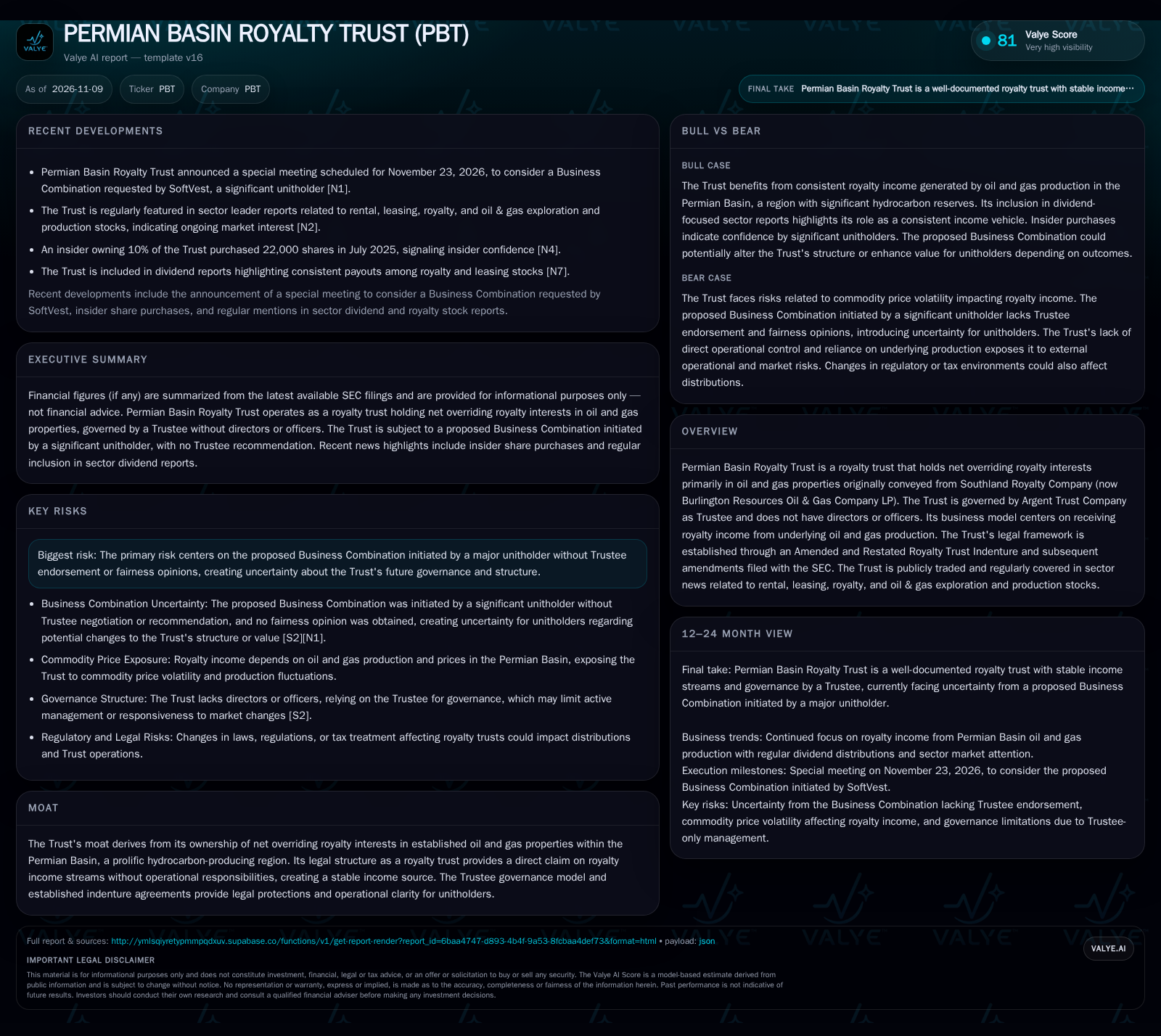
Permian Basin Royalty Trust (PBT) is approaching a special unitholder vote on a proposed business combination that, if approved, would terminate the trust and convert unitholders’ interests into shares of a new operating company, PBT Land and Minerals, Inc. This would end the trust’s current passive royalty structure, introduce new operational exposures, and shift governance away from the trustee model. The outcome could reshape income predictability, risk profile, and market perception for current and future stakeholders.Insider transaction activity was reported in the cited source; this activity does not by itself establish insider confidence. [S2] [N1] [N4] [N7]
Permian Basin Royalty Trust (PBT), long regarded as a passive vehicle for direct exposure to oil and gas royalties in the prolific Permian Basin, stands on the verge of a dramatic transformation. With a special unitholder meeting scheduled for November 23, 2026, the trust’s future hangs in the balance: a proposed business combination could dissolve the trust, convert units into shares of a new operating company, and fundamentally alter the nature of unitholder participation. The trustee’s decision not to opine on or recommend the transaction, coupled with recent insider buying and ongoing sector recognition for its dividends, sets the stage for a consequential decision that could reshape both risk and return for current and future investors. [S2] [N1] [N4] [N7]
A Defining Vote: Trust Dissolution and Business Combination on the Table
The most material current development is the proposed business combination between Permian Basin Royalty Trust and Blackbeard Holdings, LLC, which would terminate the trust and combine its royalty interests with additional assets in a new operating company, PBT Land and Minerals, Inc. Unitholders are being asked to vote on November 23, 2026, on amendments to the trust indenture and related matters, including the trust’s liquidation. If approved, trust units would cease trading and convert into shares of the new entity. The trustee, Argent Trust Company, has not negotiated or recommended the deal, nor obtained a fairness opinion, placing the decision squarely with unitholders. [S2] [N1]
A notable 10% owner purchased 22,000 shares in July 2025, reflecting confidence among significant stakeholders. The cited source reports dividend-related activity; that disclosure alone does not establish dividend-policy continuity, management confidence, or a material constraint on capital flexibility. [N4] [N7]
From Passive Royalties to Operating Exposure: Changing the Income Equation
Historically, Permian Basin Royalty Trust’s economics have been straightforward: it receives net overriding royalties from oil and gas production, passes through cash after minimal administrative expenses, and distributes nearly all income to unitholders. This structure offers high income visibility, low overhead, and minimal reinvestment or capital-expenditure requirements—attributes that have made royalty trusts attractive to income-focused investors.
If the business combination is approved, the new PBT Land and Minerals, Inc. would likely operate as a C-corp with direct ownership and management of mineral and land assets. This could introduce operational expenses, the need for active management, capital allocation decisions, and potential reinvestment or development strategies. Such a shift could increase both upside potential and risk, as future income would depend not only on commodity prices and production volumes but also on management execution, operating costs, and capital deployment.
The transition away from a pure pass-through model would likely reduce the predictability of distributions, introduce new fixed and variable costs, and change the balance of operating leverage. The risk-return profile could move closer to that of an upstream operator or diversified minerals company, rather than a passive royalty vehicle.
Royalty Trust Simplicity Versus Operating Company Complexity
Permian Basin Royalty Trust’s core advantage has been its pure exposure to royalty income from established Permian Basin properties—offering high-margin, low-cost access to oil and gas cash flows without the risks of direct operation, exploration, or capital spending. This has historically set it apart from operating companies and even from other mineral aggregators who may pursue growth through acquisitions or development.
If converted into an operating company, PBT would join a broader peer set that includes mineral aggregators, diversified E&Ps, and land management firms. Its competitive position would then depend on its asset quality, management acumen, and strategic agility, rather than just the legal structure of its income stream. This could expose it to greater competition for deals, more volatile earnings, and the need to justify capital allocation choices—areas where passive trusts have traditionally ceded responsibility to operators.
The new structure could also affect investor perception: income investors may shift away if distributions become less predictable, while new investors may be attracted by growth or reinvestment potential. The question is whether the new entity can build a defensible niche or scale advantage in a more competitive landscape.
How the Business Combination Could Unlock New Value—If Execution Outpaces Risks
In a favorable scenario, unitholders approve the business combination, and the new PBT Land and Minerals, Inc. leverages its expanded asset base and operating flexibility to drive higher long-term returns. Active management could enable opportunistic acquisitions, targeted development, or improved cost efficiencies. If commodity prices remain supportive and management demonstrates prudent capital allocation, the company could generate both income and capital appreciation beyond what the passive trust structure could offer.
Confirmation of this scenario would come from early disclosures of accretive deals, clear reinvestment policies, and consistently strong operational performance relative to peers. Evidence would include not only robust dividend policies but also positive cash flow generation, increased reserves, or successful asset optimization. Share price outperformance and positive analyst coverage post-conversion would further validate the thesis.
Conversely, failure to articulate a clear strategy or to deliver early operational wins would falsify the upside case.
Most Likely Outcome: Incremental Change with New Risks and Uncertainties
The most plausible scenario is that the business combination is approved by a narrow margin, reflecting both support from major holders and skepticism among income-focused investors. The new entity inherits a solid base of royalty assets but faces a transition period as it establishes its management team, operational practices, and investor communications.
Distributions may become less stable as capital is allocated to operational or development projects, with income now exposed to both commodity cycles and execution risks. The investor base could shift, with some income-oriented holders exiting and new investors seeking growth or asset appreciation entering. Early financial results may be mixed as the company absorbs transaction costs and navigates the transition.
This scenario would be confirmed by initial volatility in payout ratios, shifts in trading volume and investor composition, and management’s ability to articulate a credible long-term plan. Falsification would come from a failed vote or immediate operational missteps that erode asset value or investor trust.
Where the Transition Could Falter: Governance, Execution, and Income Risk
In the adverse scenario, the business combination either fails to secure unitholder approval or, if implemented, exposes holders to new risks that outweigh potential rewards. If the vote fails, the trust continues its current path, but with a potentially fractured unitholder base and lingering strategic uncertainty.
If the combination proceeds but the new entity underperforms—due to weak management, poor capital allocation, or operational missteps—distributions could decline, asset value could erode, and the stock could underperform peers. The absence of a trustee’s fiduciary structure and the lack of a fairness opinion could become flashpoints if outcomes disappoint.
This downside would be confirmed by falling distributions, negative operational updates, or loss of investor confidence as reflected in sustained share price underperformance. Legal or governance disputes could compound the risks if unitholders feel the process lacked transparency or fairness.
What Will Resolve the Uncertainty for PBT: Milestones and Metrics to Track
Outcome of the November 23, 2026, special unitholder vote: approval or rejection of the business combination and related amendments. [S2] [N1]
Disclosure of the new entity’s management team, operating strategy, and capital allocation policy—would help test the thesis post-conversion.
Early operational results from the combined asset base, including production, cash flow, and reserve reporting, if disclosed.
Investor base turnover, trading volume, and analyst coverage following the conversion—indicate market acceptance or skepticism.
Any legal challenges, governance disputes, or regulatory issues arising from the transaction or trust liquidation.
Commodity price trends and their impact on realized royalty income or new operating income streams.
Disclaimer: This is research-only, informational analysis and not investment advice. It may include AI-generated interpretation and general industry context. Always verify important details using primary sources.

Comments