
Coca-Cola Consolidated: Franchise Power, Retail Concentration, and the Economic Stakes of Bottler Scale
Coca-Cola Consolidated, Inc. stands as the largest U.S. Coca-Cola bottler, anchored by exclusive distribution rights and a sprawling regional infrastructure. While its protected franchise agreements and capital investments underpin operational resilience, the company faces profitability headwinds and high exposure to major retail customers—raising questions about its flexibility and margin trajectory in a tightly controlled bottling system.
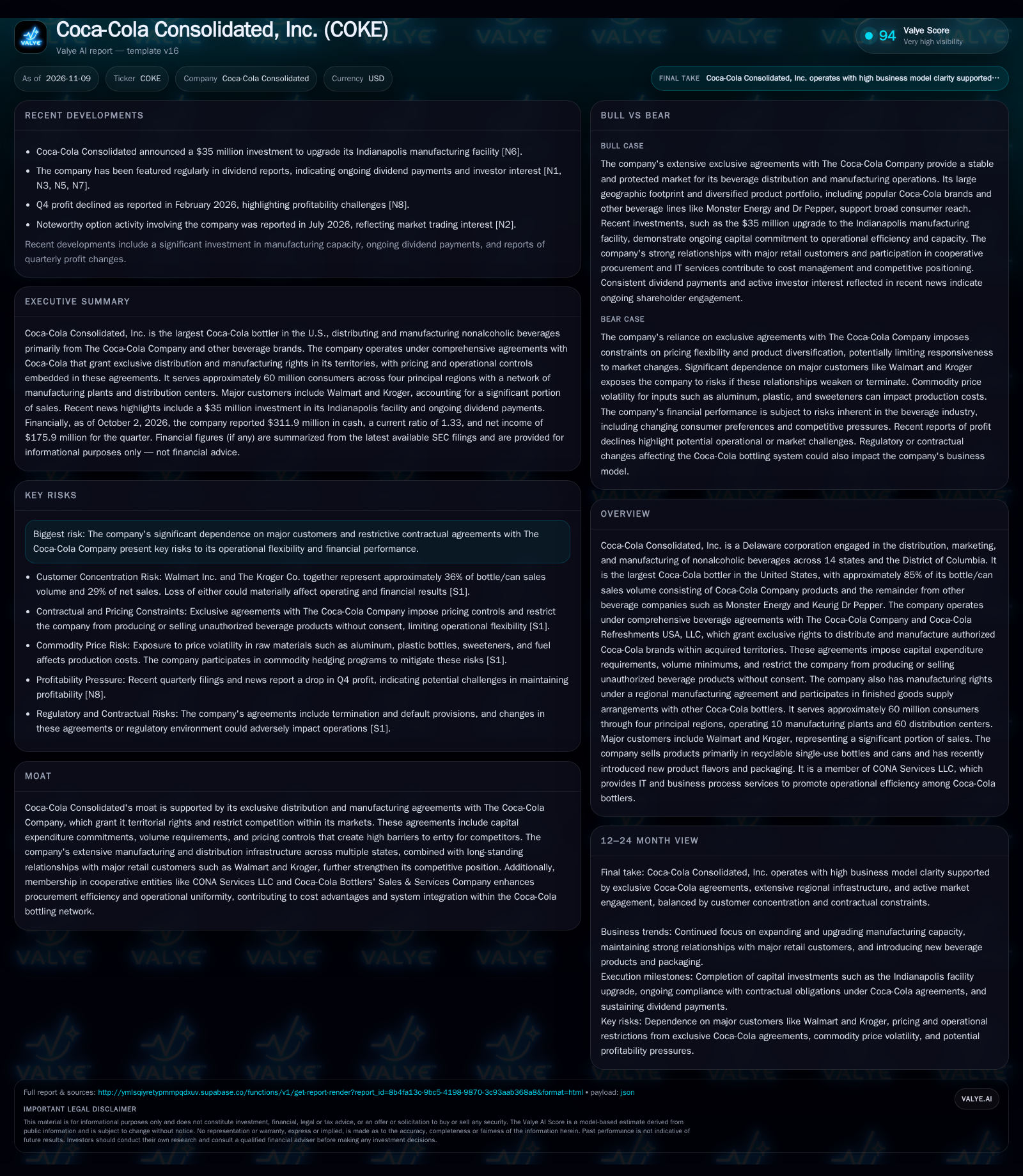
Coca-Cola Consolidated’s business model is defined by exclusive bottling and distribution rights for Coca-Cola products, a vast service footprint, and deep reliance on Walmart and Kroger. Recent facility investments and ongoing product innovation signal operational focus, but declining quarterly profits and strict contractual controls with The Coca-Cola Company highlight the challenges of margin management and limited autonomy. The strategic question is whether scale and system integration can offset the risks of customer concentration and pricing inflexibility in a changing beverage landscape. [S1] [N6] [N8] [S2]
Coca-Cola Consolidated, Inc. occupies a pivotal position within the North American beverage supply chain as the largest U.S. Coca-Cola bottler, wielding exclusive rights over a vast multi-state territory. Its business model is defined by deep integration with The Coca-Cola Company, robust manufacturing and distribution assets, and a customer base dominated by retail giants Walmart and Kroger. While ongoing investments and product launches signal operational commitment, recent profitability declines and the company’s exposure to contractual and customer concentration risks highlight the delicate balance between scale-driven efficiency and the structural limitations of the Coca-Cola bottling framework. The central business question: Can system advantages and operational scale outpace the structural constraints of a tightly controlled franchise model?
Recent Profit Pressures and Capital Commitments Reshape the Bottler’s Near-Term Outlook
As of October 2, 2026, Coca-Cola Consolidated reported $311.9 million in cash and equivalents, current assets of $1.678 billion against current liabilities of $1.261 billion, and a net income of $175.9 million for the quarter—though this represented a decline in Q4 profit compared to the prior year. [S2] [N8] This profitability pressure emerges as the company undertakes a $35 million investment in its Indianapolis manufacturing facility, aimed at upgrading capacity and efficiency. [N6] Meanwhile, Walmart and Kroger remain critical, representing 36% of bottle/can sales volume and 29% of net sales, highlighting the ongoing risk of customer concentration. [S1] These facts frame a business at the intersection of operational investment, margin challenge, and strategic dependence on a handful of retail channels.
How the Franchise Model Shapes Economics, Margins, and Scale
Coca-Cola Consolidated’s economics are fundamentally dictated by its exclusive bottling and distribution agreements with The Coca-Cola Company. Approximately 85% of bottle/can sales volume comes from Coca-Cola brands, with the remainder sourced from other beverage companies. [S1] The franchise model provides territorial exclusivity, but it embeds significant operational constraints: pricing for most finished goods is set by The Coca-Cola Company, and the agreements require ongoing capital expenditures and minimum volume commitments. [S1] This structure yields predictable volume and revenue streams, but limits the bottler’s ability to independently adjust pricing or product mix in response to market or cost shifts.
Fixed costs are high due to a network of 10 manufacturing plants and 60 distribution centers, supporting large-scale production and logistics. Variable costs are heavily influenced by input prices (aluminum, plastic, sweeteners, and fuel), which are subject to commodity volatility; while the company hedges some exposure, cost pass-through is not fully within its control. The capital expenditure requirement—exemplified by the Indianapolis upgrade—reflects both the need to maintain competitive infrastructure and the obligations embedded in franchise agreements. Operating leverage may be significant in periods of strong volume growth, but margin compression can result if volume stagnates or input costs rise faster than allowed price adjustments.
Exclusive Rights, System Integration, and the Double-Edged Sword of Bottling Scale
Coca-Cola Consolidated’s most durable advantage is its exclusive territory and product rights, which, along with its membership in the CONA Services LLC cooperative, create a formidable barrier to direct competition within its markets. [S1] This territorial exclusivity is reinforced by systemwide IT/process integration and procurement scale, reducing per-unit costs and supporting supply chain efficiency. The massive retail footprint—serving 60 million consumers—further entrenches its position.
However, these same agreements constrain product innovation and pricing flexibility. Category peers include other regional Coca-Cola bottlers, PepsiCo bottling affiliates, and independent beverage distributors. The principal threat is not direct territorial encroachment, but substitution by private-label, alternative beverages, or shifts in consumer preference toward new categories outside the authorized brand portfolio. Additionally, the reliance on Walmart and Kroger means that any change in retailer strategy or shelf space allocation could materially impact volume, regardless of bottler scale.
Operational Upgrades and System Cohesion Drive Margin Recovery
The most favorable outcome for Coca-Cola Consolidated would involve successful execution of its capital investment program, resulting in improved plant efficiency, lower per-unit costs, and the ability to handle new product introductions or packaging formats at scale. If commodity prices stabilize or decline, and if the company leverages its system integration to further reduce procurement and logistics costs, margin recovery could follow—even with limited pricing autonomy. Ongoing product launches, such as new flavors and packaging, could also boost volume by capturing incremental consumer demand within the authorized brand portfolio.
Confirmation of this scenario would come from a sustained rebound in quarterly profits, expanding gross and operating margins, and evidence of increased throughput or cost savings from the Indianapolis facility and other operational upgrades. Additional signs would include continued strong relationships with Walmart and Kroger, as well as incremental gains in volume from new product or package launches.
Structural Constraints Anchor Profits to Volume and Cost Discipline
The most plausible medium-term outcome is a steady-state business anchored by contractual exclusivity, high fixed costs, and limited pricing levers. Coca-Cola Consolidated will likely continue to generate predictable volumes via its retail partners, but margins will remain sensitive to input costs and the degree of operational efficiency achieved through ongoing capital investment. Customer concentration and pricing constraints will persist as structural features: the company can defend its core business, but outsized margin expansion will be difficult absent significant cost breakthroughs or a shift in systemwide pricing policy.
Evidence supporting this scenario would include modest or stable net income, periodic margin volatility driven by commodity prices, and regular capital expenditures focused on plant upgrades and logistics. Falsification would require either a major customer loss, a structural change in the Coca-Cola system’s pricing arrangements, or a sustained, systemwide shift in consumer beverage demand away from core categories.
Margin Squeeze Intensifies as Customer and Cost Pressures Mount
The adverse scenario would be triggered by a combination of rising commodity costs, inability to pass through price increases due to contractual constraints, and/or a deterioration in major retail relationships. If Walmart or Kroger were to reduce shelf space, switch to alternative suppliers, or exert further pricing pressure, Coca-Cola Consolidated could face a material decline in volume and net sales. At the same time, input cost inflation—if not offset by operational efficiencies or hedging—would erode margins, potentially resulting in further profit declines and reduced capacity for capital investment.
Confirmation of this scenario would come from consecutive quarters of declining net income, shrinking gross and operating margins, and/or disclosure of adverse changes in customer relationships or contract terms. Early warning signs could also include rising debt or working capital strain if profitability weakens and capital spending remains high.
Factors That Could Change the Franchise Economics or Risk Profile
Quarterly gross margin and net income trends—especially in the wake of new capital investments—would help assess whether the company is realizing efficiency gains or facing persistent margin pressure.
Volume share and net sales attributed to Walmart and Kroger: Any material change in these customers’ contribution would signal a shift in customer concentration risk.
Commodity input cost trends (aluminum, plastic, sweeteners, fuel) and the company’s ability to hedge or pass through these costs, if disclosed.
Evidence of new or renegotiated agreements with The Coca-Cola Company that alter pricing, product, or operational flexibility.
Capital expenditure cadence and project completion (e.g., Indianapolis facility upgrade): Timely and on-budget execution would support the upside scenario.
Introduction and uptake of new beverage products or packaging formats within the authorized portfolio; a useful metric would be incremental volume or revenue attributed to these launches, if disclosed.
System integration outcomes: Measurable cost savings or operational efficiencies from CONA Services LLC participation, if disclosed.
Any changes in the regulatory environment or bottling system structure that could affect franchise rights, obligations, or competitive dynamics.
Disclaimer: This is research-only, informational analysis and not investment advice. It may include AI-generated interpretation and general industry context. Always verify important details using primary sources.

Comments