
Innovative Eyewear: Sales Acceleration, AI Integration, and the Roadblocks to Smart Eyewear Scale
Innovative Eyewear has delivered rapid sales growth and broadened its retail and brand footprint, yet persistent losses, competitive threats, and Nasdaq listing risk frame a critical period where commercial execution and adoption rates must accelerate to justify further investment.
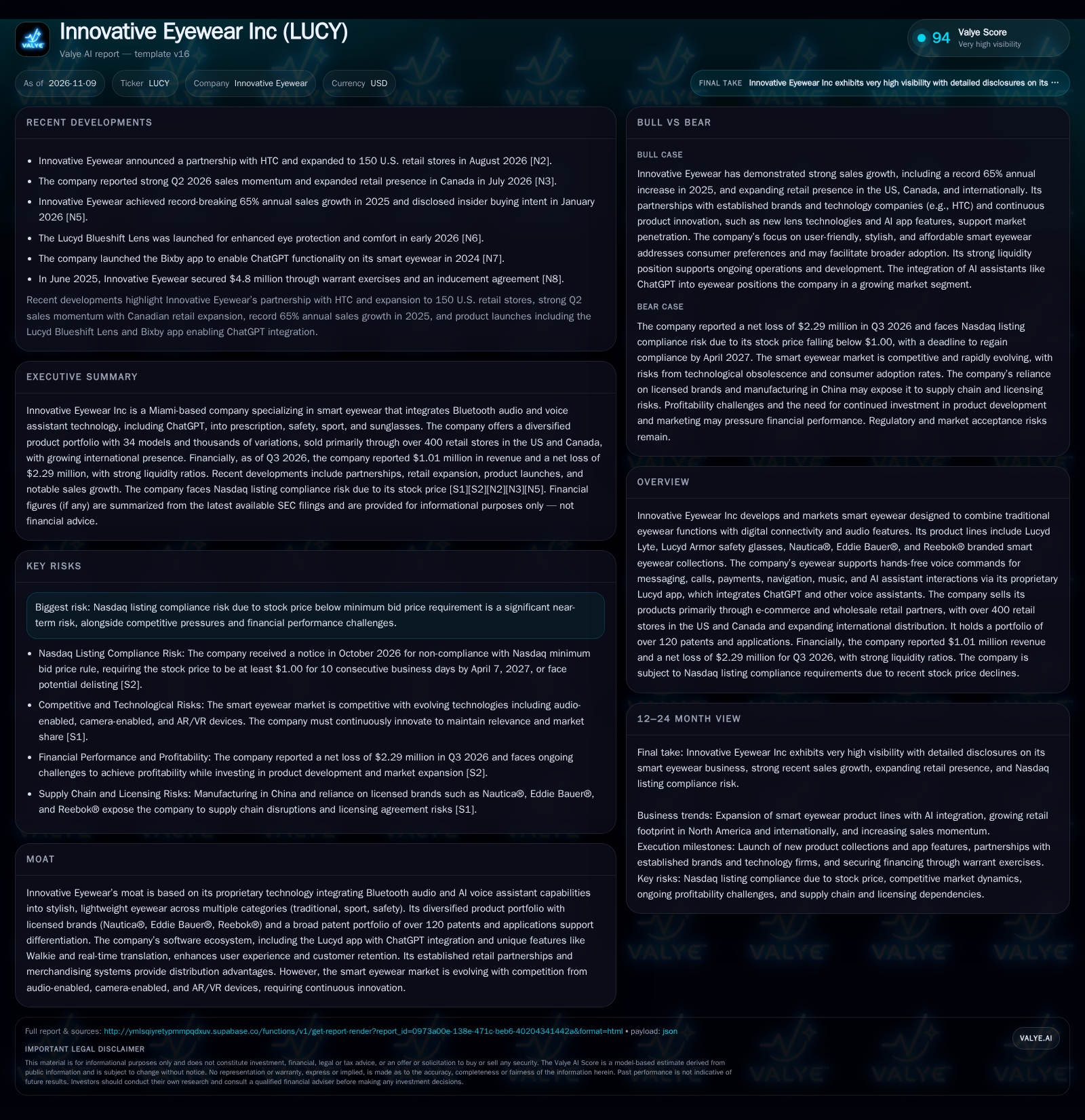
Innovative Eyewear Inc has posted strong sales growth, diversified its smart eyewear portfolio, and expanded retail distribution—including partnerships with major brands and technology firms. However, the company remains unprofitable, faces delisting risk from the Nasdaq, and must navigate intense competition and consumer adoption challenges to achieve durable scale and financial sustainability. The next year will test whether recent momentum can translate into recurring demand and margin improvement, or whether structural hurdles in the smart eyewear market will force a strategic reset. [S1] [S2] [N2] [N3] [N5]
Innovative Eyewear Inc has made notable strides in carving out a niche in the smart eyewear category, leveraging rapid product innovation, branded partnerships, and AI-driven functionality to fuel sales momentum. Yet, persistent losses, looming compliance risk with Nasdaq, and the challenge of converting early adoption into mass-market traction raise pivotal questions about the business’s ability to transition from growth to sustainable profitability. As the company enters a critical window for commercial validation, the effectiveness of its channel strategy, product upgrades, and ecosystem integration will likely determine its trajectory in a fiercely contested and still-nascent market.
Recent Growth, Losses, and Listing Risk Define the Inflection Point
Three facts currently shape Innovative Eyewear’s business outlook. First, the company achieved a record 65% annual sales growth in 2025 and reported strong Q2 2026 sales momentum, reflecting successful expansion into new retail accounts and geographies, including Canada and a growing wholesale network now spanning over 400 stores [N3] [N5] [S1]. Second, profitability remains elusive: Q3 2026 revenue reached $1.01 million, but net losses persisted at $2.29 million, underscoring the challenge of scaling fixed costs and recouping investments in R&D, marketing, and channel build-out [S2]. Third, in October 2026, Nasdaq notified the company of non-compliance with its minimum bid price requirement, giving it until April 2027 to resolve the issue or face potential delisting—a deadline that injects urgency into the company’s next set of operating decisions [S2].
Smart Eyewear Monetization: Volume Leverage, Brand Licensing, and the Role of Software
Innovative Eyewear’s business model is anchored in hardware sales—prescription, sun, sport, and safety eyewear—augmented by branded partnerships (Nautica, Eddie Bauer, Reebok) and proprietary app features, including AI-powered voice assistance and translation [S1]. Revenue is primarily driven by unit sales through a mix of wholesale retail accounts, e-commerce, and increasingly, international channels. The addition of well-known consumer brands may allow for some premium pricing and broader addressable markets, but the underlying economics remain hardware-centric, with margin profiles likely constrained by cost of goods, licensing fees, and the need for continuous product refresh.
The Lucyd app ecosystem introduces a potential recurring revenue stream via its Pro subscription, which offers unlimited ChatGPT interactions and priority support. However, the current scale and penetration of paid subscriptions are not disclosed, so it is unclear whether software can meaningfully shift the margin profile in the near term. Operating leverage could improve if fixed investments in product development and retail infrastructure translate into higher unit volumes and attach rates for value-added services. Conversely, the high mix of SKUs and customization options (over 100 lens/prescription variants per style) may add complexity and working capital needs, tempering margin expansion until volumes reach critical scale.
Differentiation, Patent Portfolio, and the Challenge from Tech Giants and Niche Rivals
Innovative Eyewear’s differentiation rests on integrating lightweight, stylish hardware with proprietary voice-assistant capabilities and a broad patent portfolio (over 120 patents and applications) [S1]. The company’s partnerships with established lifestyle and sports brands, coupled with its Lucyd app (featuring ChatGPT integration and unique functions like Walkie and real-time translation), offer an experience that blends fashion, utility, and connectivity.
However, the competitive field is formidable. Entrants range from global electronics and tech giants (who can bundle smart glasses with larger ecosystems and subsidize early losses) to niche wearable startups experimenting with AR, audio, or fitness integrations. Alternative solutions—including hearables, camera-enabled eyewear, and emerging AR/VR devices—offer substitutes for many use cases. The pace of obsolescence is high, and brand loyalty in smart eyewear is still unproven. To maintain an edge, Innovative Eyewear must continually innovate both hardware and software, deepen retail and consumer partnerships, and avoid commoditization as the category matures.
If Mass Adoption Accelerates: Retail Scale, Subscriptions, and Brand Flywheel
The best-case scenario is one where smart eyewear transitions from a niche to a mainstream accessory, supported by expanding retail presence, growing consumer comfort with voice/AI features, and the continued rollout of new branded models. If recent sales momentum is sustained and amplified by successful launches—such as the upcoming Reebok premium optical collection—and if attach rates for Lucyd Pro subscriptions rise, the company could achieve operating leverage and begin to dilute fixed costs across a larger revenue base.
Evidence that would confirm this trajectory includes: consecutive quarters of accelerating revenue growth, narrowing losses or a move toward breakeven, increasing software/subscription revenue as a share of total, and further expansion into large retail chains or international markets. A visible uptick in consumer engagement metrics (if disclosed), positive renewal rates for branded partnerships, and additional patent grants or licensing agreements would strengthen the case for durable differentiation.
Sustained Growth, But Profitability Elusive Amid Evolving Consumer Adoption
The most plausible outcome is that Innovative Eyewear continues to post healthy top-line growth, driven by new product introductions, expanded retail distribution, and incremental international sales. However, adoption remains gradual, and the conversion of early adopters into repeat buyers is inconsistent. Hardware revenues dominate, while software subscription uptake lags expectations, limiting gross margin improvement.
Operating losses persist as fixed costs for product development, marketing, and retail support remain high relative to revenue. While the company avoids delisting by regaining compliance with Nasdaq’s bid price rule—potentially via organic traction, financial engineering, or a reverse split—profitability is postponed, and external capital may be required to sustain the pace of innovation. Confirmation would come from ongoing sales growth with only modest improvement in operating losses, continued product refreshes, and steady but unspectacular expansion of retail partnerships.
Adoption Stalls, Competitive Pressures Mount, and Delisting Risk Materializes
In an adverse scenario, consumer adoption plateaus as smart eyewear struggles to move beyond tech enthusiasts and early adopters. Larger competitors introduce more advanced or integrated products, eroding Innovative Eyewear’s market share and forcing price competition. Retail partners reduce shelf space or prioritize other brands, leading to sluggish sell-through and rising inventory risk.
If recurring software revenue remains negligible and hardware margins are pressured, cash burn accelerates and the company’s reported current ratio becomes less relevant in the face of persistent net losses [S2]. Failure to regain compliance with the Nasdaq minimum bid price rule by the April 2027 deadline could result in delisting, further constraining access to capital and undermining retailer and consumer confidence. Evidence for this scenario would include flat or declining revenue, widening operating losses, loss of key retail accounts or brand partnerships, and limited product or patent pipeline progress.
Milestones That Will Clarify the Commercial Viability of Smart Eyewear at Scale
Quarterly revenue growth and gross margin trends, especially in relation to new product launches and expanded retail distribution [S2].
The mix and growth rate of Lucyd Pro or other software subscription revenue, if disclosed, as a test of ecosystem stickiness and recurring revenue potential.
Retail door count and sell-through rates by channel and geography, particularly the pace of international expansion and reorders from existing partners.
Operating expense trajectory relative to revenue growth, as an indicator of scalability and the potential for near-term breakeven.
Progress toward regaining compliance with Nasdaq’s minimum bid price requirement—including any reverse split, capital raise, or other remedial action [S2].
The cadence and impact of branded product launches, including consumer and retailer adoption of the Reebok premium optical collection in 2026 [S1].
Patent portfolio expansion, licensing activity, or technology partnerships that could enhance defensibility or open new monetization avenues.
Disclaimer: This is research-only, informational analysis and not investment advice. It may include AI-generated interpretation and general industry context. Always verify important details using primary sources.

Comments