
Beacon Financial Corp: Integration Complexity, Regional Scale, and the Stakes for Margin Expansion
Beacon Financial, now a $23 billion Northeast banking franchise after a transformative merger, faces the dual challenge of delivering on scale-driven synergies while contending with margin pressures, heightened expenses, and the operational demands of integrating two legacy platforms. The appointment of a new CEO adds another layer of uncertainty—and potential opportunity—to the company's evolving competitive posture.
Beacon Financial has rapidly expanded its Northeast presence through a major 2025 merger, resulting in a large, diversified regional bank. While Q3 2026 results showed some operational and earnings shortfalls, the company maintains strong capital and a broad service portfolio. The next phase will test Beacon's ability to realize merger synergies, manage expense pressures, and convert scale into sustainable margin improvements as integration and market competition intensify. [S2] [N4] [N6]
Beacon Financial Corp stands at a pivotal moment following its 2025 merger that created a $23 billion Northeast banking franchise with 147 branches and a diversified loan and deposit base. Despite its expanded scale and product breadth, the company’s Q3 2026 results revealed earnings and revenue that lagged expectations, partly reflecting persistent merger integration costs. With a new CEO at the helm and a complex operational environment, Beacon’s ability to realize merger synergies, stabilize margins, and manage credit and expense risks will define its path forward in a highly competitive regional banking landscape. [S2] [N4] [N6]
Merger Integration, Leadership Change, and Q3 Underperformance: The Current State
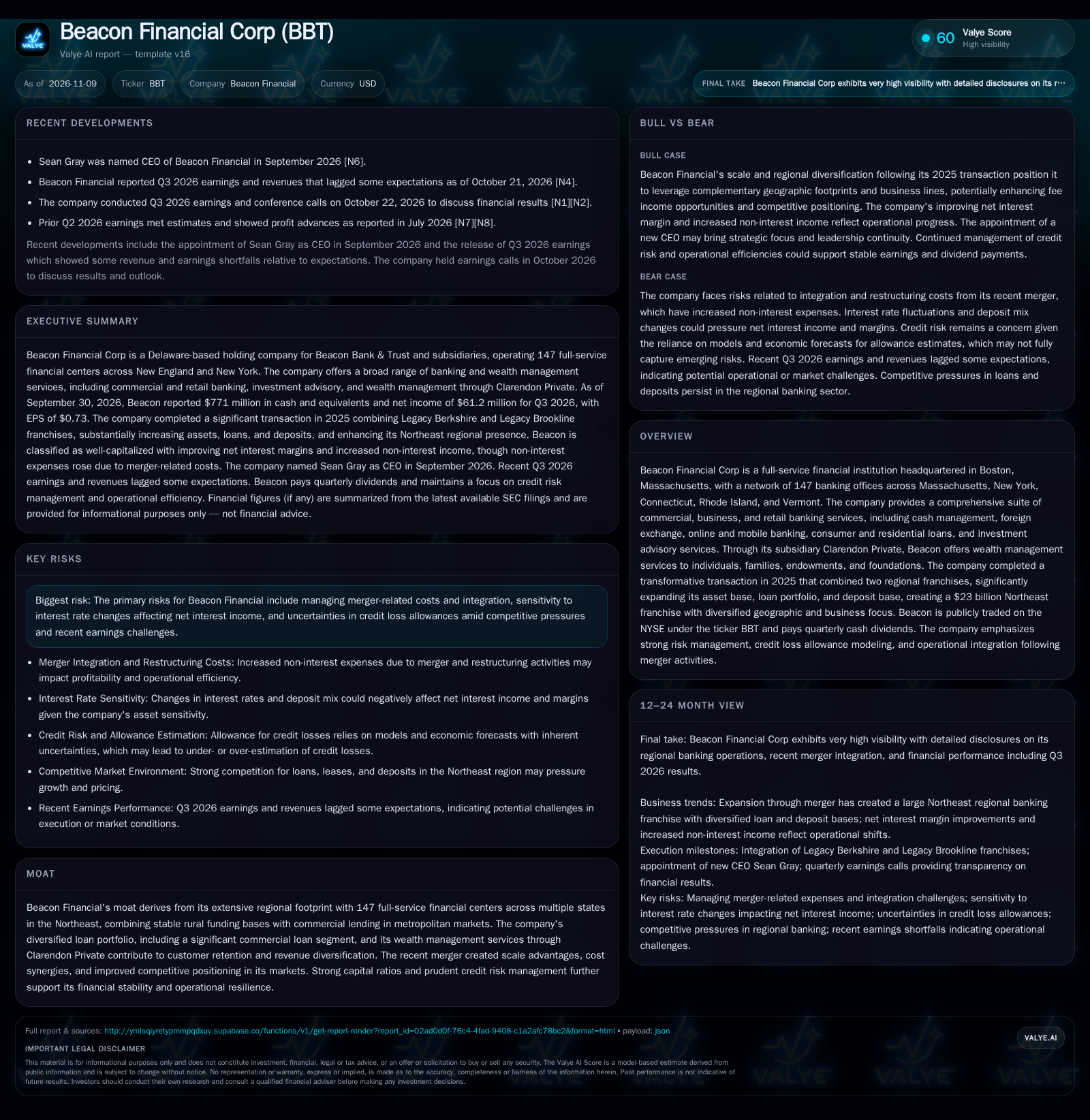
Beacon Financial’s most material recent developments include the completion of a transformative 2025 merger combining two regional banking franchises, the appointment of Sean Gray as CEO in September 2026, and the release of Q3 2026 results that fell short of earnings and revenue expectations. As of September 30, 2026, the company reported $771 million in cash and equivalents and Q3 net income of $61.2 million (EPS $0.73) [S2] [N4] [N6]. Non-interest expenses remained elevated due to ongoing integration and restructuring efforts.
These facts matter because they underscore the company's transitional stage: Beacon’s enlarged scale and diversified platform offer potential for improved margins and fee income, but the lagging financial performance and cost pressures signal continued friction in realizing merger synergies. The leadership transition further introduces both risk and opportunity as the new CEO shapes post-merger strategy.
How Scale, Costs, and Rate Sensitivity Shape Beacon’s Earnings Power
Beacon’s business economics now hinge on its ability to translate regional scale into operating leverage and sustainable earnings. The merger created a $23 billion asset base with a broad product suite spanning commercial lending, retail banking, and wealth management. In theory, this platform should enable Beacon to capture cost synergies (through branch overlap reduction, shared technology, and centralized operations) and revenue synergies (via cross-selling and expanded customer relationships).
However, the Q3 2026 results highlight the near-term drag from integration and restructuring expenses, which have pushed non-interest costs higher [S2] [N4]. In banking, scale can drive margin expansion if fixed costs are spread over a larger base, but this benefit is delayed when integration costs run high. The company also faces margin volatility due to its asset sensitivity: changes in interest rates and deposit mix can rapidly impact net interest income. While Beacon has reported some net interest margin improvement, further gains will depend on managing funding costs and loan yields in a changing rate environment.
Non-interest income—driven by wealth management (Clarendon Private), fee-based services, and investment advisory—could offset some margin pressure, but the durability of these lines depends on customer retention and competitive dynamics. Capital needs are moderate for a well-capitalized regional bank, but ongoing technology investments and regulatory compliance remain recurring fixed costs.
Scale, Diversification, and the Limits of Regional Moat
Beacon’s competitive position is anchored in its extensive network (147 branches across five states), diversified business lines, and a blend of rural and metropolitan market exposure [S2]. This footprint allows the company to tap both stable deposit bases and higher-yielding commercial lending opportunities. The addition of wealth management through Clarendon Private broadens customer relationships and offers some insulation from pure lending margin compression.
However, the Northeast regional banking sector remains highly competitive, with national banks, credit unions, digital entrants, and other super-regionals all vying for loans and deposits. The merger has improved Beacon’s competitive positioning, but integration risks and legacy system complexity could erode any scale-based cost advantages if not managed tightly. Customer switching costs in banking are moderate, especially in commoditized products, though relationship-based services (like wealth management) can provide stickier revenue.
Substitution risk is rising from fintechs and digital-first banks, which may erode fee income and pressure pricing on both sides of the balance sheet. For Beacon, maintaining a differentiated value proposition—whether through personalized service, integrated advisory, or digital innovation—will be essential to defend share and margins.
If Integration Delivers: Cost Synergies and Margin Expansion
The most constructive scenario for Beacon Financial involves a successful and timely integration of its merged franchises, yielding both cost and revenue synergies. If Beacon can reduce overlapping branch and back-office expenses faster than anticipated, non-interest costs could decline meaningfully, boosting operating leverage and net income. At the same time, if the company leverages its expanded customer base to cross-sell wealth management and fee-based services, non-interest income could rise as a share of total revenue.
Further upside could come from a stable or favorable interest rate environment, allowing Beacon to widen its net interest margin without excessive deposit repricing. Improved credit quality—if realized—would reduce provision expenses and support bottom-line growth.
Confirmation of this scenario would come from sequential improvements in the efficiency ratio (non-interest expense as a percentage of revenue), positive trends in non-interest income, and sustained NIM expansion. Management commentary on realized cost synergies and successful technology integration would further validate the upside case.
Integration Drags, but Core Banking Remains Stable
The most plausible outcome is that Beacon continues to experience elevated non-interest expenses as integration and restructuring efforts persist into 2027, with only gradual realization of cost synergies. Net interest margins may see incremental improvement, but deposit mix changes and competitive pricing could offset gains. Non-interest income is likely to grow modestly, supported by wealth management, but may not be enough to fully counteract expense pressures.
Credit quality should remain manageable, assuming no sharp economic downturn, but allowance estimates will remain a source of uncertainty.
This scenario would be confirmed by continued, but modest, improvement in the efficiency ratio, stable-to-slightly-rising NIM, and non-interest income holding steady as a percentage of total revenue. Persistent but narrowing gaps between reported results and consensus expectations would also fit this trajectory.
If Integration Falters and Margin Pressures Intensify
A more adverse scenario would see merger integration costs persist longer than planned, with operational disruptions or customer attrition undermining both cost and revenue synergies. If Beacon struggles to consolidate back-office systems or align cultures, non-interest expenses could remain stubbornly high, delaying margin recovery.
Simultaneously, if interest rates decline or deposit competition intensifies, Beacon’s net interest margin could compress, squeezing core earnings. Credit costs could rise if economic conditions deteriorate or if loan loss models underestimate emerging risks—particularly problematic if the allowance for credit losses proves insufficient.
Evidence for this scenario would include further misses on earnings or revenue expectations, persistent deterioration in the efficiency ratio, NIM contraction, and rising credit provisions. Negative revisions to management guidance or analyst downgrades citing integration and margin headwinds would corroborate the downside case.
Milestones That Will Test Beacon’s Post-Merger Thesis
Quarterly trends in the efficiency ratio: sustained improvement would indicate successful cost management and integration progress; persistent elevation would signal continued friction.
Sequential changes in net interest margin (NIM): rising NIM would support the case for margin expansion, while contraction could indicate funding cost pressures or competitive loan pricing.
Non-interest income as a share of total revenue: growth would suggest effective cross-selling and revenue diversification post-merger.
Disclosure of realized cost and revenue synergies: management commentary on integration milestones, if provided, would help assess execution risk.
Trends in allowance for credit losses and credit quality metrics: rising provisions or non-performing assets could signal emerging credit risk or model inadequacy.
Deposit mix and growth rates: shifts toward higher-cost or less-stable funding could pressure margins and test franchise strength.
Branch consolidation progress and customer retention data, if disclosed: these would clarify whether scale and integration are translating into actual operational leverage.
Disclaimer: This is research-only, informational analysis and not investment advice. It may include AI-generated interpretation and general industry context. Always verify important details using primary sources.

Comments