
ONE Group Hospitality: Persistent Losses and the Complexities of Restaurant Scale Economics
Despite robust Q3 revenues, ONE Group Hospitality faces mounting net losses and acute short-term liquidity pressure, raising questions about the sustainability of its multi-concept restaurant strategy and its ability to withstand industry and geopolitical shocks.
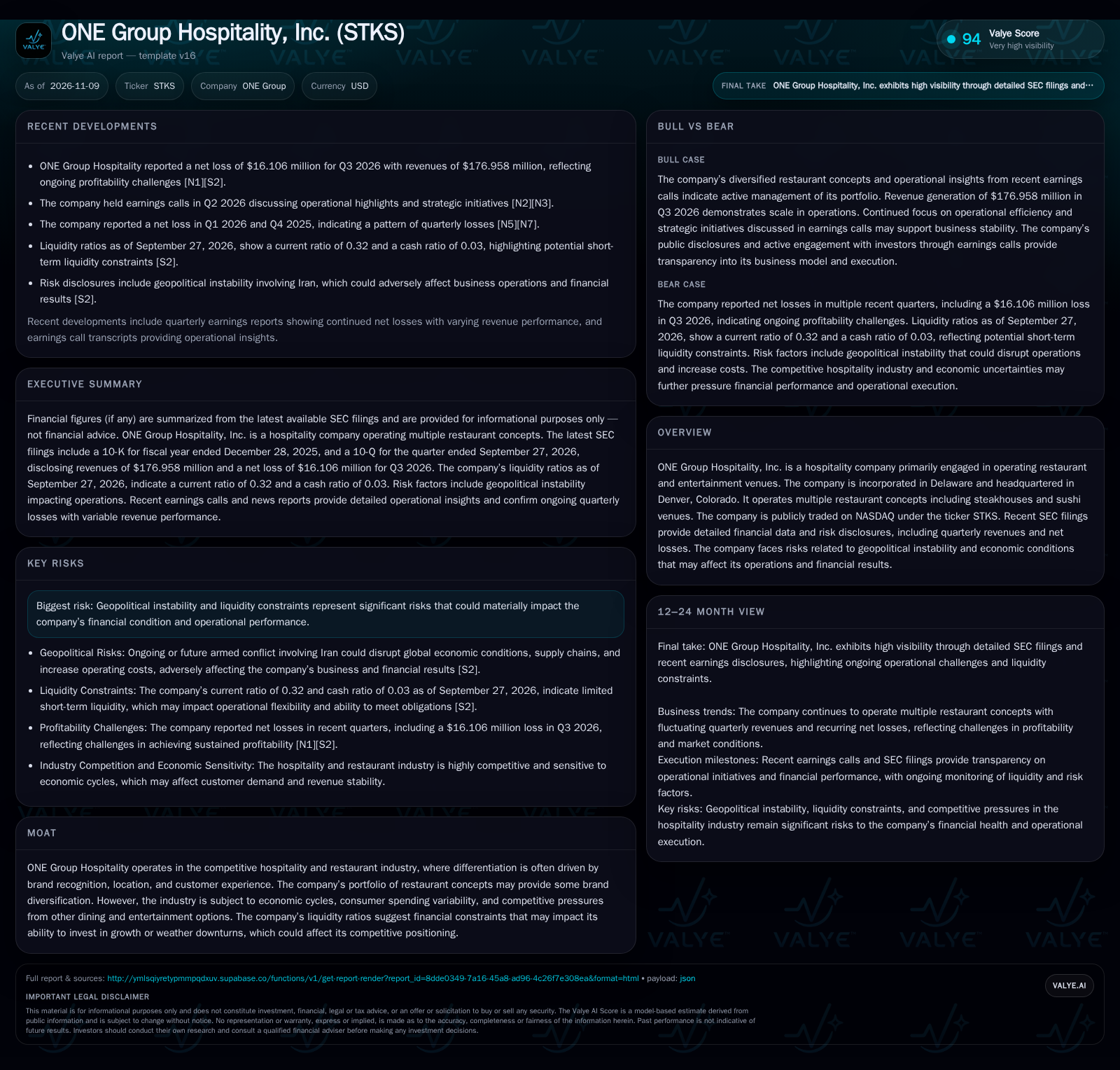
ONE Group Hospitality reported $176.96M in Q3 2026 revenue but posted a $16.1M net loss and ended the quarter with a current ratio of just 0.32. The company’s ability to generate positive cash flow, manage competitive pressures, and navigate macro/geopolitical risks will determine whether it can stabilize or faces further financial distress over the coming year. [S2] [N1]
ONE Group Hospitality, Inc. stands at a crossroads: while its $176.96 million in Q3 revenue reflects ongoing consumer demand for its restaurant and entertainment venues, the company’s persistent net losses and acute liquidity shortfall raise existential questions. The next several quarters will test whether scale and operational initiatives can overcome mounting financial pressures or whether deeper restructuring—or even distress—becomes unavoidable. [S2] [N1]
Mounting Losses and Tightening Liquidity Heighten Operational Strains
ONE Group Hospitality reported $176.958 million in revenue for Q3 2026, but this topline strength was overshadowed by a net loss of $16.106 million for the same period—marking at least the third consecutive quarter of negative earnings. The company’s basic and diluted earnings per share for Q3 stood at -$0.79. As of September 27, 2026, cash and cash equivalents were just $3.574 million, with total current assets of $42.681 million against current liabilities of $133.051 million, resulting in a current ratio of 0.32 and a cash ratio of 0.03. [S2] [N1]
Navigating Fixed Costs and Cash Flow in a Multi-Concept Restaurant Model
ONE Group’s business model hinges on operating a portfolio of restaurant and entertainment venues, including steakhouse and sushi concepts. Restaurant economics are typically characterized by high fixed costs—rent, labor, and utilities—paired with relatively low margins, making scale and high occupancy critical for profitability. While $176.96 million in quarterly revenue suggests a sizable operation, the recurring net losses indicate that fixed and variable costs are not being offset by current sales volumes or pricing. In the absence of meaningful operating leverage, incremental revenue may not convert to profits if food, labor, and occupancy expenses remain elevated or if discounting is required to maintain traffic.
If the company cannot quickly convert revenue growth into positive cash flow, it may face the need for asset sales, outside capital, or restructuring to remain solvent.
The multi-concept approach inherently introduces complexity in cost management and operational focus, as each brand may have distinct supply chain needs, labor skill requirements, and marketing strategies. This fragmentation can dilute bargaining power with suppliers and increase overhead related to management layers and systems integration. Additionally, the need to maintain consistent quality and brand standards across diverse venues can necessitate higher training and compliance costs. Unless the company achieves significant scale economies or operational synergies, these factors may exacerbate margin pressures rather than alleviate them.
Moreover, the restaurant industry's sensitivity to external shocks—such as fluctuations in commodity prices, wage inflation, and regulatory changes—can disproportionately affect companies with thin margins and high fixed costs. In such an environment, the timing and effectiveness of cost control measures become critical. For example, labor scheduling optimization can only partially offset wage inflation if minimum wage laws or labor market tightness push baseline costs higher. Similarly, renegotiating leases may provide temporary relief but cannot fully insulate from rising real estate costs in desirable locations. The ability to dynamically adjust menu pricing without eroding customer traffic is thus a key determinant of sustainable profitability.
Brand Differentiation and Competitive Pressures Shape Market Position
The hospitality and restaurant sector is notoriously competitive, with barriers to entry that are relatively low for new concepts and significant pressure from established chains, local independents, and new-format delivery/takeout models. ONE Group’s strategy of operating multiple branded concepts offers some portfolio diversification but does not guarantee defensibility in a market where consumer preferences can shift rapidly and brand loyalty is hard-won.
The company’s ability to generate repeat business depends on customer experience, perceived value, and the uniqueness of its offerings—areas where larger chains may benefit from national marketing scale and smaller independents from local authenticity. With liquidity constraints, ONE Group may struggle to invest in brand-building or technology upgrades (such as digital ordering or loyalty programs) that could drive retention or higher average check sizes. Additionally, ongoing economic uncertainty and geopolitical risks could drive consumers to substitute away from premium dining toward lower-cost or at-home options, intensifying margin pressure.
Margin Improvement and Operational Efficiency as Catalysts for Recovery
A plausible bullish scenario would see ONE Group successfully executing operational initiatives that drive higher same-store sales, optimize labor scheduling, and renegotiate supplier or lease terms—allowing for margin recovery even in a challenging macro environment. If the company can stabilize cash outflows, perhaps by streamlining underperforming venues or leveraging data-driven menu engineering, incremental revenues could begin to fall to the bottom line due to high fixed-cost leverage.
Confirmation of this scenario would include a return to positive operating cash flow, narrowing net losses, and evidence of sustained same-store sales growth outpacing industry averages. Announcements of successful refinancing, new capital infusions, or asset-light expansion (such as franchising) would further support a turnaround thesis. Conversely, persistent negative cash flow, continued venue closures without commensurate margin improvement, or the need for dilutive capital raises would falsify this upside path.
Cost Pressures, Competitive Dynamics, and Economic Uncertainty Challenge Stability
The most plausible near-term trajectory for ONE Group is a period of operational triage, with management focused on cash conservation, cost containment, and selective investment in higher-performing venues. Revenue may remain steady or grow modestly if consumer demand holds, but ongoing competitive and macroeconomic pressures—including possible supply chain disruptions from geopolitical instability—could prevent material margin expansion.
Evidence for this scenario would be continued volatility in quarterly earnings, with net losses gradually narrowing (but not eliminated) as cost controls take effect.
Potential Liquidity Shortfalls or Economic Shocks Could Trigger Restructuring
A sharp drop in consumer spending, a major supply chain disruption (potentially linked to geopolitical events), or a spike in input costs could quickly overwhelm available cash reserves.
Confirmation of this negative scenario would include missed debt or lease payments, abrupt venue shutdowns, or disclosures of going-concern doubts in future filings. Emergency capital raises on highly dilutive terms or the announcement of a formal restructuring process would be further evidence that the company’s financial position has become untenable.
Critical Developments Influencing ONE Group’s Financial and Operational Trajectory
Quarterly cash flow from operations—if disclosed—would provide a direct measure of whether the company is burning or generating cash.
Net change in the current ratio or cash ratio over the next two quarters would help assess whether liquidity is stabilizing or deteriorating.
Same-store sales growth for core concepts, compared to industry benchmarks, would indicate the effectiveness of operational and marketing initiatives.
Announcement of any refinancing, new credit facilities, or equity raises would signal management’s ability (or necessity) to secure outside capital.
Disclosure of venue closures, asset sales, or other restructuring actions would be a sign of cash conservation measures or distress.
Gross margin and labor cost trends—if broken out—would show whether cost control efforts are having a material impact.
Any management commentary on supply chain disruptions or inflationary pressures stemming from geopolitical events would provide early warning of potential external shocks.
Evidence of new partnerships, franchising, or asset-light growth strategies would show efforts to shift the business model and reduce capital intensity.
Disclaimer: This is research-only, informational analysis and not investment advice. It may include AI-generated interpretation and general industry context. Always verify important details using primary sources.

Comments