
VIVIC CORP.: Electric Yacht Ambitions Confront Financial Strain and Market Realities
VIVIC CORP. is seeking to carve out a niche in the electric and energy-efficient yacht segment through partnerships, government contracts, and digital platforms. However, persistent net losses, acute liquidity pressures, and reliance on external manufacturing and financing raise existential questions about the company’s ability to scale and compete in a capital-intensive, brand-driven market.
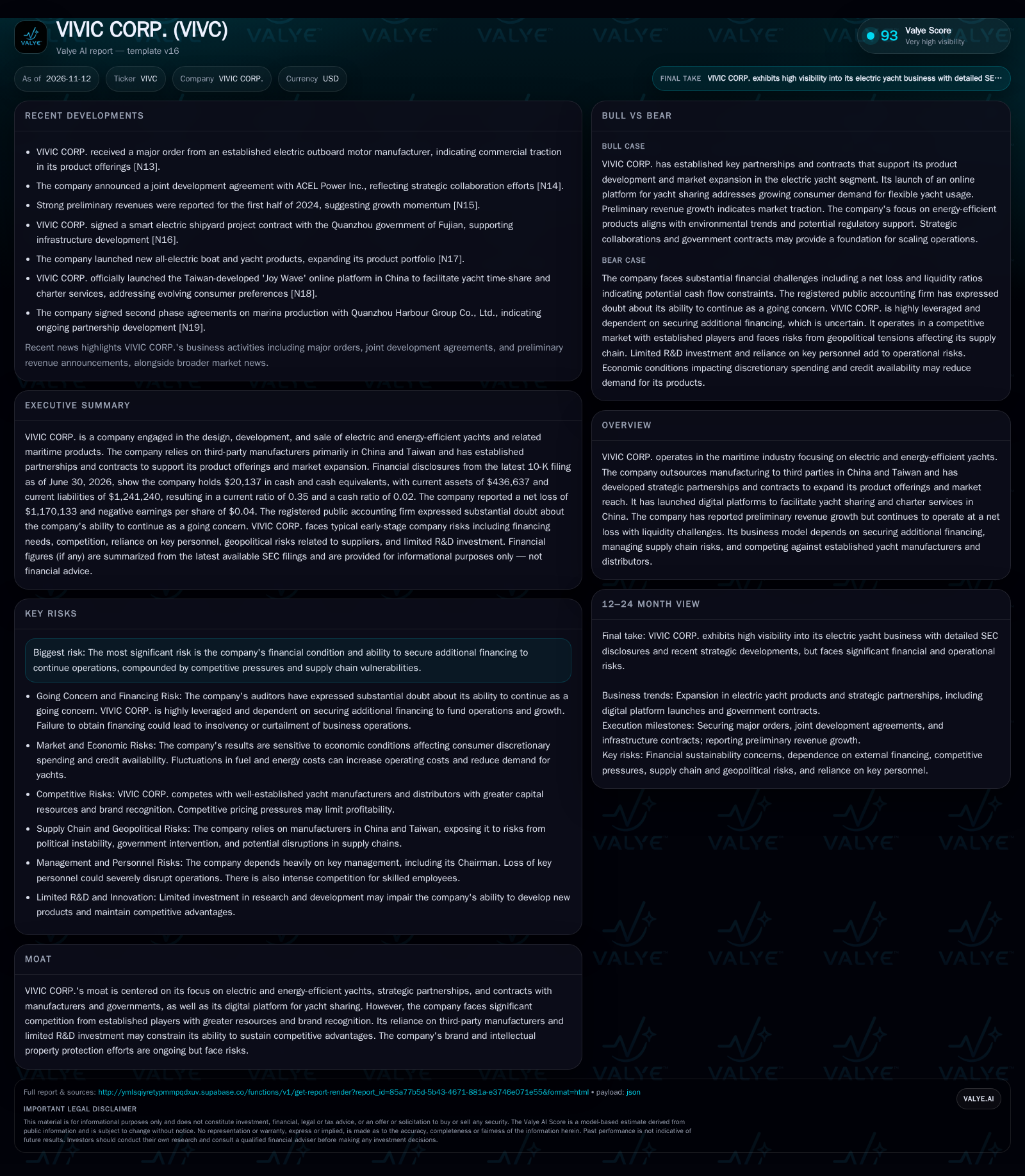
VIVIC CORP. is pursuing growth in electric yachts via strategic partnerships and digital initiatives, bolstered by recent preliminary revenue momentum and contract wins. Yet, the company’s reported cash balance, high leverage, and going-concern warning underscore the urgent need for fresh capital and operational execution. The interplay between potential market opportunity and acute financial constraints defines the near-term thesis. [S1]
VIVIC CORP. stands at a crossroads as it attempts to scale an electric and energy-efficient yacht business through a blend of outsourced production, collaborative partnerships, and digital platforms. While recent contract wins and revenue growth suggest budding demand, the company’s financial disclosures reveal a precarious position: acute liquidity shortfalls, high leverage, and a formal warning about its ability to continue as a going concern. The next twelve months will test whether VIVIC’s commercial momentum can overcome deep structural and operational vulnerabilities, or whether the weight of financial and supply chain risks will capsize its ambitions.
Recent Orders and Liquidity Constraints Shape Immediate Prospects
VIVIC CORP. has reported strong preliminary revenues for the first half of 2024, alongside securing a major order from an established electric outboard motor manufacturer and signing further agreements with Quanzhou Harbour Group Co., Ltd. for marina production projects. These developments indicate some traction in both product adoption and partnership expansion. However, as of June 30, 2026, the company’s cash and cash equivalents stood at just $20,137, with a current ratio of 0.35 and a net loss of $1,170,133 for the fiscal year. Auditors have expressed substantial doubt about VIVIC’s ability to continue as a going concern, and the company is highly dependent on additional financing to sustain operations. This stark contrast between commercial activity and financial fragility is the pivot around which the company’s near-term future revolves. [S1]
How VIVIC’s Model Could Generate Value—and Where It May Break Down
VIVIC’s business model centers on the sale of electric and energy-efficient yachts, with manufacturing outsourced to third parties in China and Taiwan. This asset-light approach can theoretically reduce capital intensity and fixed overhead, enabling the company to scale production in response to demand. However, it also introduces variable cost risk, limited control over quality, and vulnerability to supply chain disruptions—especially given geopolitical tensions and potential tariff or regulatory changes.
Revenue generation likely depends on a mix of direct yacht sales, joint development agreements, and possibly recurring or platform-based income from digital yacht sharing and charter services. Without disclosed details on pricing, margins, or contract structures, it is unclear if early revenue growth is translating into positive unit economics. The company’s limited R&D spend raises concerns about its long-term ability to innovate or command premium pricing. Operating leverage could be positive if volume scales, but with persistent net losses and reported cash balance, VIVIC may face a negative feedback loop: insufficient working capital restricts growth, while fixed costs and financing requirements erode margins.
The need for additional capital is acute. If VIVIC cannot raise funds on favorable terms, it may be forced to curtail R&D, delay deliveries, or forfeit strategic contracts, further weakening its competitive position and brand credibility.
Brand, Scale, and R&D Gaps Define the Competitive Chessboard
VIVIC competes in a market dominated by established yacht manufacturers and distributors with deep pockets, recognized brands, and entrenched dealer networks. These incumbents benefit from scale economies, global supply chains, and reputational advantages that can translate into lower per-unit costs, superior after-sales support, and greater customer trust. VIVIC’s strategy of focusing on electric and energy-efficient models is aligned with broader environmental and regulatory trends, but competitors are also moving aggressively into this segment.
The company’s reliance on third-party manufacturing magnifies its exposure to supply chain risks, especially given current geopolitical uncertainties in China and Taiwan. Low R&D investment further limits the company’s ability to differentiate technologically or respond quickly to market shifts. VIVIC’s digital sharing and charter platforms could offer a niche advantage if network effects take hold, but success hinges on critical mass and seamless integration with physical assets—a tall order in a cash-constrained environment.
Switching costs for customers are generally low in the yacht market, as buyers are often swayed by brand prestige, after-sales service, and perceived reliability. Unless VIVIC can build brand equity and demonstrate product quality at scale, it may struggle to command loyalty or premium pricing.
Commercial Traction and Capital Infusion Unlock Scalable Growth
In a favorable scenario, VIVIC leverages its recent major order and partnership agreements to demonstrate sustained revenue growth and operational execution. Successful delivery on marina projects and smart electric shipyard contracts with local governments could enhance brand awareness and validate its value proposition in the electric yacht segment. If the company secures additional financing—whether through equity, strategic investment, or government support—it could fund working capital, accelerate production, and modestly increase R&D to expand its product portfolio.
Confirmation of this scenario would come from: multiple quarters of sequential revenue growth; evidence of improved gross margins; new or expanded government contracts; and disclosure of a successful funding round that strengthens the balance sheet. Falsification would be indicated by stalled order flow, contract cancellations, or continued inability to raise capital on acceptable terms.
Financial Strain Limits Execution Despite Market Opportunity
The most plausible near-term outcome is that VIVIC continues to win occasional contracts and generates lumpy revenue, but ongoing net losses and reported liquidity position severely constrain its ability to scale. The company may be forced to prioritize short-term cash flow over strategic investment, resulting in deferred R&D, delayed deliveries, and missed growth opportunities. Competitive pressures from established brands, coupled with supply chain disruptions or cost inflation, could further erode margins and customer confidence.
In this scenario, VIVIC remains operational but struggles to gain meaningful market share or establish a durable competitive advantage. Evidence supporting this outcome would include continued reliance on bridge financing, persistent negative operating cash flow, and limited product or geographic expansion. Falsification would require a material improvement in liquidity, margin profile, or a breakthrough strategic partnership that unlocks scale.
Liquidity Crunch and Execution Missteps Trigger Business Retrenchment or Failure
The most adverse pathway is one where VIVIC’s acute cash shortfall leads to missed payrolls, supplier defaults, or contract breaches, further undermining customer and partner trust. Inability to secure fresh capital could force asset sales, layoffs, or a rapid wind-down of operations. Supply chain disruptions or loss of key management—especially Chairman Shang-Chiai Kung—could accelerate this downward spiral.
Confirmation of this scenario would include disclosures of default, bankruptcy filings, asset divestitures at distressed prices, or abrupt management departures. Early warning signs would be shrinking order books, negative working capital trends, and deteriorating supplier or customer relationships.
What Will Determine Whether VIVIC’s Electric Yacht Play Sinks or Sails?
Quarterly revenue growth and order backlog trends, if disclosed, to assess commercial traction and sustainability.
Gross margin evolution, particularly whether scale or product mix improvements translate into better unit economics.
Updates on new or renewed government contracts, especially for smart electric shipyard or marina projects.
Disclosure of successful capital raises—equity, debt, or strategic investment—that materially improve liquidity.
R&D spending levels and new product launches, to test whether the company is investing in innovation or retrenching.
Customer concentration and repeat order rates, if disclosed, to gauge brand acceptance and recurring demand.
Supply chain stability indicators, including updates on relationships with manufacturers in China and Taiwan.
Retention and continuity of key management, particularly Chairman Shang-Chiai Kung, given the company’s dependence on leadership.
Disclaimer: This is research-only, informational analysis and not investment advice. It may include AI-generated interpretation and general industry context. Always verify important details using primary sources.

Comments