
Cohen & Co Inc.: Navigating Volatility with a New CEO and Shifting Revenue Dynamics
Cohen & Co Inc. enters a pivotal phase following a CEO transition and a Q3 2026 swing to profitability, yet faces mixed earnings performance and persistent financial volatility. The firm's diversified capital markets and asset management model offers both opportunity and exposure, making future execution and market adaptation central to its investment case.
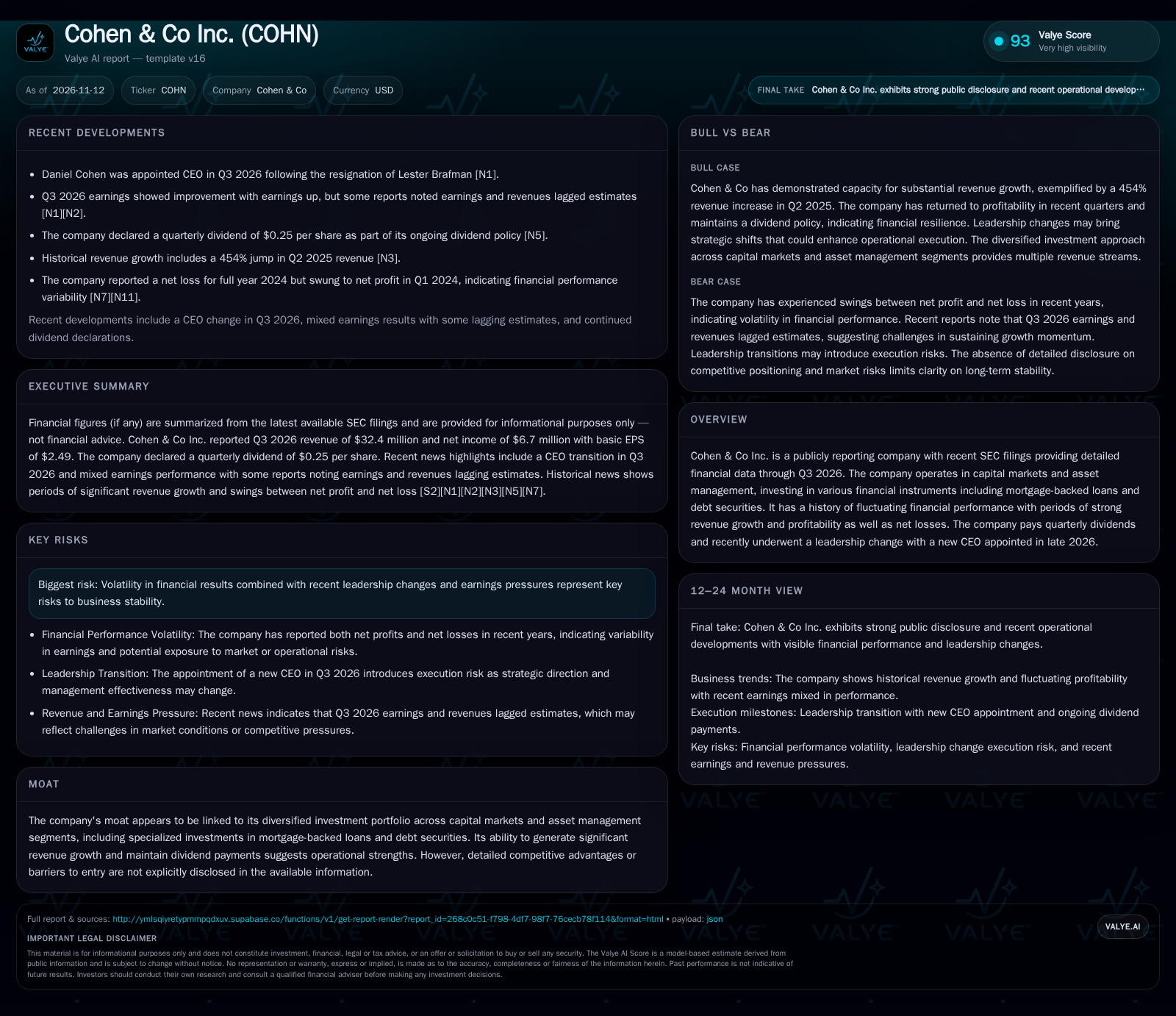
Cohen & Co Inc. reported Q3 2026 revenue of $32.4 million and net income of $6.7 million, reversing past net losses but missing some analyst estimates. The appointment of Daniel Cohen as CEO after Lester Brafman's resignation signals potential strategic shifts. Despite historical surges—such as a 454% revenue jump in Q2 2025—the company’s earnings history is volatile, reflecting both the upside of its investment model and its exposure to market swings. Execution under new leadership and the ability to stabilize results will be decisive going forward. [S2] [N1] [N2] [N3]
Cohen & Co Inc. stands at a crossroads after a period marked by both exceptional revenue surges and unsettling profit swings. With the recent appointment of Daniel Cohen as CEO, the company is signaling a possible new strategic direction just as its Q3 2026 results reveal both a profitable quarter and persistent challenges in meeting earnings expectations. Operating in the highly cyclical and competitive world of capital markets and asset management, Cohen & Co’s future will be shaped by its ability to manage risk, maintain operational discipline, and adapt to evolving market conditions under new leadership.
Recent Leadership Change and Earnings Volatility Define the Present
Cohen & Co reported Q3 2026 revenue of $32.4 million and net income of $6.7 million, translating to basic EPS of $2.49 and diluted EPS of $0.12. While these figures mark a return to profitability, reports indicate that both earnings and revenues missed some analyst expectations, suggesting that the business is not yet on stable footing. Concurrently, Daniel Cohen was appointed CEO after Lester Brafman’s resignation in Q3 2026, introducing a new leadership dynamic at a critical juncture. The company’s recent history also includes a dramatic 454% revenue surge in Q2 2025, but this growth was not sustained, as evidenced by a net loss for the full year 2024. These recent developments underscore both the potential upside and the enduring volatility in Cohen & Co’s business model. [S2] [N1] [N2] [N3] [N7]
How Diversified Investment Exposures Drive Earnings—and Volatility
Cohen & Co generates revenue across capital markets and asset management, with investments spanning mortgage-backed loans, debt securities, and related financial instruments. Revenue streams likely include management fees, performance-based incentives, trading income, and returns from proprietary investments. This diversified approach can create multiple income avenues but also increases exposure to financial market cycles, interest rate shifts, and credit risk.
The business may exhibit operating leverage, as a portion of costs—such as personnel and technology infrastructure—are relatively fixed, while revenue can swing sharply depending on market activity and investment performance. The company reported cash and liquidity metrics for the period; these figures do not by themselves establish operating runway, investment capacity, financial flexibility, or financing capacity. [S2]
Absent detailed segment disclosures, it is plausible that the firm’s earnings mix between recurring fees and more volatile investment/trading income is a key determinant of its financial stability. Greater reliance on performance or transaction-driven revenues would naturally increase earnings volatility.
Competitive Pressures in Capital Markets and Asset Management
Cohen & Co operates in highly competitive sectors where scale, reputation, and risk management capabilities are central to sustained performance. Major competitors include diversified asset managers, boutique investment firms, and specialty finance companies. These peers often compete aggressively on fees, investment performance, and product innovation.
Potential advantages for Cohen & Co may include its experience with niche financial instruments such as mortgage-backed securities and its ability to source or structure complex deals. However, the cyclical nature of its investments, combined with less transparent differentiation compared to larger asset managers, may limit its pricing power or ability to command premium fees.
Switching costs for clients in asset management are generally low unless the firm manages specialized products or maintains unique client relationships. The absence of explicit evidence about multi-year contracts, recurring revenue, or proprietary platforms suggests that Cohen & Co’s retention and revenue visibility may be more sensitive to market conditions than to structural competitive advantages.
Strategic Realignment Spurs Sustainable Growth and Higher Margins
If Daniel Cohen’s appointment as CEO leads to a renewed strategic focus—such as tightening risk controls, enhancing fee-based revenue, or expanding into more stable asset management products—Cohen & Co could reduce earnings volatility and achieve more consistent profitability. The historical capacity for rapid revenue growth, as seen in Q2 2025, demonstrates the firm’s ability to seize market opportunities when conditions align.
Evidence supporting this scenario would include a rising share of management fees versus trading or performance income, improved earnings consistency across quarters, and public disclosure of new client mandates or strategic partnerships.
Confirmation would also come from positive market feedback on leadership changes and explicit guidance from management on growth and risk-mitigation strategies in upcoming disclosures.
Cohen & Co Maintains Profitability—but Earnings Remain Cyclical
The most plausible path is that Cohen & Co continues to experience swings in quarterly performance, with profitability dependent on market cycles and investment results. While operational improvements under new leadership may gradually reduce volatility, the business will likely remain exposed to macroeconomic trends, interest rate movements, and capital markets sentiment.
Revenue will probably continue to oscillate between strong quarters—when investment strategies align with market conditions—and weaker periods amid market stress or muted deal flow. Confirmation of this scenario would come from continued variability in quarterly earnings and revenue, with occasional outperformance but no clear trajectory toward sustained margin expansion or recurring revenue dominance.
Conversely, evidence of a shift toward more stable fee-based income or improved retention of assets under management would challenge this base case.
Market Dislocation or Execution Missteps Trigger Renewed Losses
In a negative scenario, Cohen & Co’s earnings volatility increases—whether due to adverse market events, failed risk management, or disruptions from the CEO transition. A sharp downturn in capital markets, rising defaults in mortgage-backed portfolios, or loss of key clients could quickly erode revenue and push the company back into net losses, as occurred in 2024.
Execution risk is heightened during leadership transitions, particularly if strategic realignment is slow or misaligned with market realities. If the company fails to stabilize its income mix or control costs, persistent underperformance could trigger investor skepticism, limit access to growth capital, or force asset sales.
This scenario would be confirmed by renewed quarterly net losses, shrinking cash balances, negative operating cash flow, or the announcement of restructuring charges and client attrition.
Signals That Will Define Cohen & Co’s Next Chapter
Quarterly breakdown between fee-based (recurring) revenue and investment/trading income, if disclosed, would clarify the stability of the firm’s earnings mix.
Sustained positive net income across consecutive quarters, especially in volatile market conditions, would signal improved operational resilience.
Public guidance or commentary from Daniel Cohen regarding strategic priorities, product focus, or risk management initiatives will be critical for assessing leadership impact.
Material client wins, new mandates, or expansion into new asset classes would indicate growth in core business lines.
Trends in assets under management (AUM), if disclosed, would provide insight into client retention and the potential for scale-driven margin improvement.
Evidence of cost discipline, such as reduced expense ratios or improved operating margins, would support a case for greater earnings stability.
Any significant changes to the balance sheet—such as large capital raises, asset sales, or shifts in liquidity—would alter risk and growth capacity.
Disclosure of multi-year contracts or recurring revenue arrangements, if they emerge, would help test for the development of more durable competitive advantages.
Disclaimer: This is research-only, informational analysis and not investment advice. It may include AI-generated interpretation and general industry context. Always verify important details using primary sources.

Comments