
Groove Botanicals: Can a Strategic Pivot Unlock Value in Early-Stage Tech Commercialization?
Groove Botanicals Inc. stands at a strategic crossroads, seeking to break into North American tech commercialization with a focus on Norwegian university IP. Yet, with no products, IP, or meaningful liquidity, the company’s future hinges on its ability to secure and develop high-potential assets before resources run out.
Groove Botanicals Inc. Its business model targets licensing early-stage Norwegian research, but execution is unproven amid intense competition and minimal resources. The company’s next moves—securing capital and landing its first licensing deal—will determine whether it can build a viable tech commercialization platform or remain in perpetual startup limbo. [S1] [S2]
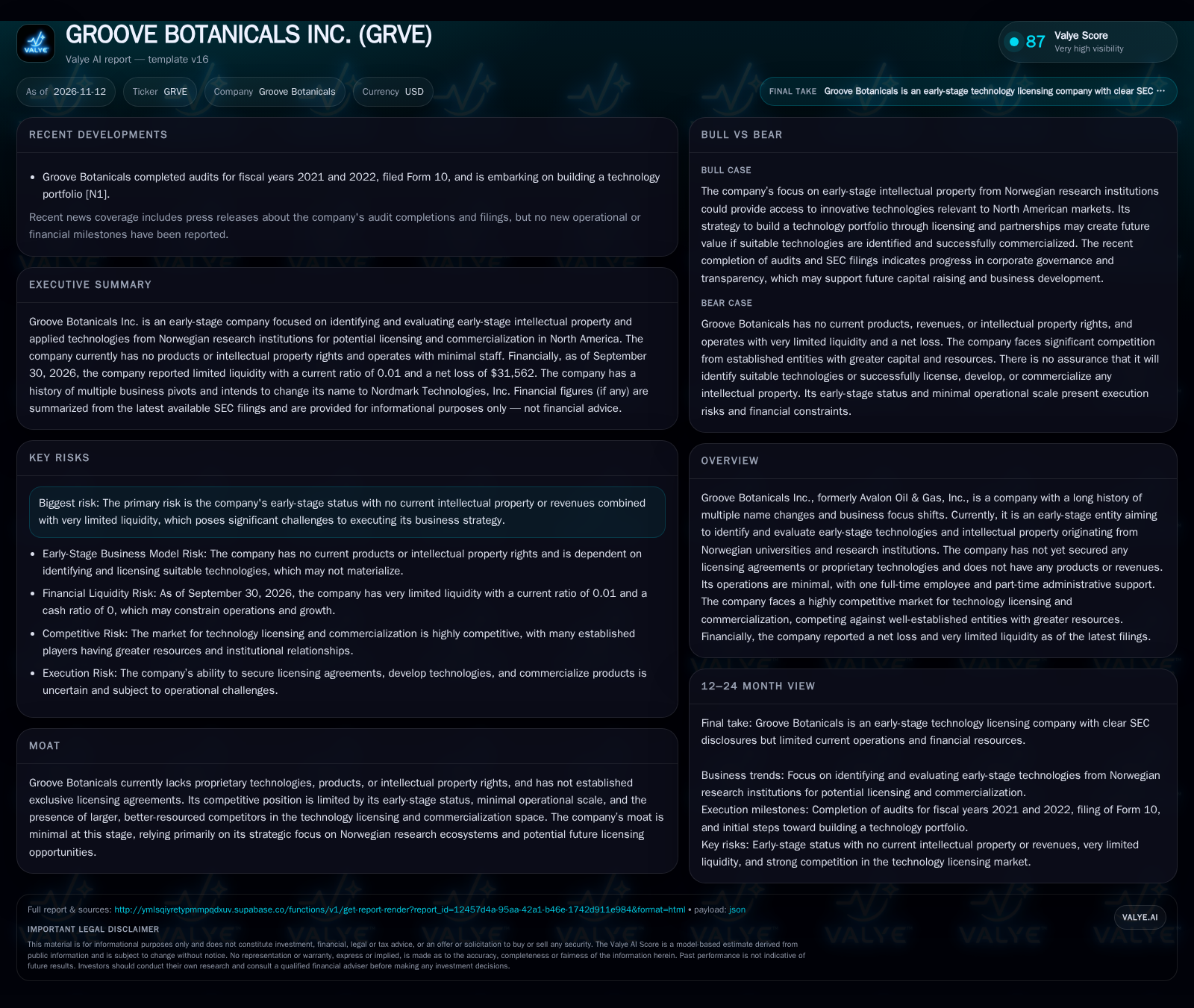
Groove Botanicals Inc. embodies the archetype of a speculative early-stage technology commercialization vehicle: minimal staff, no products or IP, and a business model built on the hope of securing promising intellectual property from Norwegian research institutions. With a history of business pivots and a planned rebrand to Nordmark Technologies, the company’s ambitions outpace its current operational and financial reality. [S1] [S2]
Liquidity Crunch and Strategic Reset Define the Current State
Groove Botanicals enters late 2026 with no products, technologies, or intellectual property rights, and no licensing agreements or formal relationships with Norwegian research institutions. The company’s operations remain skeletal, with one full-time employee and a part-time administrative assistant. The company reported cash and liquidity metrics for the period; these figures do not by themselves establish operating runway, investment capacity, financial flexibility, or financing capacity. [S1] [S2]
This context makes the planned rebranding to Nordmark Technologies more than cosmetic—it signals a desire to reset market perceptions and align the company’s identity with its stated focus on Scandinavian research commercialization. However, until Groove can secure either a pipeline of licensable assets or fresh capital, its ambitions remain largely theoretical.
Economic Realities of Early-Stage Tech Licensing Without a Pipeline
The core business model Groove Botanicals aspires to is classic technology transfer: identify promising early-stage intellectual property from Norwegian research institutions, acquire or license these assets, and develop or out-license them for commercial application in North America. In theory, such a model offers attractive upside if the right assets are secured and value is added through development, regulatory navigation, or industry partnerships.
However, the economics of this strategy are highly binary and capital-intensive: upfront costs (licensing fees, due diligence, legal, and initial development) can be significant, long before any revenue materializes. Groove has incurred zero R&D costs in 2025 and 2026, highlighting its pre-deal status. This leaves the company exposed to a catch-22—without capital, it cannot acquire assets; without assets, it cannot attract capital or generate revenue. The company’s stated capital needs range from $500,000 to $5 million, depending on growth trajectory, underscoring the scale of funding required to become operational. [S1]
Operating leverage could theoretically emerge if Groove builds a portfolio of IP that can be monetized through licensing or productization. But until the first deal is executed, all fixed and variable cost assumptions remain hypothetical and the risk of negative operating leverage is acute.
Facing Entrenched Rivals in a Crowded Tech Commercialization Ecosystem
Groove Botanicals operates—or aspires to operate—in a fiercely competitive landscape dominated by established technology transfer offices, university-affiliated commercialization arms, venture capital funds, and specialist IP aggregators. These entities benefit from deep institutional relationships, robust deal flow, and superior financial resources.
The company currently lacks any proprietary technology, exclusive rights, or material relationship with Norwegian research institutions, placing it at a disadvantage not only in deal sourcing but also in negotiations and downstream commercialization. Larger competitors can often offer better terms to inventors and universities, and have the capital to shepherd technologies through lengthy development and market validation cycles.
Without a unique sourcing mechanism, privileged institutional access, or demonstrable success in prior commercialization, Groove’s current competitive position is tenuous. Its only potential differentiator—an explicit Nordic focus and a willingness to license very early-stage assets—remains untested in practice.
Breakthrough via First-Mover Deal and Strategic Capital Infusion
The most favorable scenario for Groove Botanicals would see the company secure its first licensing agreement with a Norwegian research institution, ideally for a technology with clear North American commercial potential and a plausible development path. This would serve as a proof point for its model, attracting investor interest and triggering a capital infusion within its stated funding range.
With new capital, Groove could begin to build a portfolio, hire technical and business development talent, and initiate the early development work required to de-risk and package assets for further licensing or commercialization. If the company can demonstrate success in sourcing and advancing a first asset—such as through a signed licensing agreement, disclosed development milestones, or partnership announcements—this would validate its thesis and potentially allow for follow-on deals.
Confirmation of this scenario would come from SEC filings or press releases detailing an executed licensing agreement, successful fundraising, and progress on asset development. Conversely, the absence of such milestones within the next 12 months would cast doubt on the company’s ability to break out of its pre-operational state.
Operational Stasis Persists Until Capital or Asset Pipeline Materializes
Absent a rapid breakthrough, the most plausible outcome is that Groove Botanicals remains in a state of operational stasis: minimal staff, no assets, and a continued search for both capital and deal flow. The company may pursue small-scale fundraising from insiders or existing investors to cover overhead, but without a pipeline of licensable technologies, it will struggle to attract meaningful external capital or strategic partners.
This scenario would be confirmed by continued minimal operating expenses, repeated net losses, and no new disclosures of licensing agreements, asset acquisitions, or partnership deals in future filings. If Groove manages to secure even a small or non-exclusive licensing deal, it could signal incremental progress, but the risk remains that the company is unable to achieve the scale or asset quality needed to be competitive.
Liquidity Exhaustion and Risk of Dissolution Without Tangible Progress
If Groove Botanicals is unable to secure new funding or sign its first licensing agreement in the near term, the company faces a real risk of functional insolvency. With less than $2,000 in cash against over $1.6 million in liabilities, continued operating losses could lead to creditor pressure, delisting, or voluntary dissolution if no rescue financing is arranged. [S2]
A scenario in which the company fails to demonstrate any asset acquisition, partnership, or funding progress would likely result in staff reductions (from an already minimal headcount), loss of any remaining investor interest, and the potential for the company to revert to shell status or pursue another business pivot. Evidence for this scenario would include continued negative net income, lack of new filings or corporate actions, and possible going-concern warnings in future SEC documents.
Milestones That Will Determine Groove Botanicals’ Strategic Viability
Execution of the first licensing agreement with a Norwegian university or research institution—if disclosed—would be a critical signal of business model validation.
Any capital raise, whether through equity, debt, or strategic partnership, that increases cash resources to a level sufficient to cover at least twelve months of projected operating expenses.
Disclosure of a pipeline of evaluated or targeted technologies, including specifics on field, stage, or potential addressable market.
Hiring of technical, legal, or business development staff beyond the President and part-time support, indicating operational ramp-up.
Evidence of a formal relationship or memorandum of understanding with a major Norwegian technology-transfer office or innovation agency.
Material changes in current liabilities or the settlement of outstanding obligations, given the acute liquidity constraints.
If disclosed, updates on any R&D spending or asset development costs, which would indicate progress beyond the evaluation stage.
Announcements of strategic partnerships with North American commercial entities interested in co-developing or out-licensing Norwegian-origin technologies.
Disclaimer: This is research-only, informational analysis and not investment advice. It may include AI-generated interpretation and general industry context. Always verify important details using primary sources.

Comments