
Newton Golf: Proprietary Tech, Pro Endorsements, and the Capital Stakes in U.S. Golf Equipment
Newton Golf has achieved rapid revenue growth by leveraging proprietary shaft technologies and U.S.-based manufacturing, but ongoing losses, capital needs, and Nasdaq compliance challenges frame the stakes for its next phase. The company’s ability to scale distribution, maintain innovation, and secure financial stability will determine whether its recent momentum translates into lasting industry relevance.
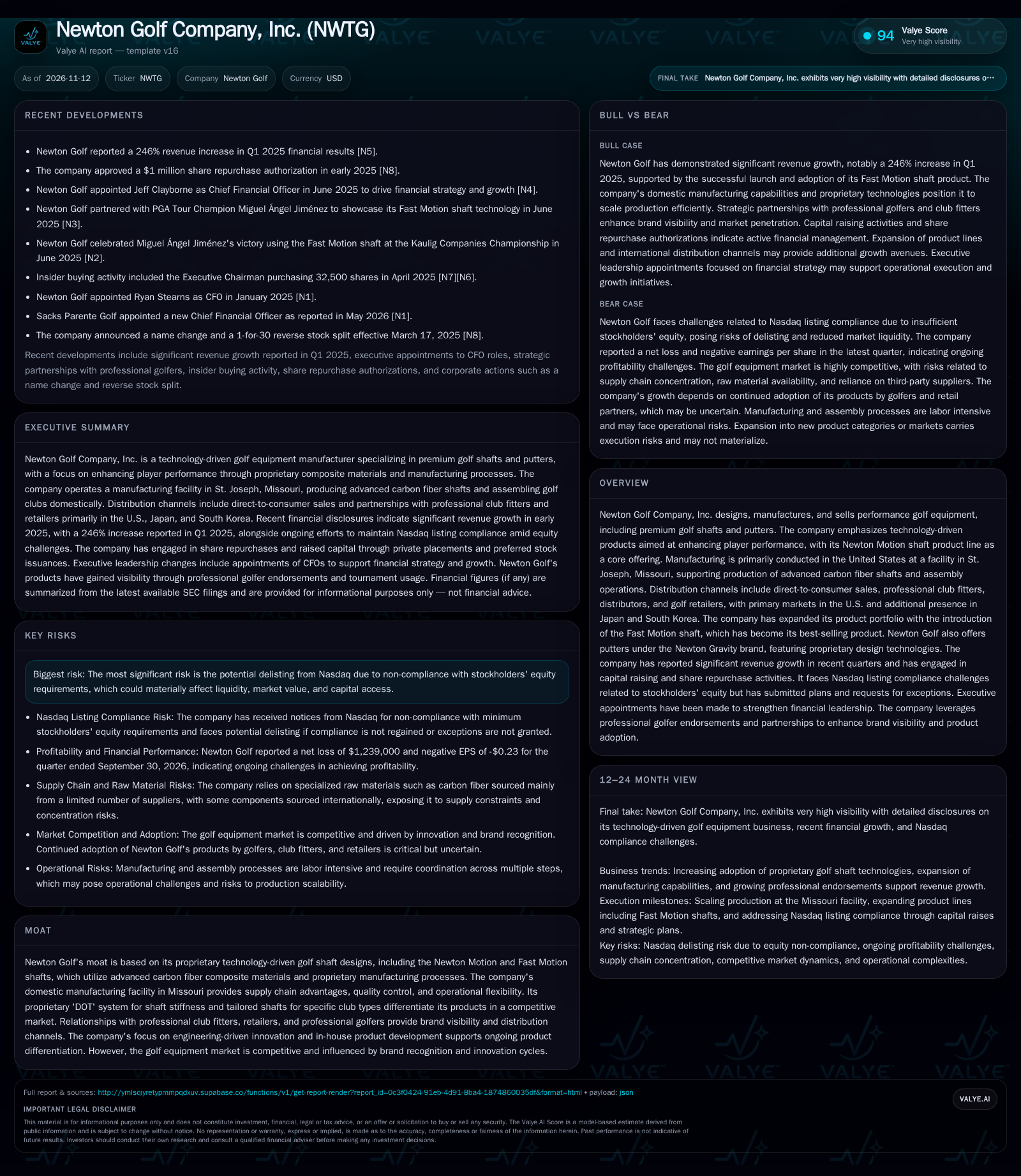
Newton Golf’s 246% Q1 2025 revenue surge was propelled by its technology-driven Fast Motion shaft and high-profile professional endorsements, but the company remains unprofitable and faces Nasdaq delisting risk due to equity shortfalls. Recent capital raises have extended its runway, yet the core challenge is converting product traction and brand visibility into sustainable, profitable growth in a competitive golf equipment market. [N5] [S2]
Newton Golf Company, Inc. is attempting to carve out a durable niche in the fiercely competitive golf equipment market by anchoring its brand on proprietary shaft technologies, domestic manufacturing, and high-profile professional endorsements. The company’s Fast Motion shaft has quickly become a commercial highlight, helping drive a dramatic 246% revenue increase in early 2025. Yet, beneath this growth lies persistent operating losses, supply chain concentration, and the looming threat of Nasdaq delisting due to stockholders’ equity deficits. Newton Golf’s near-term trajectory depends on its ability to convert technical and marketing wins into scalable, profitable operations while navigating a capital-intensive environment and tightening listing standards.
Recent Revenue Surge, Persistent Losses, and Capital Raises Shape the Strategic Landscape
Newton Golf delivered a headline 246% revenue increase in Q1 2025, catalyzed by the launch and market acceptance of its Fast Motion shaft, which leverages advanced carbon fiber and proprietary construction methods. Despite this commercial momentum, the company reported a net loss of $1,239,000 and a basic/diluted EPS of -$0.23 for Q3 2026, with a current ratio of 0.84 and a cash ratio of 0.2 as of September 30, 2026. To address liquidity and Nasdaq equity compliance concerns, Newton Golf raised approximately $3.1 million in additional capital via ATM sales, private placements, and preferred stock issuance after the quarter closed. The company’s ongoing Nasdaq listing is contingent on regaining equity compliance or securing exceptions. [N5] [S2]
How Newton Golf’s Technology-Driven Model Could Unlock Operating Leverage
Newton Golf’s business model centers on designing, manufacturing, and selling premium golf shafts and putters, with a focus on proprietary technologies that target performance-conscious golfers. The company’s Missouri facility enables domestic production, which may help control quality, reduce lead times, and mitigate some supply chain risks compared to overseas manufacturing. However, this approach also entails higher fixed costs and capital intensity than pure-play importers or design/licensing competitors.
Product economics are driven by a mix of direct-to-consumer sales (potentially higher margin but marketing-intensive), professional club fitter/retailer channels (offering scale and credibility but often requiring channel discounts), and international distribution (with incremental logistics and localization costs). The Fast Motion shaft’s success suggests pricing power for differentiated, technology-forward products, but the company faces ongoing costs for R&D, endorsements, and manufacturing scale-up.
Operating leverage could emerge if the company achieves sustained volume growth without proportionate increases in fixed costs, especially as shaft production lines are further utilized. However, Newton Golf’s recent net losses point to either insufficient gross margins, high SG&A relative to scale, or both. The company’s ability to improve unit economics—via higher ASPs, broader channel penetration, or manufacturing efficiencies—will be key to longer-term profitability.
Proprietary Materials and Pro Endorsements as Differentiators—But Competitive Pressures Persist
Newton Golf’s proprietary manufacturing processes, including its ‘DOT’ system for shaft stiffness and use of high-modulus carbon fiber, create differentiation in a market where performance claims are often incremental. The company’s ability to tailor shafts for specific club types and its use of professional endorsements—such as the partnership with Miguel Ángel Jiménez and visibility from PGA TOUR Champions—provide brand credibility and potential pull-through among advanced amateurs and club fitters.
However, the golf equipment sector remains dominated by entrenched players with larger R&D budgets, global distribution, and established relationships with top professionals and retailers. Newton Golf faces ongoing threats from both traditional OEMs and emerging direct-to-consumer brands leveraging digital sales and influencer marketing. Switching costs for consumers are modest, as golf shafts and putters are replaceable and performance differences, while real, are often perceived as marginal by the broader market.
Supply chain concentration—particularly in advanced carbon fiber and prepreg materials—adds another layer of risk, as does the absence of long-term supply agreements for key inputs. While proprietary tech and U.S.-based manufacturing offer a moat against pure commoditization, sustained differentiation will require ongoing innovation and marketing investment.
Scaling Distribution and Brand Credibility Could Drive a Step-Change in Profitable Growth
In a favorable scenario, Newton Golf’s Fast Motion shaft and Gravity putters continue to gain traction among high-visibility professionals and elite amateurs, leading to increased adoption by club fitters and premium retailers. This pull-through effect may enable the company to expand its U.S. and Asia-Pacific distribution footprint, leveraging endorsements and on-course victories to drive consumer demand.
If Newton Golf translates product buzz into higher-margin direct-to-consumer sales and deeper retail penetration, operating leverage could materialize as production volumes rise and fixed costs are spread over a larger revenue base. Additional product launches using proprietary materials or design platforms could further expand the addressable market and reinforce brand positioning.
Evidence confirming this scenario would include: sustained double-digit revenue growth, margin expansion, new high-profile retail or club fitting partnerships, repeat professional victories with Newton equipment, and demonstrable improvements in gross profit and operating cash flow.
Momentum Meets Margin Pressure: Can Product Traction Offset Competitive and Capital Hurdles?
The most plausible outcome is that Newton Golf sustains moderate growth in its core shaft products, supported by ongoing professional endorsements and incremental gains in U.S. and select international markets. However, competitive intensity and channel discounts may pressure gross margins, while recurring R&D and marketing costs keep the company near break-even or at modest operating losses.
The company’s ability to negotiate better material terms, optimize manufacturing throughput, and selectively expand its retail network will likely determine whether it can achieve consistent profitability.
Confirmation would come from stable or gradually improving revenue, modest margin gains, manageable quarterly losses, and continued Nasdaq listing—without material dilution or disruptive financing events. Falsification would be indicated by slowing revenue growth, persistent or widening losses, or a forced delisting event.
Delisting, Capital Shortfalls, or Supply Chain Disruptions Could Impair Business Viability
A more adverse scenario would see Newton Golf unable to regain Nasdaq compliance, resulting in delisting and diminished access to public capital. Such an outcome could erode liquidity, reduce brand credibility with partners and customers, and force the company into cost-cutting or asset sales. If capital raises become dilutive or fail to close, operational funding for manufacturing and R&D could be constrained.
Supply chain shocks—such as price spikes or shortages in carbon fiber or prepreg materials—could further squeeze gross margins or disrupt production, especially given supplier concentration and the lack of long-term contracts. A failure to secure new endorsements or maintain product momentum might result in inventory build-up, channel resistance, and loss of mindshare to larger, better-funded competitors.
Downside validation would include: delisting announcements, unsuccessful or highly dilutive financings, significant revenue declines, gross margin compression, or material production interruptions.
Factors That Will Determine Whether Newton Golf Converts Momentum into Sustainable Growth
Quarterly revenue growth and product mix trends, with particular attention to the contribution of Fast Motion shafts versus legacy products.
Gross margin percentage and its movement over time, as an indicator of pricing power, input cost management, and channel mix.
Operating cash flow and net income trajectory, revealing whether scale is translating into improved profitability or merely higher losses.
Progress on regaining and maintaining Nasdaq listing compliance, including updates on stockholders’ equity and any new capital raises.
Expansion or deepening of relationships with professional club fitters, retailers, and high-profile endorsers, as evidenced by new distribution agreements or endorsements.
Updates on supply chain stability—especially sourcing of carbon fiber and prepreg materials—and any new or extended supplier agreements.
The pace and commercial impact of new product launches, especially those leveraging proprietary materials or design platforms.
Material changes in SG&A or R&D spending that affect the company’s ability to balance growth investment with cost discipline.
Disclaimer: This is research-only, informational analysis and not investment advice. It may include AI-generated interpretation and general industry context. Always verify important details using primary sources.

Comments