
South Dakota Soybean Processors: Capacity Expansion, Regional Leverage, and the Stakes of Margin Volatility
With the Mitchell facility nearly doubling its processing volume, South Dakota Soybean Processors enters a new phase of scale—but faces persistent margin cyclicality, industry consolidation, and exposure to commodity and regulatory swings.
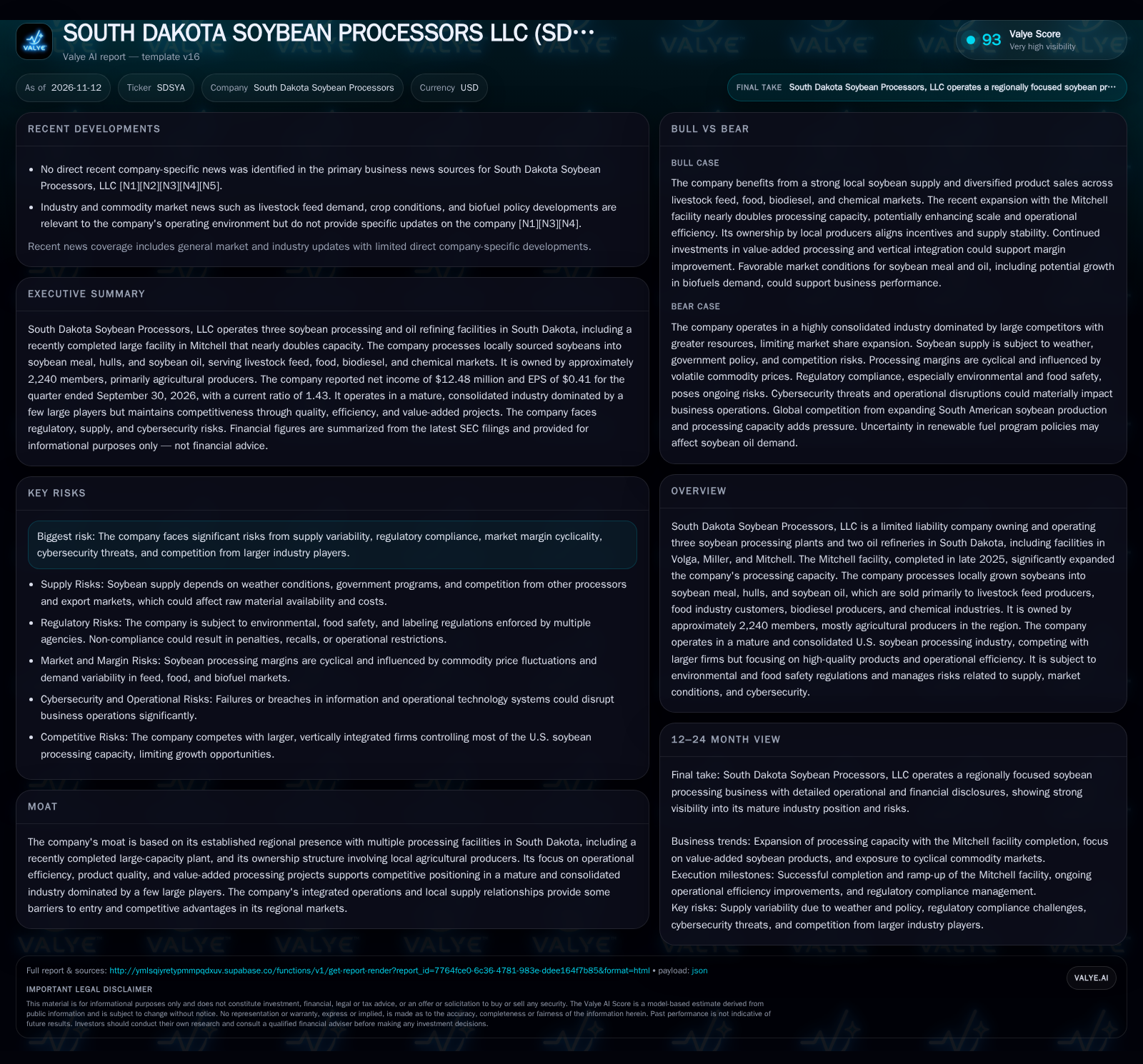
South Dakota Soybean Processors (SDSYA) has completed its large Mitchell facility, nearly doubling annual processing capacity to 35 million bushels. This expansion leverages strong local supply relationships and diversified product sales across meal, hulls, and oil. However, the company remains a regional player in a mature, consolidated industry dominated by larger competitors, with margin and supply risks still acute. The next phase hinges on how efficiently SDSYA can absorb new capacity, maintain operational discipline, and defend margins amid commodity and regulatory volatility. [S1] [S2]
South Dakota Soybean Processors’ recent commissioning of its Mitchell facility marks a pivotal scale-up, nearly doubling its annual processing potential and shifting the company into a new operational bracket. While this expansion draws on the company’s deep local supply relationships and diversified product mix, it also sharpens exposure to the cyclical swings of the commodities market and the competitive realities of a consolidated, mature industry. The company’s ability to capture scale benefits, defend margins, and navigate regulatory and supply risks will determine whether the Mitchell investment delivers durable value or simply amplifies existing volatility.
Mitchell Facility Drives Step-Change in Capacity and Output
The most significant recent development for South Dakota Soybean Processors is the completion and ramp-up of its Mitchell facility, which became operational in October 2025. This plant alone can process 35 million bushels of soybeans annually, nearly doubling the company’s total capacity and driving a sharp increase in throughput—40.8 million bushels processed in 2025 versus 33.3 million in 2024 [S1]. The expansion was completed on time and within budget, suggesting disciplined project execution. As of September 30, 2026, the company reported net income of $12.48 million and EPS of $0.41, with a current ratio of 1.43 and cash and equivalents of $28.6 million [S2]. The company reported cash and liquidity metrics for the period; these figures do not by themselves establish operating runway, investment capacity, financial flexibility, or financing capacity.
Volume Leverage, Margin Sensitivity, and the Structure of Soybean Processing Economics
South Dakota Soybean Processors’ revenue model is driven by the 'crush margin'—the difference between the cost of soybeans and the combined value of meal, oil, and byproducts. The addition of the Mitchell facility significantly increases fixed costs but also creates the opportunity for greater operating leverage if capacity utilization remains high and margins are favorable. However, the business remains fundamentally exposed to commodity-driven cyclicality: soybean input prices, meal and oil demand, and byproduct values can all swing sharply based on global supply/demand, weather, and policy.
The company’s diversified product sales—livestock feed (meal and hulls), food and biodiesel ingredients (oil), and chemical intermediates—help buffer some volatility, but end markets are themselves cyclical and sensitive to macro conditions. Export sales comprise around 15% of meal/hull volume and 10% of oil, exposing the company to global pricing and trade risk [S1]. While the member-owner model helps secure local soybean supply and may reduce procurement costs, it does not immunize the business from weather, policy, or competitive disruptions.
Capital requirements remain high: processing plants and refineries are capital-intensive, and meaningful maintenance and periodic upgrades are required to preserve efficiency and regulatory compliance. [S2] High fixed costs from the new facility mean that margin compression or underutilization could quickly erode profitability.
Competing at Regional Scale in a Consolidated National Market
SDSYA operates in a U.S. soybean processing landscape where four large, vertically integrated companies control 85% of national capacity [S1]. This consolidation creates significant barriers to national market share growth and limits pricing power for smaller players. SDSYA’s 2.7% share of U.S. capacity reflects its status as a substantial regional operator but a minor national player.
The company’s strengths lie in its established presence in South Dakota, strong relationships with local growers (reinforced by its member-owner structure), and a multi-facility footprint that enables some scale efficiencies. However, these advantages are inherently local. Larger competitors can often negotiate better commodity procurement and sales contracts, deploy more sophisticated risk management, and absorb shocks more easily.
Substitution risk is indirect but real: alternative protein sources, changing livestock feed trends, and global shifts in oilseed demand could all pressure volumes or pricing. Additionally, South American processors continue to expand capacity, influencing global trade flows and pricing dynamics, which could compress margins for U.S. regional processors.
If Scale and Value-Added Processing Translate to Margin Expansion
A favorable scenario would see the Mitchell facility quickly ramp to high utilization, allowing SDSYA to spread fixed costs and capture greater operating leverage. If commodity markets are supportive—particularly if demand for soybean oil in biofuels remains strong and meal prices hold up—incremental volumes could translate to higher net income and improved margins.
Further upside could be unlocked if the company successfully executes value-added processing initiatives, such as refining specialty oils or expanding into higher-margin feed ingredients. Strong operational discipline and continued regulatory compliance would preserve the company’s license to operate and avoid costly disruptions.
Evidence confirming this scenario would include sustained high capacity utilization rates at all facilities, improving gross margins despite industry cyclicality, and successful launch or expansion of value-added product lines. A positive trend in export volumes or new long-term offtake agreements could also bolster visibility and earnings stability.
Absorbing New Capacity in a Cyclical, Margin-Pressured Environment
The most plausible outcome is that SDSYA benefits from higher volumes and some efficiency gains as the Mitchell facility comes fully online, but remains exposed to the underlying margin volatility of the soybean processing sector. Crush margins are likely to fluctuate with global commodity cycles, and while the company may see periodic earnings strength, it will also experience periods of compression.
Operationally, the company is expected to maintain steady throughput, leveraging its local supply relationships and multi-plant footprint. However, its limited national scale and bargaining power will constrain its ability to defend margins in adverse cycles. Regulatory compliance, supply chain stability, and cost control will remain ongoing management challenges.
Evidence for this scenario would be stable or gradually improving volumes, with margins and cash flow tracking historical volatility rather than showing structural expansion. Financial results would likely remain highly sensitive to commodity price swings and weather-related supply disruptions.
When Margin Compression and Disruption Override Scale Gains
A negative scenario emerges if crush margins deteriorate due to falling meal/oil prices or rising soybean input costs, and the company cannot offset this with higher volumes or efficiency gains. Underutilization of the new Mitchell facility could increase per-unit costs and erode profitability, especially given the higher fixed cost base.
Regulatory or operational disruptions—such as environmental compliance failures, food safety incidents, or cybersecurity breaches—could trigger costly shutdowns, fines, or reputational damage. Supply shocks from poor harvests, policy changes, or increased competition from global producers could further squeeze margins and working capital.
Confirmation of this scenario would include declining capacity utilization, sustained margin compression, negative operating cash flow, or unexpected costs related to regulatory or operational issues.
What Will Reveal the True Impact of SDSYA’s Expansion and Margin Management
Capacity utilization rates at the Mitchell and legacy facilities—if disclosed—will be critical to gauge whether new capacity is being efficiently absorbed.
Quarterly and annual trends in crush margins (soybean meal/oil byproduct value minus input costs) would help test whether scale delivers margin improvement or simply amplifies volatility.
Volume growth in value-added or specialty product lines (e.g., refined oils, specialty feed ingredients), if disclosed, could indicate success in moving up the value chain.
Export sales share and pricing trends, particularly in meal and oil, would show whether SDSYA can capture growth outside its regional base.
Regulatory compliance incidents or costs—any spikes in environmental or food safety expenses—would be a warning sign for operational risk.
Evidence of new long-term offtake agreements or customer contracts would improve revenue visibility and reduce exposure to spot-market swings.
Any material cybersecurity or operational disruptions reported would test the company’s ability to manage modern industrial risks.
Disclaimer: This is research-only, informational analysis and not investment advice. It may include AI-generated interpretation and general industry context. Always verify important details using primary sources.

Comments