
XBiotech: Clinical Milestones, Leadership Evolution, and the Economic Stakes of Antibody Innovation
Recent clinical progress in oncology and autoimmune disease trials, combined with a fortified leadership team and robust cash reserves, positions XBiotech at a critical inflection point. The company’s future will be determined by the translation of scientific advances into regulatory approvals and, ultimately, commercial viability.
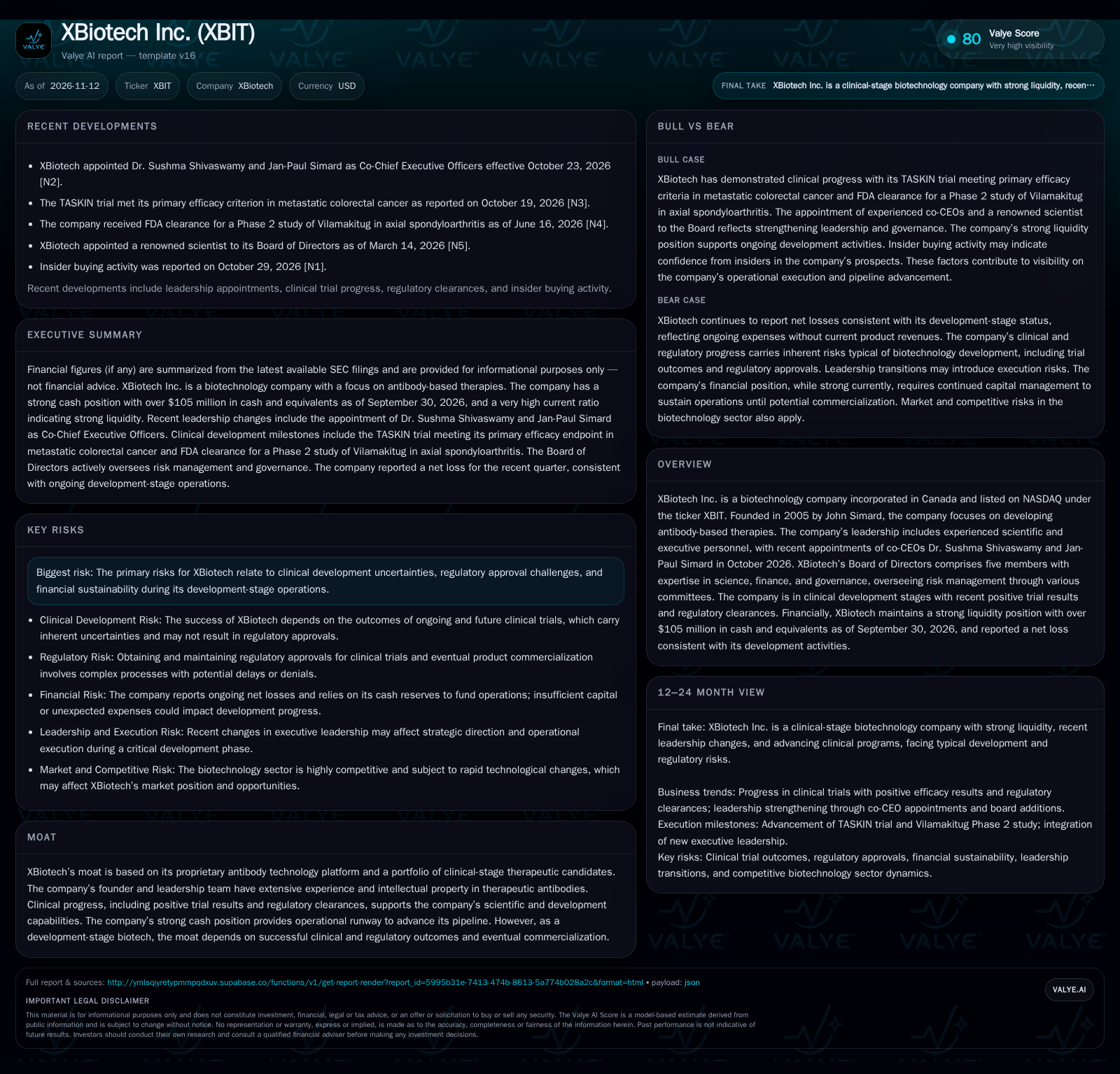
XBiotech has crossed key clinical and regulatory milestones in 2026, including efficacy in metastatic colorectal cancer and FDA clearance for its Vilamakitug candidate. Leadership has been refreshed with co-CEOs and a new scientific board member.
XBiotech’s latest clinical and regulatory milestones—positive efficacy in metastatic colorectal cancer and FDA clearance for a new immunology trial—underscore the company’s scientific momentum at a time of leadership transition. Backed by a substantial cash reserve, XBiotech now faces the quintessential biotech dilemma: can it convert promising clinical data into sustainable commercial value? The answer will depend on execution across scientific, regulatory, and business development fronts, all while managing the risks inherent to drug development and a competitive therapeutic landscape.
Clinical Achievements and Executive Realignment Define 2026
In 2026, XBiotech achieved several milestones that materially shift its development narrative. The company’s TASKIN trial met its primary efficacy criterion in metastatic colorectal cancer, which represents a major clinical validation for its antibody-based approach and could serve as a springboard for broader oncology ambitions if subsequent trial phases reinforce these results [N3]. Additionally, the FDA granted clearance for a Phase 2 study of Vilamakitug in axial spondyloarthritis, signaling regulatory confidence in XBiotech’s pipeline diversification into autoimmune disease [N4].
Simultaneously, the company underwent significant leadership changes. Dr. Sushma Shivaswamy and Jan-Paul Simard were appointed co-CEOs, with Dr. Shivaswamy also retaining the Chief Scientific Officer role [N2]. This dual leadership model, accompanied by new scientific expertise on the Board, may alter strategic direction or accelerate decision-making during a pivotal period.
The company reported cash and liquidity metrics for the period; these figures do not by themselves establish operating runway, investment capacity, financial flexibility, or financing capacity. [S2] However, the company remains in a net loss position, reporting a $4.46 million loss for Q3 2026, which underscores the economic realities of pre-commercial biotech operations [S2].
Beyond the immediate milestones, the interplay between leadership realignment and clinical strategy execution is critical. A dual-CEO structure, especially when one leader also serves as Chief Scientific Officer, can streamline scientific prioritization but may also introduce challenges in balancing operational and research imperatives. The success of this model depends on clear role delineation and effective communication channels, particularly during a phase of rapid clinical advancement. Moreover, the integration of new scientific board members can influence the company’s risk appetite and innovation focus, potentially accelerating pipeline diversification or reinforcing core therapeutic areas based on evolving industry trends and competitive pressures.
How XBiotech’s Model Could Translate Science into Revenue
XBiotech’s core business model is built around developing proprietary antibody therapies for high-need indications, aiming to generate value through successful clinical development, regulatory approval, and eventual commercialization or partnering. In the absence of approved products, current revenue is effectively nil, and the company’s economics are dominated by R&D and G&A costs, leading to recurring net losses [S2].
If clinical trials progress favorably, XBiotech could monetize its pipeline via three main avenues: (1) direct commercialization (requiring investment in sales and manufacturing), (2) licensing deals with larger pharmaceutical partners (yielding milestone payments and royalties), or (3) outright asset sales. Each pathway has distinct capital requirements and time-to-cash implications. Direct commercialization offers higher long-term margin but demands substantial investment and carries significant launch risk; licensing or asset sales could provide earlier, less risky cash inflows but at the expense of total economic upside.
Biotech economics are characterized by high fixed R&D costs with limited variable costs until commercialization.
The capital intensity of antibody drug development necessitates careful cash flow management and strategic financing decisions. Should XBiotech opt for direct commercialization, it must weigh upfront investments in manufacturing scale-up, market access infrastructure, and sales force deployment against the timing of potential revenue streams. Conversely, licensing deals may reduce capital burden but require negotiation of terms that preserve sufficient economic upside and control rights. The choice among these pathways often hinges on the company’s assessment of its internal capabilities, the competitive landscape, and the willingness of partners to share development risk. Additionally, evolving reimbursement environments and payer dynamics will critically influence pricing power and market penetration, factors that must be incorporated into long-term financial modeling.
Antibody Platform Differentiation and Sector Headwinds
XBiotech operates in a fiercely competitive sector populated by large pharma, mid-cap biotechs, and emerging companies, many of whom are pursuing similar targets in oncology and autoimmune disease. Its competitive position rests on the uniqueness and efficacy of its antibody platform, intellectual property portfolio, and ability to generate differentiated clinical outcomes.
Should XBiotech’s therapies demonstrate superior safety or efficacy versus incumbent biologics (such as anti-TNF agents in autoimmune disease or established antibodies in colorectal cancer), it could carve out a defensible market niche. However, the sector is prone to fast-follow innovation, and larger competitors often have greater resources for late-stage trials, commercialization, and payer negotiations.
Switching costs in the therapeutic market are typically low for prescribers and payers unless a new therapy delivers clear clinical or economic benefits. Thus, the burden is on XBiotech to prove its candidates are meaningfully better or uniquely suited for subpopulations. Strategic partnerships or licensing deals may be essential to overcome scale disadvantages in commercialization.
In addition to clinical differentiation, the robustness of XBiotech’s intellectual property portfolio will shape its competitive moat. Strong patent protection and freedom-to-operate analyses can deter generic or biosimilar entrants and provide leverage in partnership negotiations. However, the rapid pace of innovation in antibody engineering—such as bispecifics or antibody-drug conjugates—may require continuous platform evolution to maintain relevance. Furthermore, regulatory pathways for biosimilars and emerging modalities could compress market exclusivity windows, underscoring the importance of speed to market and post-approval lifecycle management. Strategic alliances that enhance distribution networks or co-development capabilities may also be pivotal in overcoming scale disadvantages relative to larger incumbents.
From Clinical Validation to Commercial Breakthrough
The most compelling upside scenario for XBiotech involves its lead candidates achieving pivotal trial success and regulatory approval, followed by rapid adoption in targeted indications. If the TASKIN trial’s positive efficacy is confirmed in larger studies and leads to approval for metastatic colorectal cancer, XBiotech could either launch the product directly or secure a lucrative licensing deal with a major pharma partner. Similarly, successful Phase 2 results for Vilamakitug could open doors to further autoimmune indications or partnering opportunities.
This scenario would be confirmed by: (1) initiation or positive readouts from Phase 3 trials, (2) announcement of licensing or co-development deals with major pharmaceutical companies, (3) regulatory submissions or approvals, and (4) early revenue recognition from upfront or milestone payments. Additional evidence might include expansion of the clinical pipeline and further insider buying, reflecting management confidence.
Sustained Development Progress with Ongoing Capital Needs
The most plausible path for XBiotech over the next 12–24 months is continued advancement of its lead programs with a focus on generating robust clinical data and expanding its pipeline.
Milestones would include: (1) completion of ongoing trials, (2) presentation or publication of clinical results at major conferences, (3) regulatory feedback and potential advancement to later-stage studies, and (4) incremental pipeline progress. Confirmation of this scenario would come from regular R&D updates, maintenance of a reported cash position, and absence of major clinical or regulatory setbacks. Any delay in trials, negative data, or adverse regulatory decisions would challenge this outlook.
Clinical Setbacks and Capital Erosion Threaten Pipeline Viability
The primary risk for XBiotech is that one or more lead programs encounter negative or inconclusive trial results, leading to regulatory delays or discontinuations. Given the binary nature of clinical development, a single high-profile failure could materially erode the company’s perceived value and its ability to attract partners or raise capital on favorable terms.
This scenario would be confirmed by: (1) negative or equivocal clinical readouts, (2) regulatory holds or rejections, (3) rapid drawdown of cash reserves without offsetting capital inflows, or (4) large-scale layoffs or program discontinuations. In this case, XBiotech could be forced into asset sales, down-round financings, or strategic pivots to remain solvent.
Milestones and External Factors That Could Reshape XBiotech’s Trajectory
Progression of the TASKIN trial to later-stage studies or regulatory submission—timing, design, and outcomes would clarify commercial potential.
Initiation, enrollment rates, and interim/final results of the Phase 2 Vilamakitug study in axial spondyloarthritis.
Announcement of new licensing, co-development, or partnership deals—would validate platform value and provide non-dilutive funding.
Updates on cash burn and runway—quarterly disclosures of operating expenses and cash balance, with scenario sensitivity if disclosed.
Any additional insider buying or selling activity—may provide a market signal, though interpretation requires context.
Board or executive team changes—especially if accompanied by shifts in strategy, program prioritization, or investor communications.
Pipeline expansion or prioritization decisions—new IND filings, orphan drug designations, or discontinuation of non-core programs would help test the thesis.
Disclaimer: This is research-only, informational analysis and not investment advice. It may include AI-generated interpretation and general industry context. Always verify important details using primary sources.

Comments