
MiNK Therapeutics: Early Revenue, Clinical Progress, and the Economic Stakes in Allogeneic Cell Therapy
MiNK Therapeutics has begun generating pre-commercial revenue from its lead iNKT cell therapy, AgenT-797, while managing financial constraints and significant operating risks. The company's trajectory now hinges on its ability to convert clinical milestones and collaborations into sustainable economics amid a tightening competitive and regulatory environment.
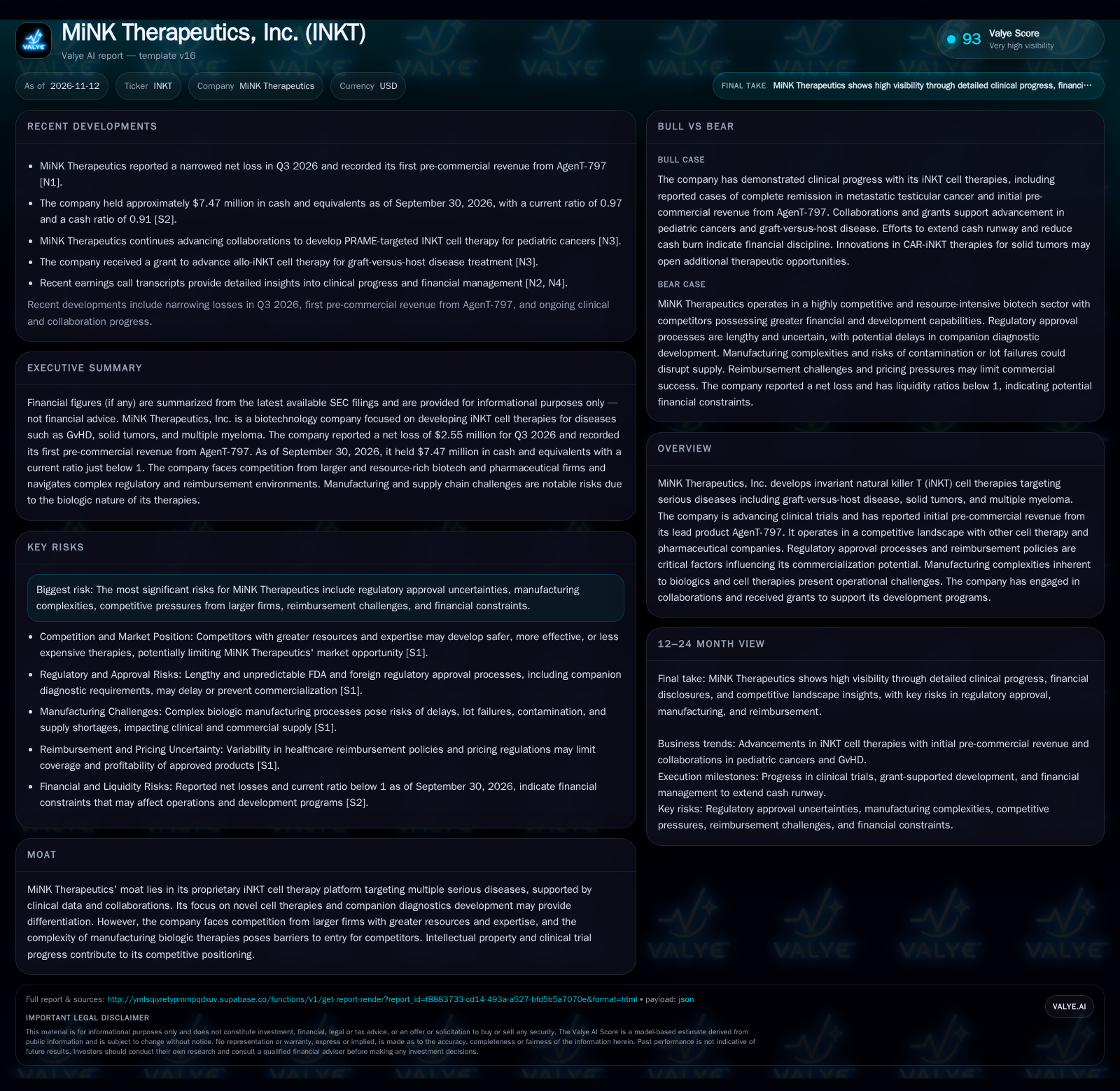
MiNK Therapeutics reported its first pre-commercial revenue from AgenT-797 and narrowed losses in Q3 2026, but continues to operate with a current ratio below 1 and faces intense competition and operational complexity. The next phase will test whether clinical progress, grant-backed collaborations, and financial discipline can overcome manufacturing, regulatory, and reimbursement hurdles to establish a viable cell therapy business model. [N1] [S2]
MiNK Therapeutics’ emergence into pre-commercial revenue with its lead iNKT cell therapy, AgenT-797, marks a pivotal moment in the company’s journey from research-driven biotech to potential commercial-stage innovator. While the Q3 2026 financials show disciplined cost management and the beginnings of external validation, MiNK is still contending with the dual challenges of limited working capital and a fiercely competitive cell therapy landscape. The company’s progress in clinical collaborations and grant-funded programs underscores its scientific promise, but the crucial test ahead will be whether these milestones can translate into a scalable, sustainable business amid high regulatory, operational, and reimbursement barriers. [N1] [S2]
From Clinical Bench to Pre-Commercial Revenue: The 2026 Inflection Point
MiNK Therapeutics reported its first pre-commercial revenue from AgenT-797 in Q3 2026, signaling a transition from pure development-stage biotech to a company with initial market exposure. This revenue event, while likely modest in scale, is important because it demonstrates real-world uptake or validation of the company’s iNKT cell therapy platform. The company also narrowed its net loss to $2.55 million for the quarter, reflecting efforts to control expenses and manage its cash runway. As of September 30, 2026, MiNK held $7.47 million in cash and equivalents, with a current ratio of 0.97—below the threshold typically associated with reported liquidity position. This financial profile frames a company at a strategic crossroads: early clinical and commercial momentum, but with the need for disciplined capital management and further external funding or partnerships likely required to sustain development and commercialization initiatives. [N1] [S2]
Cell Therapy Economics: Fixed Costs, Revenue Pathways, and the Scaling Challenge
The economics of iNKT cell therapies are characterized by high fixed costs in R&D, manufacturing infrastructure, and regulatory compliance. Manufacturing allogeneic cell therapies like AgenT-797 involves complex, multi-step processes—cell sourcing, expansion, engineering, and quality control—each introducing risk, cost, and potential for delay. Unlike small molecules, these therapies require bespoke facilities and skilled personnel, making the cost base relatively inflexible until substantial scale is achieved.
Revenue in the near term is likely to be lumpy and tied to clinical trial activity, early access programs, or limited commercial launches, rather than broad recurring sales. Pricing power, if achieved, may be significant given the life-threatening indications targeted, but will ultimately depend on clinical differentiation, payer acceptance, and demonstration of health-economic value. The company’s ability to secure grants and collaborative funding can offset some burn, but commercial sustainability will require successful transition from grant- and milestone-based income to consistent product revenue. If reimbursement is strong and manufacturing yields improve, operating leverage could be meaningful; conversely, lot failures or reimbursement headwinds could rapidly erode margins.
Navigating a Crowded Landscape: Differentiation and Defensive Barriers
MiNK Therapeutics operates in a field crowded with cell therapy developers, including companies with autologous and allogeneic approaches, as well as larger pharmaceutical firms leveraging stem cell technologies, bispecific antibodies, and other immuno-oncology modalities [S1]. MiNK’s focus on iNKT cell biology and its proprietary platform provides a scientific angle of differentiation, particularly if ongoing clinical collaborations in pediatric cancers and GvHD yield compelling results.
However, competitors with greater financial resources, deeper manufacturing experience, and established commercial infrastructures can move quickly to capture market share if their therapies prove safer, more effective, or economically advantageous. Intellectual property and early clinical data provide some defensive moat, but these are eroded if rivals achieve faster regulatory approval, superior clinical outcomes, or solve manufacturing bottlenecks at scale. MiNK’s collaborative grants and scientific publications add credibility, but do not fully offset the scale and reach advantages enjoyed by large-cap pharma and advanced biotechs.
Unlocking Commercial Viability: If Clinical and Manufacturing Milestones Align
A bullish scenario emerges if MiNK’s clinical programs—particularly for AgenT-797 and PRAME-targeted iNKT therapies—achieve pivotal trial success, resulting in regulatory approval for one or more high-value indications. If the company is able to demonstrate compelling efficacy (such as the reported complete remissions in metastatic testicular cancer) and maintain a clean safety profile, payer adoption could follow, especially in settings with few alternatives. Successful scale-up of manufacturing, minimizing lot failures and ensuring consistent product quality, would further support margin expansion.
Confirmation of this scenario would come through accelerated patient enrollment in late-stage trials, regulatory milestones (such as IND/filing acceptances or fast-track designations), and the signing of commercial supply or distribution agreements. A meaningful uptick in recurring product revenue, expansion of payer coverage, and positive real-world outcomes would also corroborate successful business model transition. Conversely, this scenario would be falsified by regulatory setbacks, persistent manufacturing bottlenecks, or lack of payer acceptance despite clinical progress.
Clinical Progress, Capital Constraints, and Incremental Commercialization
Pre-commercial and early commercial revenue may increase modestly, but is unlikely to fully offset operating expenses in the near term. The company may need to pursue further external financing, licensing deals, or strategic collaborations to bridge to full commercial launch and scale.
Key confirming evidence would include steady clinical enrollment, new grant or partnership announcements, and incremental revenue growth from expanded access or limited market launches. This scenario could persist for several years, with upside or downside inflection points driven by major regulatory or commercial milestones.
Execution Risks: Manufacturing, Funding, and Competitive Displacement
Adverse outcomes could materialize if MiNK experiences manufacturing setbacks—such as lot failures, contamination, or supply chain disruptions—that delay clinical trials or commercial supply. If regulatory submissions are delayed or denied due to insufficient data or companion diagnostic challenges, the timeline to meaningful revenue could extend, straining financial resources. Inability to secure additional funding or non-dilutive capital would force difficult trade-offs, potentially jeopardizing pipeline breadth or continuity.
A further risk is competitive displacement: if a rival cell therapy or alternative immuno-oncology approach secures approval and reimbursement in a target indication, MiNK’s addressable market and pricing power could shrink materially. Evidence of such downside would include publicized manufacturing failures, missed regulatory milestones, delayed trial enrollment, or negative comparative clinical data from competitors.
Concrete Milestones That Will Make or Break the MiNK Therapeutics Thesis
Quarterly trend in pre-commercial and commercial revenue from AgenT-797 and other pipeline products—if disclosed, this would clarify early market traction and the pace of adoption.
Net cash burn and updates to cash runway projections, especially in relation to clinical trial milestones and manufacturing scale-up plans.
Progression of pivotal clinical trials, including patient enrollment rates, interim efficacy and safety data, and regulatory interactions for lead programs.
Announcement and terms of new grants, collaborations, or licensing agreements, which may signal external validation and provide capital relief.
Manufacturing consistency metrics: rates of lot success/failure, contamination events, and ability to meet clinical/commercial demand—if disclosed.
Reimbursement progress: payer coverage decisions, pricing levels secured in initial markets, and third-party payor feedback.
Competitive landscape developments: regulatory approvals, clinical data releases, or commercial launches by direct cell therapy and immuno-oncology peers.
Disclaimer: This is research-only, informational analysis and not investment advice. It may include AI-generated interpretation and general industry context. Always verify important details using primary sources.

Comments