
Greenland Technologies: Concentrated Growth, Customer Risk, and the Stakes of Electric Equipment Expansion
Greenland Technologies combines profitable legacy manufacturing with a push into electric industrial heavy equipment, but faces a high-stakes balancing act between customer concentration, cash-flow management, and intense competitive and regulatory headwinds.
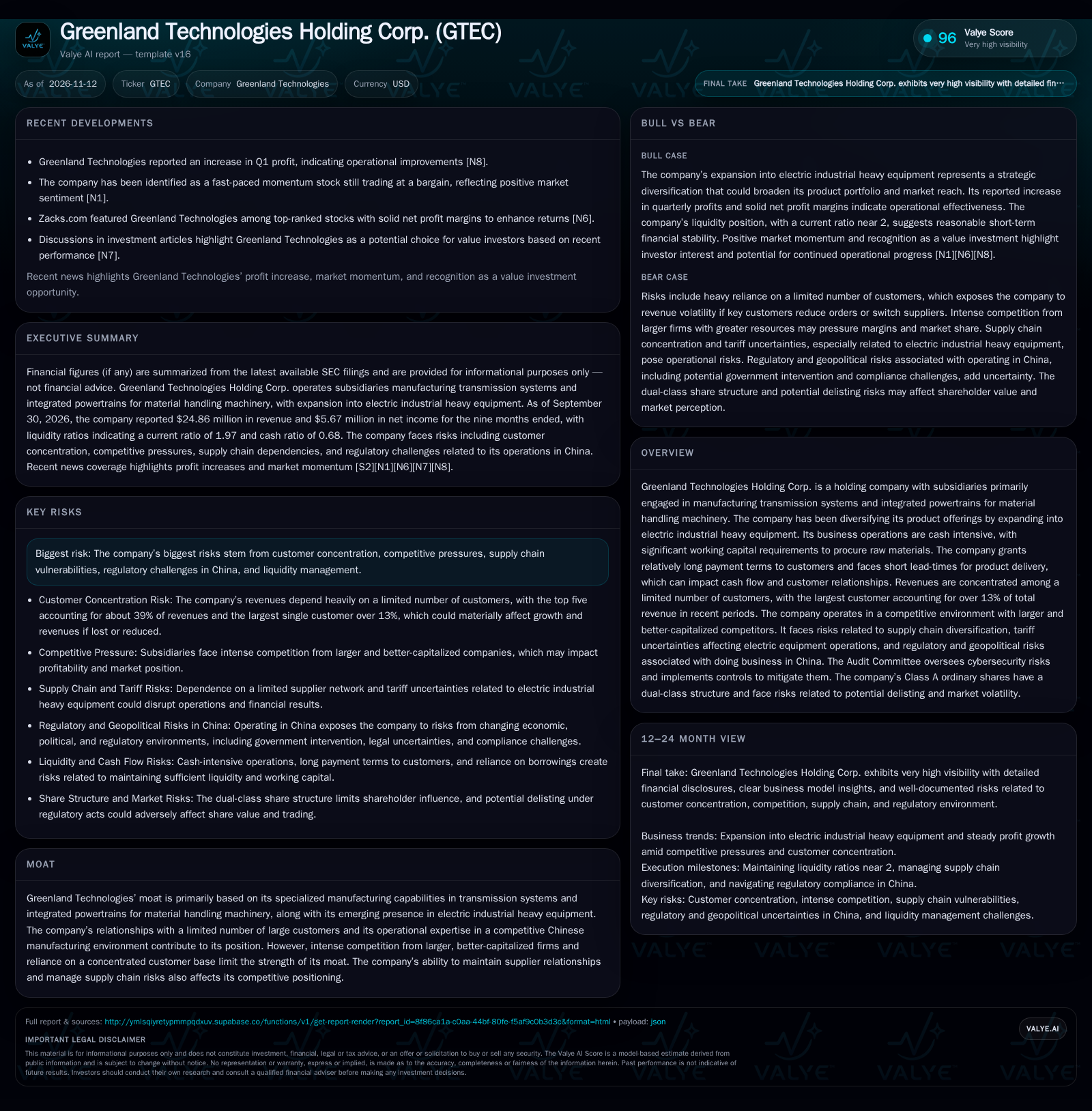
Greenland Technologies reported $24.86 million in revenue and $5.67 million in net income for the first nine months of 2026, with a current ratio of 1.97 and significant customer concentration—its top five customers accounted for 39% of revenue. The company is expanding into electric industrial heavy equipment, introducing fresh risks around supply chain, tariffs, and market adoption. The core thesis centers on whether Greenland can diversify both its customer base and supply chain fast enough to sustain profitable growth while navigating fierce competition and Chinese regulatory uncertainty. [S2]
Greenland Technologies Holding Corp. occupies a strategic but precarious niche at the intersection of traditional industrial powertrain manufacturing and the emerging market for electric industrial heavy equipment. The company’s recent financials show profitability and a seemingly reported liquidity position, yet its business model is tightly bound to a handful of major customers and a narrow supplier base. As Greenland pivots toward electric equipment, it faces a complex web of competitive, supply chain, and regulatory challenges—each with the potential to reshape its earnings trajectory. The next phase will test whether the company can translate diversification efforts into sustainable, less volatile growth, or whether it remains vulnerable to shocks from concentrated relationships and external headwinds. [S2]
Recent Performance Highlights Concentration and Expansion Risks
For the nine months ended September 30, 2026, Greenland Technologies generated $24.86 million in revenue and $5.67 million in net income, translating to basic and diluted earnings per share of $0.21. As of the same date, the company reported cash and cash equivalents of $9.57 million and short-term investments of $39.94 million, with a current ratio of 1.97 and a cash ratio of 0.68. The five largest customers contributed about 39% of total revenue, with the largest single customer at 13.3%. The company is expanding into electric industrial heavy equipment, but this move introduces additional business risk due to tariff uncertainties and supply chain dependencies. These facts frame a company that is both profitable and exposed: its strong earnings are counterbalanced by customer concentration and ambitious diversification. [S2]
How Greenland Makes—and Risks—Its Money
Greenland’s core revenue stream comes from manufacturing transmission systems and integrated powertrains for material handling machinery. This legacy business likely enjoys moderate gross margins typical of specialized industrial suppliers, but requires material working capital outlays for raw materials and inventory. The company reported cash and liquidity metrics for the period; these figures do not by themselves establish operating runway, investment capacity, financial flexibility, or financing capacity. Operating leverage is present but constrained by the company’s scale and supply chain limitations: fixed costs are spread across a concentrated revenue base, so the loss of a major customer would have a disproportionate impact on profitability.
The move into electric industrial heavy equipment could, in theory, unlock higher-margin sales and expand the addressable market, especially if the company can leverage existing manufacturing capabilities. However, this segment is likely to demand significant up-front R&D, inventory, and compliance investments, further intensifying working capital requirements and exposing Greenland to volume and adoption risk. Margins in the new segment will depend on the company’s ability to achieve scale, secure differentiated technology, and avoid price competition from larger incumbents or newer, more agile entrants. [S2]
Competitive Pressures and the Limits of Scale
Greenland operates in a fiercely competitive landscape, facing rivals with greater scale, capital resources, and established distribution networks—especially in China’s crowded industrial equipment sector. Larger competitors can exert pricing pressure, invest more heavily in R&D, and weather supply chain disruptions more effectively. Greenland’s specialized manufacturing expertise and long-standing customer relationships provide some insulation, but its relatively small size and concentrated customer base limit its bargaining power and ability to absorb shocks.
In the electric heavy equipment segment, the company not only faces established industrial giants but also new entrants—some of whom may have access to advanced battery technology, integrated software, or government support. The limited supplier network further constrains Greenland’s agility: any disruption or price increase from key suppliers could erode margins or delay delivery, potentially damaging customer relationships. While the company’s expansion strategy could yield a differentiated offering, the burden of proof remains high: successful navigation of this environment would likely require either unique technology, a cost advantage, or privileged access to customers—none of which is yet established by the supplied evidence.
What If Electric Equipment Expansion Pays Off?
The bull case for Greenland Technologies rests on the successful commercialization of its electric industrial heavy equipment line. If the company can leverage its existing manufacturing base to achieve early mover advantage in this segment—securing contracts with new customers and expanding its geographic reach—it could reduce revenue concentration while driving higher-margin growth. This scenario would likely require the company to demonstrate reliable product performance, on-time delivery despite short lead-times, and a credible plan to diversify both its customer and supplier base.
Evidence that would support this scenario includes a rising number of new or recurring customers outside the legacy top five, growing contribution from electric equipment to total revenue, and stable or improving gross margins despite higher R&D and compliance costs. Announcements of major contract wins or partnerships in the electric segment, as well as progress in supplier diversification (e.g., new sourcing agreements or inventory management improvements), would also bolster the upside thesis. Conversely, stagnation in electric equipment revenue, continued over-reliance on a handful of customers, or margin erosion would challenge the bull case.
Profitability Maintained, But Structural Risks Persist
The most plausible middle path is one in which Greenland Technologies maintains profitability in its legacy business but makes only incremental progress in electric equipment. Customer concentration remains high, and while the company may add new accounts or modestly grow electric sales, these are insufficient to fundamentally diversify risk. Margin stability is preserved by prudent cost control and gradual supply chain improvements, but any major disruption—such as the loss of a top customer or supplier—could quickly expose the business to downside shocks.
Confirmation of this scenario would come from continued reporting of similar revenue and net income levels, a reported liquidity-ratio trends, and no material change in the composition of the customer base. Warning signs would include rising receivables, inventory build-up, or evidence of delayed payments from key customers, all of which could signal weakening negotiating leverage or operational stress. [S2]
Customer Loss or Supply Chain Shock Triggers Margin Compression
The most acute risk for Greenland Technologies is the loss of one or more of its largest customers, given that the top five account for nearly 40% of revenue. Such a loss could result from competitive pricing, superior offerings from larger rivals, or dissatisfaction due to missed delivery deadlines—especially with the company’s short lead-times. Margin compression would likely follow, as fixed costs are spread over a smaller revenue base and the company scrambles to replace lost volume.
A secondary but significant threat is supply chain disruption. Greenland’s reliance on a limited supplier network leaves it exposed to input shortages, price hikes, or quality issues. If the company cannot quickly diversify suppliers or pass through higher costs, its financials could deteriorate rapidly. Tariff uncertainties related to the electric equipment business compound this risk, potentially forcing the company to suspend operations or absorb unexpected costs.
Evidence supporting this scenario would include a sudden drop in revenue, a spike in accounts receivable or inventory, negative cash flow from operations, or a sharp deterioration in liquidity ratios. Public disclosures of lost contracts, supply interruptions, or regulatory sanctions would further validate the bear case. [S2]
Milestones That Will Define Greenland’s Strategic Evolution
Progress toward diversifying the customer base, specifically a reduction in the top five customers’ share of total revenue, would help test whether revenue concentration risk is being addressed. If disclosed, the number of new customers or contribution from new segments would be instructive.
Trends in electric industrial heavy equipment revenue compared to legacy transmission and powertrain sales would indicate whether the expansion strategy is gaining traction.
Gross margin evolution, particularly in the electric segment if disclosed, would reveal whether the company is achieving profitable scale or facing margin compression as it ramps new products.
Supplier diversification metrics—such as the number of active suppliers or percentage of raw materials sourced from the top three vendors—would help assess operational resilience.
Receivables and inventory turnover rates would provide insight into working capital discipline and early warning on cash flow stress.
Disclosure of major contract wins, renewals, or losses—especially outside the legacy top five customers—would signal success or setbacks in market diversification.
Any material regulatory, tariff, or compliance developments affecting Chinese industrial exporters or the electric equipment segment would be pivotal for scenario outcomes.
Management commentary on capital allocation, R&D investment, or supply chain strategy would help clarify the company’s commitment to, and execution of, its diversification ambitions.
Disclaimer: This is research-only, informational analysis and not investment advice. It may include AI-generated interpretation and general industry context. Always verify important details using primary sources.

Comments