
Neonode’s Licensing Pivot: Can Machine Perception Scale Beyond a Concentrated Customer Base?
Neonode’s exit from hardware sales and shift to pure licensing of its MultiSensing® and zForce® platforms has delivered reported liquidity position and a focused R&D effort, but leaves the company exposed to severe customer concentration, competitive pressures, and the threat of Nasdaq delisting if it cannot broaden adoption or demonstrate sustained revenue growth.
Neonode has completed its transition to a licensing-only model, supporting software-driven machine perception and optical sensing for OEMs—especially in automotive and consumer electronics. Future success will hinge on Neonode’s ability to convert R&D into new licensing wins and reduce its dependence on a narrow revenue base. [S2]
Neonode Inc. has transformed itself into a pure-play licensing company in machine perception and optical sensing, leaving behind its hardware roots to focus on embedding its technology in automotive and consumer electronics through OEM partners. The next phase for Neonode will test whether its R&D and patent portfolio can unlock broader adoption and offset these vulnerabilities, or whether competitive and structural pressures will limit its ability to scale.
Revenue Concentration, Strategic Shift, and Listing Risk Define Neonode’s Present
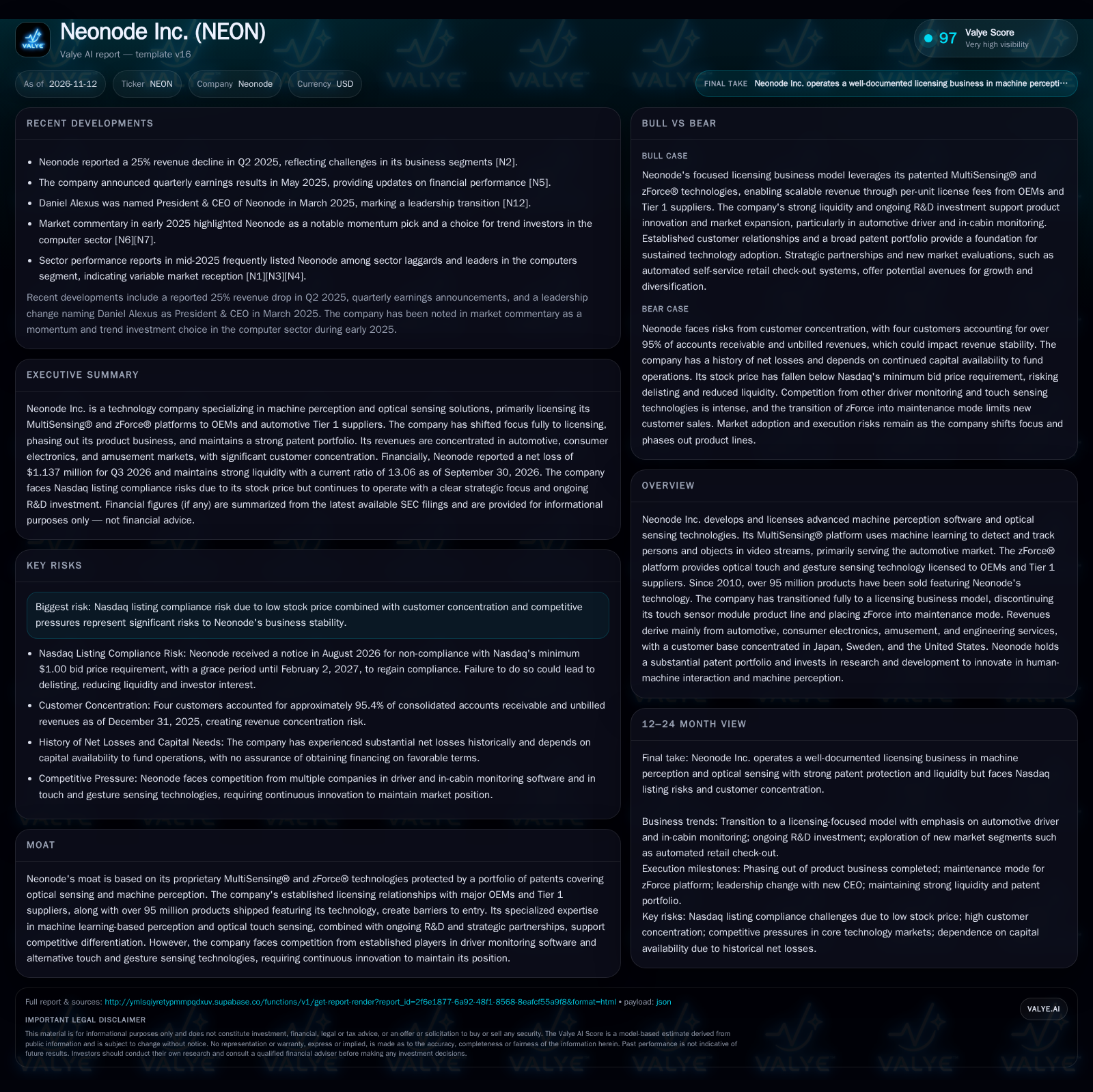
Neonode has now fully transitioned to a licensing model, discontinuing its touch sensor module (TSM) hardware business and placing its key zForce® platform into maintenance mode—ceasing new customer sales but supporting existing deployments. Revenue is derived from licensing its MultiSensing® and zForce® technologies, primarily to global OEMs and Tier 1 automotive suppliers, with per-unit license fees the primary commercial mechanism. [S2]
The company’s financials reveal a stark concentration: as of December 31, 2025, just four customers—Seiko Epson, Alps Alpine, Hewlett-Packard, and a commercial vehicle OEM—accounted for over 95% of Neonode’s accounts receivable and unbilled revenues. In 2025, the automotive segment provided 26% of revenues, consumer electronics 55.7%, and the rest from amusement and engineering services. [S2]
The company reported cash and liquidity metrics for the period; these figures do not by themselves establish operating runway, investment capacity, financial flexibility, or financing capacity. However, the company’s common stock fell below Nasdaq’s $1.00 bid requirement in August 2026, placing its listing in jeopardy if compliance is not regained by February 2027. [S2]
How Neonode’s Licensing Model Scales—and Where It Could Stall
Neonode’s business now depends on scaling its licensing agreements rather than direct product sales, with revenues largely tied to per-unit royalties paid by OEMs embedding its technologies. This model offers high gross margins and low variable costs once R&D is amortized, as incremental units shipped by licensees require little additional Neonode input. The shift away from manufacturing hardware eliminates inventory and supply chain risk, reducing working capital needs and enabling a leaner cost structure.
However, this approach also means revenue growth is determined by licensee production volumes and Neonode’s ability to sign new agreements. With zForce® in maintenance mode, new customer acquisition for this legacy platform is effectively halted; growth potential now rests on MultiSensing® and any future platforms that can be licensed into new verticals. R&D spending ($3.8 million in 2025) remains critical for product innovation and competitive differentiation, but the path to revenue from new technology is long and uncertain, as OEM adoption cycles—especially in automotive—are often multi-year.
The capital-light licensing model provides operating leverage if Neonode can expand its installed base, but it also exposes the company to abrupt revenue drops if major licensees shift away, as seen in the 25% revenue decline in Q2 2025. [N2] The economics thus hinge on both the stickiness of existing relationships and Neonode’s ability to seed new high-volume design wins.
Competitive Dynamics: Patent Protection Versus Substitution and Scale
Neonode’s moat is rooted in its proprietary technology and patent portfolio, which covers optical touch, contactless interaction, and machine perception for in-cabin monitoring. Over 95 million products have shipped with its technology since 2010, reflecting some degree of market validation and embeddedness. [S2]
However, the company faces formidable competition in both its legacy and growth segments. In driver and in-cabin monitoring (the focus of MultiSensing®), Neonode contends with software specialists like SmartEye, Cipia, Xperi, Seeing Machines, and PUX, as well as diversified automotive suppliers. In touch and gesture sensing, alternative modalities—resistive, capacitive, ultrasonic, radar—are promoted by large players such as Ultraleap, Texas Instruments, and Acconeer. These competitors may offer broader product portfolios, deeper OEM relationships, and greater resources for integration support.
Neonode’s patent protection and long-standing OEM relationships could increase switching friction, but not insurmountable barriers. OEMs are motivated by cost, reliability, and integration ease, and may switch to alternative suppliers or in-house solutions if the economics or performance justify it. The decision to place zForce® in maintenance mode could accelerate customer evaluation of substitutes, especially if Neonode cannot demonstrate clear technical or cost advantages in new use cases. The company’s ability to maintain relevance will depend on the pace of R&D-driven innovation and the success of embedding its latest machine perception technologies in next-generation platforms.
Unlocking Broader Adoption: What Would Signal Neonode’s Licensing Model Gaining Traction
The most favorable scenario for Neonode would see its MultiSensing® platform gain design wins in high-growth automotive applications—such as advanced driver monitoring, occupant detection, or in-cabin interaction—leading to new or expanded licensing agreements with additional OEMs or Tier 1 suppliers. Expansion into adjacent verticals (for example, automated retail check-out or medical devices) could diversify the customer base and reduce revenue concentration.
Evidence supporting this scenario would include announcements of new licensing deals with top-tier OEMs, significant increases in the number of customers actively shipping products with Neonode technology, and a visible uptick in royalty revenue—especially from markets outside Japan, which currently dominates Neonode’s revenue mix. Additional signals would be the launch of new platforms or features that address emerging regulatory or industry requirements (such as driver monitoring mandates), and evidence of Neonode’s patents being referenced or cited by major industry players.
This trajectory could be falsified if no new design wins are announced, if reported shipment volumes by licensees stagnate or decline, or if revenue remains concentrated among the same handful of customers. A failure to demonstrate adoption of MultiSensing® in new markets, or an inability to monetize the patent portfolio beyond maintenance fees, would signal that Neonode’s upside is capped.
Stability Hinges on Retaining Existing Licensees and Slow Expansion
The most plausible near-term outcome is that Neonode continues to support its existing licensees—especially in automotive and consumer electronics—while seeking incremental growth through targeted R&D and modest new licensing wins. Revenue remains volatile and highly concentrated, with the majority tied to the production cycles and market success of a few OEM customers, particularly in Japan and Sweden.
Neonode’s Nasdaq listing remains at risk unless the share price recovers, but the company avoids a near-term liquidity crisis. The zForce® platform, now in maintenance mode, gradually declines as existing deployments reach end-of-life, while the pace of new MultiSensing® adoptions remains slow due to long OEM validation cycles and intense competitive pressure.
Signs confirming this scenario would be flat or slightly declining revenue, continued concentration in a small customer set, and ongoing but unremarkable R&D expense. Falsification would come from either a sudden loss of a major customer (triggering a sharp revenue drop) or, conversely, breakthrough licensing agreements that shift the revenue mix and customer diversity meaningfully.
Concentration and Delisting Risks Materialize: What Failure Would Look Like
The most adverse scenario would unfold if Neonode loses one or more of its top customers—either to technological substitution, in-house development, or competitive displacement. Given the extreme revenue concentration, even a single customer loss could trigger a step-function decline in royalties and cash flow, pressuring both operations and R&D continuity.
If this is coupled with an inability to sign new licensing agreements or expand into fresh markets, the company’s revenue base could shrink below sustainable levels. The transition of zForce® to maintenance mode exacerbates this risk, as no new customers are being added for that platform. Failure to regain compliance with Nasdaq’s listing requirements could further reduce investor interest and access to capital, amplifying the company’s vulnerability.
Confirmation of this scenario would include a sharp decline in quarterly revenue, disclosures of major customer contract losses, cash burn accelerating without offsetting new business, and eventual delisting from Nasdaq. Further R&D cuts or forced restructuring would likely follow, putting Neonode’s long-term viability in question.
Milestones That Could Reshape Neonode’s Licensing Trajectory
Any new design win or multi-year licensing agreement with a major OEM or Tier 1 supplier, especially outside the current customer cohort, would help validate Neonode’s technology and reduce concentration risk.
Quarterly updates on the number of customers actively shipping products with Neonode technology would provide visibility into adoption breadth—if disclosed.
Sustained or growing per-unit royalty revenue, broken out by segment (automotive, consumer electronics, new verticals), would indicate commercial traction and improved mix.
Progress reports on R&D milestones, such as new platform launches or regulatory certifications, would signal ongoing innovation and market relevance.
Updates on the company’s Nasdaq listing status, including the share price relative to the $1.00 threshold and any remedial actions taken, are critical to assessing market access and sentiment.
Disclosure of patent licensing or enforcement actions—such as new IP monetization deals or settlements—would demonstrate the leverage of Neonode’s patent portfolio.
Announced customer losses, contract terminations, or design-outs would be early warning signs of revenue cliff risk.
Geographic revenue mix shifts, particularly growth outside Japan, could signal success in diversifying the customer base and reducing regional dependency.
Disclaimer: This is research-only, informational analysis and not investment advice. It may include AI-generated interpretation and general industry context. Always verify important details using primary sources.

Comments