
Future Vision II Acquisition: The Stakes of the MicroTouch Merger and the SPAC’s Final Countdown
Future Vision II Acquisition Corp. is approaching a pivotal moment as it seeks to close its $90 million merger with MicroTouch Technology Inc., a Hong Kong-based IT services firm. With reported liquidity position and shareholder approval in hand, the SPAC’s future now hinges on regulatory clearance, Nasdaq listing compliance, and the operational prospects of its chosen target.
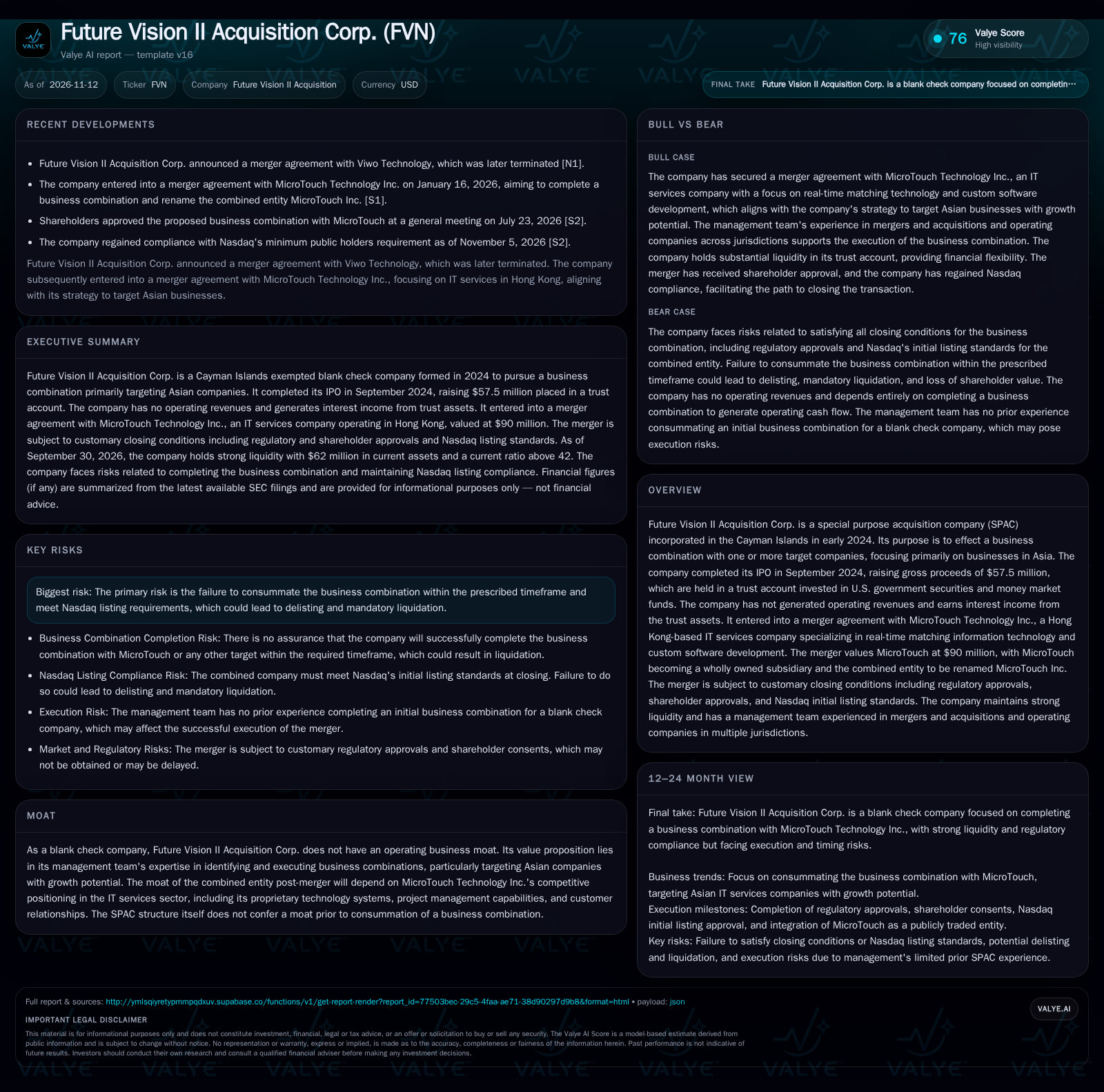
Future Vision II Acquisition Corp. (FVN) stands on the brink of transformation: after raising $57.5 million in its 2024 IPO, it has secured shareholder approval for a merger with MicroTouch Technology Inc., an Asian IT services specialist. With over $62 million in current assets and recent Nasdaq compliance, the SPAC’s fate now depends on satisfying remaining regulatory hurdles and the ultimate value MicroTouch can deliver as a public company. If the deal fails to close by September 2027, FVN must liquidate, returning funds to shareholders and rendering its public equity worthless. [S1] [S2]
Future Vision II Acquisition Corp. (FVN) is a SPAC racing against the clock to consummate its $90 million merger with MicroTouch Technology Inc., an IT services company rooted in Hong Kong. The deal, which has already secured shareholder approval and recently met Nasdaq’s public holder compliance, is the SPAC’s only route to operating relevance—and survival. With more than $62 million in current assets and no operating business of its own, FVN’s entire value proposition now rests on closing this transaction before the 36-month window expires in September 2027. The outcome will determine whether FVN emerges as a newly public Asian IT services platform or faces liquidation and dissolution.
Merger Milestones and Liquidity Position Define the Critical Juncture
As of November 2026, Future Vision II Acquisition Corp. has executed several material steps toward its business combination: entering a $90 million merger agreement with MicroTouch Technology Inc., securing shareholder approval as of July 2026, and regaining compliance with Nasdaq’s minimum 300 public holders rule as of November 2026. The company reported cash and liquidity metrics for the period; these figures do not by themselves establish operating runway, investment capacity, financial flexibility, or financing capacity. Net income for the quarter was $396,051, driven by non-operating interest income—FVN has no operating revenues prior to the merger. The convergence of these facts means FVN is positioned to close the deal, but faces a binary outcome: successful merger and transition to an operating company, or forced liquidation if closing conditions are not met by September 2027. [S1] [S2]
How the SPAC Structure Shapes Economic Outcomes Pre- and Post-Merger
FVN’s economics are currently defined by its SPAC structure: it generates only interest income from trust assets, with operating cash flows contingent on closing a business combination. The trust account, invested in U.S. government securities and money market funds, preserves capital for either acquisition or shareholder redemption. The SPAC incurs minimal operating costs, but faces significant opportunity costs and regulatory risk if a deal is not consummated. Upon successful merger with MicroTouch, the economics shift dramatically: the combined entity would inherit MicroTouch’s IT services business, which may feature project-based and recurring revenue streams, margin variability tied to software development and service delivery, and the need for ongoing investment in talent and technology. The post-merger company would also bear public company costs, integration expenses, and heightened scrutiny from investors and regulators. The availability of more than $62 million in current assets provides resources for initial operations and potential growth investments, but future capital needs will depend on MicroTouch’s business model and competitive ambitions. Any specific commercial mechanics—such as contract structure, customer concentration, or average deal size—remain to be disclosed and cannot be assumed at this stage.
From Blank Check to Platform: Assessing Prospective Competitive Edges
As a SPAC, FVN has no intrinsic moat; its value is entirely a function of its ability to source and close a compelling transaction. After the merger, the competitive position will depend on MicroTouch’s standing within the Asian IT services landscape. Real-time matching technology and custom enterprise software development suggest specialization, but the sector is crowded with regional and global players ranging from boutique consultancies to large-scale integrators. Potential sources of advantage for MicroTouch could include proprietary algorithms, deep industry relationships, or domain-specific expertise. However, switching costs in IT services are often modest unless underpinned by long-term relationships or highly integrated solutions. The ability to scale, win repeat business, and demonstrate superior delivery will be key, especially as a newly public entity subject to market expectations. Without specific disclosure, the nature and durability of MicroTouch’s commercial relationships, contract terms, or customer retention mechanisms remain unknown and should be treated as conditional factors rather than established facts.
If the MicroTouch Merger Unlocks Growth and Public Market Appeal
A favorable scenario unfolds if FVN closes the MicroTouch merger on schedule, and MicroTouch leverages its public listing to accelerate growth in the Asian IT services space. The influx of capital could fund expansion into new verticals or geographies, invest in R&D for proprietary matching technologies, and attract high-caliber talent. Public company status may also help win larger enterprise relationships or strategic partnerships. Confirmation of this scenario would require evidence of rapid post-merger revenue growth, margin expansion, and strong customer acquisition, as well as clear communications about differentiated offerings and a robust project pipeline. Conversely, delays in closing, tepid customer wins, or inability to articulate a credible growth roadmap would falsify the upside case. Any assumptions about average contract value, customer retention, or recurring revenue would require future disclosure and cannot be asserted at this stage.
Execution on Merger Timeline, with Measured Transition to Operating Company
The most plausible pathway is that FVN completes the merger with MicroTouch after securing all regulatory and listing approvals, and the new entity transitions into an operating public company with typical early-stage growing pains. MicroTouch’s initial quarters as a public company may feature moderate revenue growth, investment in sales and delivery capacity, and incremental improvements in operational discipline. The company’s financials will likely reflect both integration costs and the challenge of establishing predictable cash flows. Evidence supporting this scenario would include timely regulatory clearance, successful Nasdaq uplisting, and disclosure of a credible operating plan. Disconfirming signals would be regulatory holdups, Nasdaq listing issues, or a lack of transparency about post-merger operations. The specifics of MicroTouch’s commercial mechanics—such as contract duration, customer mix, or pricing power—will only become clear with future public filings.
Deal Failure, Delisting, or Liquidation: The Binary Risk of the SPAC Clock
The adverse scenario materializes if FVN fails to satisfy all closing conditions—whether due to regulatory pushback, Nasdaq listing shortfalls, or stakeholder disagreements—before the September 2027 deadline. In such a case, FVN would be forced to liquidate and redeem public shares from the trust, with public and private rights expiring worthless. Delisting risk is real if the combined company cannot meet or maintain Nasdaq standards, further jeopardizing liquidity and investor confidence. Confirmation would come from missed regulatory or shareholder milestones, Nasdaq warnings, or withdrawal of MicroTouch from the transaction. Any extension requests not funded by the sponsor, or public communications indicating uncertainty about closing, would also support the downside scenario.
Milestones That Will Determine Whether FVN Delivers Shareholder Value
Progress on regulatory approvals and satisfaction of all closing conditions for the MicroTouch merger—any delays or obstacles would signal elevated risk.
Maintaining compliance with all Nasdaq initial and continuing listing standards, particularly minimum public holders and market capitalization rules.
Timely and transparent shareholder communications regarding the merger timeline, extension requests, and any material changes to deal terms.
MicroTouch’s public disclosure of its business model, revenue mix, customer concentration, and competitive differentiation following merger closing.
Actual post-merger financial performance—including revenue growth, margins, and cash flow—if disclosed, will be critical to evaluating the combined entity’s potential.
The sponsor’s willingness and ability to fund monthly extension fees if the deal timeline slips, as failure would trigger liquidation.
Market reaction and trading liquidity for the combined company’s shares after uplisting, which will shape capital access and investor sentiment.
Disclaimer: This is research-only, informational analysis and not investment advice. It may include AI-generated interpretation and general industry context. Always verify important details using primary sources.

Comments