
Thunder Mountain Gold: Exploration Ambitions Meet Capital Discipline in Idaho’s Mining District
The path to value creation hinges on converting mineral resources into economic reserves and managing external regulatory and commodity price pressures.
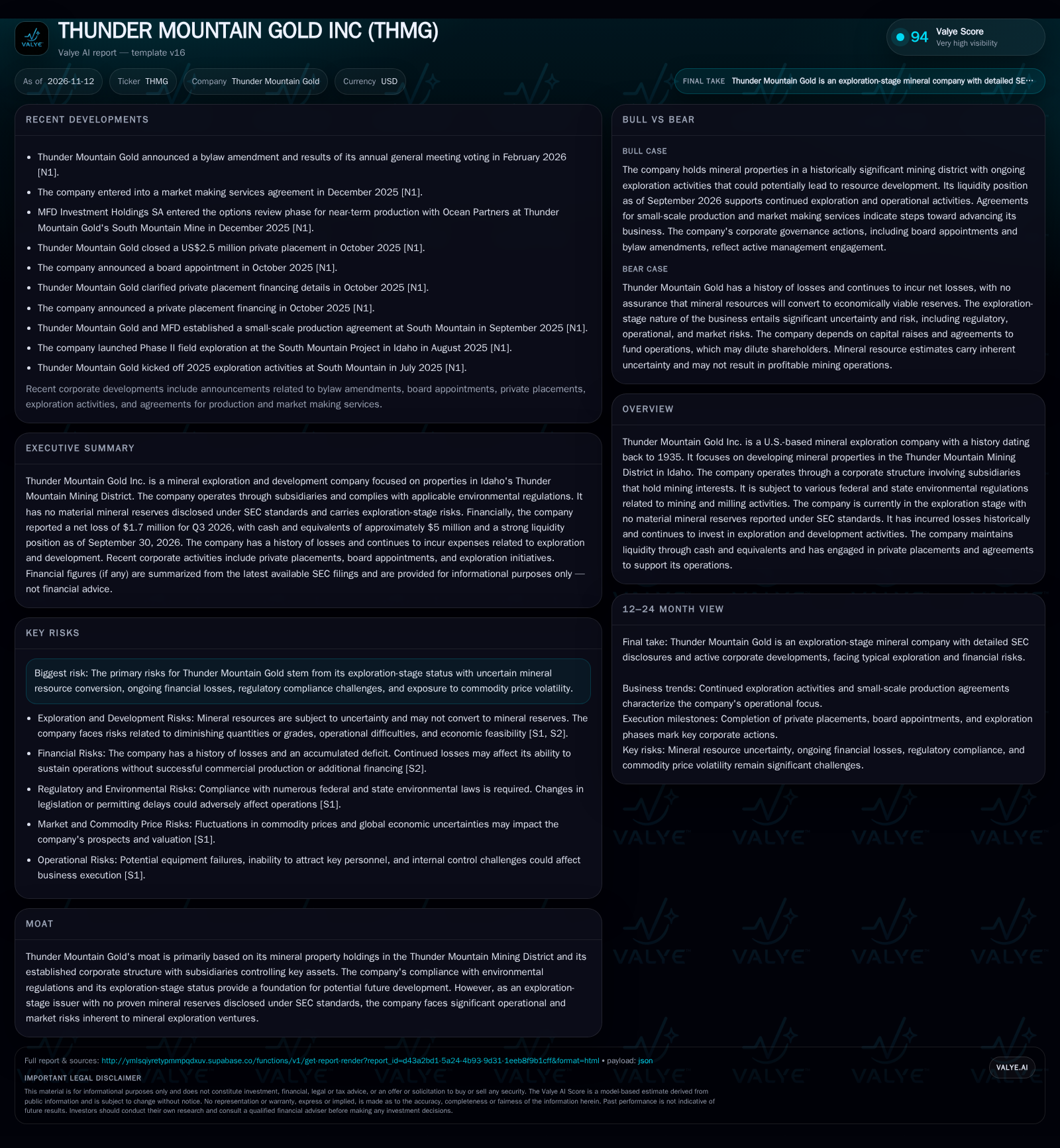
Thunder Mountain Gold is an exploration-stage company focused on Idaho’s Thunder Mountain Mining District, reporting no SEC-compliant mineral reserves and a $1.7 million net loss for Q3 2026. Persistent losses and the uncertainty of resource conversion remain key risks. [S1] [S2]
Thunder Mountain Gold Inc. exemplifies the high risk–high potential dynamic of mineral exploration. With deep roots in Idaho’s Thunder Mountain Mining District and a cash-rich balance sheet, the company’s future will be determined by its ability to convert its mineral resources into SEC-compliant reserves and, ultimately, profitable operations. However, persistent losses, regulatory hurdles, and the absence of proven reserves underscore the challenges ahead, making this a story of both opportunity and significant uncertainty.
Liquidity and Losses Define Thunder Mountain Gold’s Present Position
As of September 30, 2026, Thunder Mountain Gold reported a net loss of approximately $1.7 million for the quarter and an accumulated deficit nearing $13.93 million, reflecting its ongoing status as an exploration-stage issuer. The company reported cash and liquidity metrics for the period; these figures do not by themselves establish operating runway, investment capacity, financial flexibility, or financing capacity. However, the absence of SEC-compliant mineral reserves means the company has yet to demonstrate economically viable resources. The regulatory environment remains strict, and the company’s small staff highlights a lean operational profile focused on capital conservation. [S1] [S2]
Exploration Economics: High Fixed Costs, Deferred Revenue, and Capital Intensity
Thunder Mountain Gold’s business model is typical of early-stage mineral explorers: significant upfront investment in exploration, permitting, and compliance, but no meaningful revenue until a resource is proven and developed. The company’s cost base is dominated by exploration expenditures, regulatory compliance, and corporate overhead—expenses that are largely fixed in the short term and only scale if the company enters a development or production phase.
Revenue generation is deferred until and unless mineral resources are converted to reserves and commercial production commences. This creates a prolonged period of negative operating cash flow, during which dilution risk from new capital raises is high. The absence of patents or proprietary technology indicates that competitive advantage is tied to property access and resource quality rather than process or intellectual property.
The capital intensity inherent in early-stage exploration necessitates a strategic balance between expenditure and the timing of financing rounds. Given the fixed-cost nature of regulatory compliance and exploration activities, the company must carefully manage cash outflows to extend its operational runway. This dynamic often leads to a cyclical pattern of capital raises followed by accelerated exploration spending, which can dilute existing shareholders if not matched by corresponding increases in resource confidence. Moreover, the absence of proprietary technology means that competitive differentiation depends heavily on geological insight and efficient capital deployment, underscoring the importance of disciplined project prioritization and cost control.
Another economic consideration is the sensitivity of exploration economics to commodity price volatility. Since revenue generation is contingent on eventual production, fluctuations in gold and silver prices can materially impact the feasibility and timing of advancing projects. If prices remain depressed, the threshold for proving economic reserves rises, potentially delaying development or forcing project re-scoping. Conversely, favorable price environments can justify increased investment in exploration and infrastructure, enhancing the prospect of resource conversion. Thus, the company’s financial planning must incorporate scenario analyses to anticipate and adapt to commodity cycles, balancing aggressive exploration with prudent capital conservation.
Property Holdings as the Core Asset in a Crowded Junior Mining Landscape
Thunder Mountain Gold’s competitive positioning relies on its mineral property interests in the Thunder Mountain Mining District. In the absence of proven reserves, these holdings are a speculative asset, valued primarily on the potential for future resource delineation. The company’s long operational history and established local presence may offer regulatory familiarity and stakeholder relationships, but do not, by themselves, confer a durable moat.
Competition is intense among junior explorers, with many firms vying for capital and attention based on similar project-stage assets. Larger mining companies may acquire or partner with successful juniors, but only after resource conversion is demonstrated. Substitution risk is high—capital flows can shift rapidly to projects with clearer reserve potential, better infrastructure access, or more favorable regulatory regimes. Thunder Mountain Gold’s lack of unique technology or processing capability means its fortunes are tied to the geological promise of its properties and its ability to advance them cost-effectively.
Resource Conversion and Partnership Could Unlock Significant Value
A favorable scenario for Thunder Mountain Gold would see successful exploration leading to the delineation of SEC-compliant mineral reserves within its Thunder Mountain properties. This could catalyze a re-rating of the company’s asset base, enabling access to new forms of financing or strategic partnerships with larger mining companies.
Confirmation of this scenario would come from technical reports demonstrating resource upgrades, announcements of joint ventures or farm-in agreements with established miners, or commencement of small-scale pilot production with positive economics. If commodity prices remain strong and regulatory approvals proceed without delay, the company could transition from a pure explorer to a development-stage enterprise, materially improving its valuation and funding options.
Sustained Exploration with Incremental Progress and Ongoing Capital Needs
The most plausible path for Thunder Mountain Gold is continued incremental progress on exploration, funded by existing liquidity and periodic capital raises. The company will likely focus on advancing technical studies, maintaining regulatory compliance, and seeking non-dilutive funding opportunities such as option agreements or government grants, if available. However, without a clear technical breakthrough or resource upgrade, the company remains exposed to the risk of capital exhaustion and dilution.
Evidence confirming this scenario would be ongoing but slow technical progress, further private placements, or small-scale corporate actions such as board changes or minor asset transactions. Falsification would come from either a major resource discovery (catalyzing a step-change in value) or a material setback such as a failed financing, regulatory delay, or operational impairment.
Failure to Convert Resources or Secure Funding Triggers Value Erosion
In this scenario, the company could be forced to scale back operations, sell assets at distressed valuations, or enter into dilutive financings to survive.
Downside evidence would include technical reports showing disappointing exploration results, delays or denials in permitting, or a rapid drawdown of cash and equivalents without commensurate progress. Broader market downturns or commodity price declines could exacerbate these risks, reducing investor appetite for early-stage mining ventures.
Tracking Progress: What Will Test Thunder Mountain Gold’s Exploration Thesis?
Evidence of resource upgrades or new technical reports converting mineral resources to reserves would materially test the value thesis.
Announcements of joint ventures, farm-in deals, or strategic partnerships—especially with established mining companies—would indicate external validation and potential for de-risking.
Permitting milestones or evidence of timely regulatory approvals will be critical in assessing project advancement.
Updates on commodity price trends, particularly for gold and silver, will affect project economics and funding appetite.
Changes in the company’s capital structure, such as new private placements or debt facilities, will indicate funding health and dilution risk.
Any evidence of board or management turnover, especially among technical staff, would be a watchpoint for operational continuity.
Disclaimer: This is research-only, informational analysis and not investment advice. It may include AI-generated interpretation and general industry context. Always verify important details using primary sources.

Comments