
Oxley Bridge Acquisition: SPAC Execution, Sector Focus, and the Stakes of the 2027 Deadline
Oxley Bridge Acquisition Ltd, a SPAC targeting disruptive consumer and tech businesses in Asia (excluding China), faces a narrowing window to secure a business combination by June 2027. While armed with $253 million in trust and led by a seasoned management team, execution risks, competitive pressures, and the realities of the SPAC cycle define both its opportunity and its constraints.
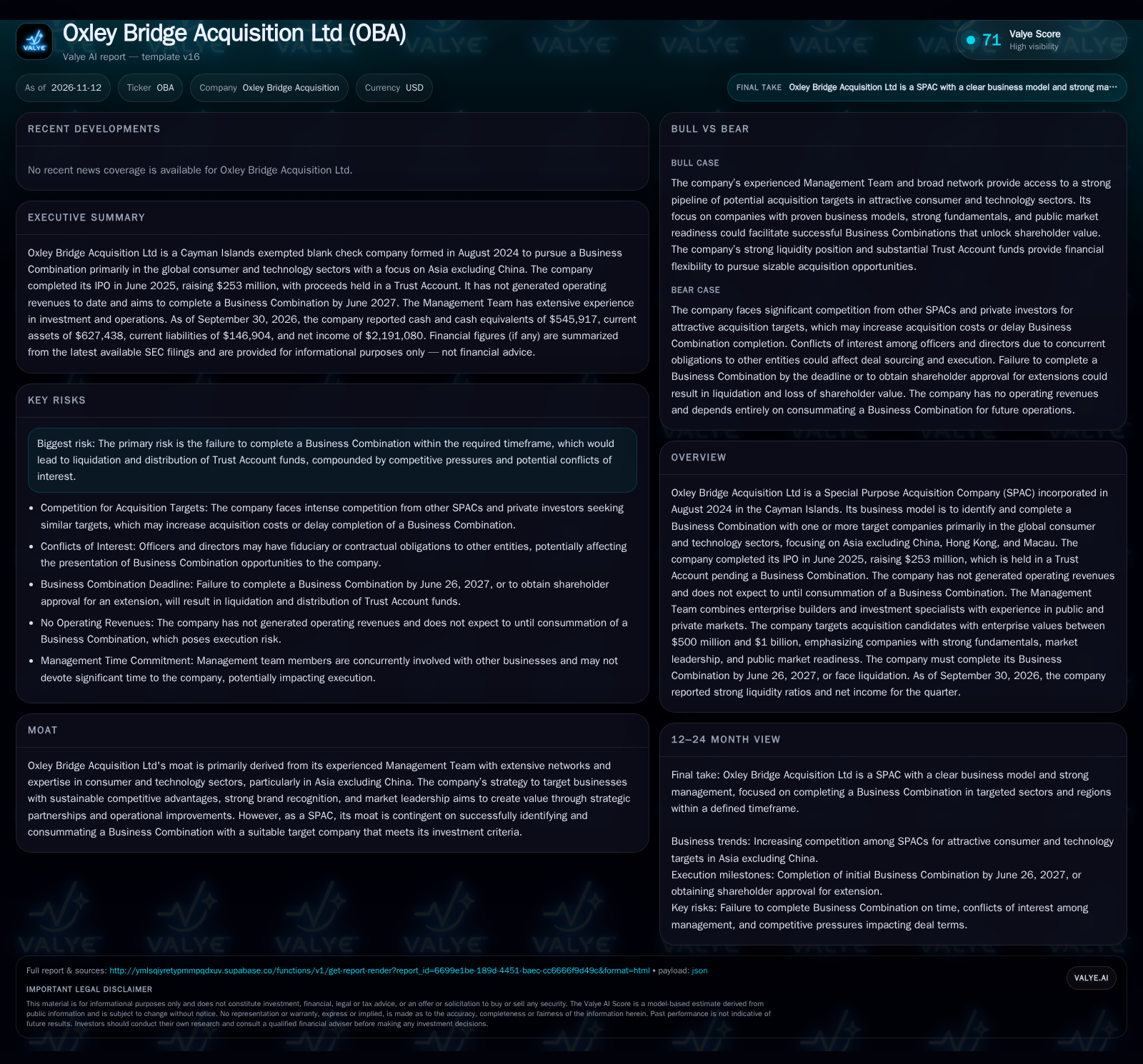
Oxley Bridge Acquisition Ltd is a SPAC with $253 million in trust, aiming to merge with a high-growth consumer or technology company in Asia (excluding China) by June 2027. The management team’s track record and sector focus provide a foundation, but intense competition, looming deadlines, and possible conflicts of interest are material risks. The next 18 months are critical for sourcing, negotiating, and closing a value-accretive deal before facing potential liquidation. [S2]
Oxley Bridge Acquisition Ltd stands at a familiar yet high-stakes crossroads for modern SPACs: flush with $253 million in trust from its 2025 IPO, the company has until June 2027 to identify and consummate a merger with a disruptive, high-growth business in Asia’s consumer or technology sectors (excluding China). The management team’s reputation and network provide a plausible sourcing advantage, but with no operating revenues and a finite window to execute, the next 18 months will determine whether Oxley Bridge can deliver shareholder value— or become another SPAC forced into liquidation by competition, timing, or execution missteps. [S2]
The SPAC Clock Is Ticking: Material Facts Shaping Oxley Bridge’s Next Moves
Oxley Bridge Acquisition Ltd, incorporated in August 2024 as a Cayman Islands exempted company, completed its IPO on June 26, 2025, raising $253 million from the sale of 25,300,000 units at $10 each. These proceeds, along with an additional $6.4 million from private placement warrants, were placed in a trust account and remain the primary financial resource until a business combination is closed. The company has no operating revenues and reported net income of $2.19 million for the quarter ended September 30, 2026, which likely reflects interest income on trust assets rather than business operations. Critically, Oxley Bridge must close a business combination by June 26, 2027, or face liquidation and return of trust assets to shareholders. [S2]
The management team, led by CEO Jonathan Lin and CFO Gary Chan, brings experience in venture capital, private equity, and public markets. The targeted acquisition sweet spot is a company in the global consumer or technology sector (outside China) with an enterprise value of $500 million to $1 billion. Competition from other SPACs and private investors in the same regional and sectoral hunting grounds could raise the bar for deal quality and speed. [S2]
How the Value-Creation Model Hinges on Sourcing, Negotiation, and Post-Deal Execution
A SPAC like Oxley Bridge does not generate operating revenues prior to a business combination; its economic model is binary. Success depends on sourcing a target at an attractive valuation, negotiating favorable terms, and facilitating a public listing that unlocks value for both original owners and SPAC shareholders. The trust account provides the capital base for an acquisition, and the structure (including public shares and warrants) incentivizes sponsors to close a deal but also exposes them to dilution if deal economics are poor or redemptions are high.
The size of Oxley Bridge’s trust ($253 million) supports the pursuit of mid-size targets, bridging to enterprise values of $500 million to $1 billion through possible PIPE (private investment in public equity) financing or equity rollover from target shareholders. However, deal economics are sensitive to the negotiation of valuation, redemptions by SPAC shareholders at the time of the merger vote, and the fee structure for sponsors and advisors. If redemptions are high— a common occurrence in the current SPAC cycle— the effective capital delivered to the target could shrink, reducing the scale of the business combination or forcing last-minute renegotiation.
Operating leverage and fixed costs are minimal pre-transaction, but post-combination, success depends on the operating economics of the acquired business: revenue growth, margins, and capital needs in the chosen sector. The SPAC structure itself offers little recurring revenue or margin buffer; all value is contingent on the deal.
Sourcing Advantage or Commodity Capital? The Realities of SPAC Competition in Asia’s Growth Sectors
Oxley Bridge’s potential edge comes from its management team’s networks and sector experience— particularly in Asian technology and consumer markets. In theory, this could translate to access to proprietary deal flow or better insight into which companies are genuinely public-ready. However, the competitive landscape is crowded: other SPACs, private equity funds, and strategic buyers are all seeking similar targets, and the pool of companies both willing and ready to go public via a SPAC has shrunk as the market cycle matures.
Unlike traditional private equity funds, SPACs face a hard deadline and public scrutiny, which can erode negotiating leverage with targets aware of the SPAC’s ticking clock. Moreover, the presence of warrants and the risk of shareholder redemptions can make SPAC capital less attractive than direct private investment. While Oxley Bridge’s focus on Asia outside China narrows the field, it also means competing with regionally specialized investors and local capital pools.
The potential for conflicts of interest— with officers and directors involved in other entities or deals— adds a further layer of complexity. If management’s relationships yield true sourcing advantages, that could translate into a differentiated outcome; if not, Oxley Bridge risks becoming a price-taker in a crowded market.
Unlocking Value: What a High-Quality Business Combination Would Require
The most favorable scenario for Oxley Bridge involves leveraging its management networks to source an under-the-radar, high-growth technology or consumer company in Asia (excluding China) that is both public-market ready and undervalued relative to its growth potential. If the team can negotiate a business combination at a reasonable valuation, minimize shareholder redemptions, and secure PIPE financing if needed, the resulting company could command a premium as a newly listed U.S. growth stock.
Confirmation of this scenario would come from announcements of a definitive business combination agreement with a target that exhibits strong fundamentals (e.g., revenue growth, gross margins, path to profitability) and a compelling narrative for U.S. public investors. Further evidence would include low redemption rates at the merger vote, successful PIPE participation (if required), and post-combination trading at or above the $10 per share trust value. A high-quality target with a clear competitive moat and management continuity would also signal a differentiated outcome.
Executing a Deal Under Pressure: The Most Likely Outcome for Oxley Bridge
The base case is that Oxley Bridge will identify a viable target within its sector and regional mandate and close a business combination before the June 2027 deadline, but under less-than-ideal conditions. Given the competitive environment and the maturing SPAC cycle, the company may need to compromise on valuation, structure, or target quality to avoid liquidation.
This scenario would be confirmed by the announcement of a deal with a company that fits the basic investment criteria but does not command a significant public-market premium. Moderate to high shareholder redemptions could reduce net cash delivered to the target, potentially necessitating additional capital raising or a smaller-scale transaction. Post-merger performance may be volatile, reflecting both the quality of the underlying business and residual SPAC-related overhang (e.g., warrant dilution, legacy shareholders). Evidence against this scenario would include failure to announce a deal by early 2027 or repeated extensions requested from shareholders.
The Cost of Missing the Window: What Liquidation Would Mean for Shareholders
The adverse scenario is that Oxley Bridge fails to secure a business combination by the June 2027 deadline, or cannot obtain shareholder approval for an extension, resulting in liquidation. In this outcome, trust assets are returned to public shareholders— typically close to the original $10 per share, but with no upside beyond interest earned, and all sponsor at-risk capital (warrants, founder shares) becoming worthless.
This scenario could be confirmed by a lack of deal announcements as the deadline approaches, or by repeated disclosures of failed negotiations, high redemption risk, or inability to attract PIPE financing. Additional warning signs would include management turnover, disclosures of conflicts of interest impeding deal flow, or deteriorating market sentiment toward SPAC mergers in the targeted sectors.
Testing the Thesis: Milestones and Metrics That Will Define Oxley Bridge’s Outcome
Announcement of a definitive business combination agreement with a target that fits the stated sector, region, and enterprise value criteria.
Level of shareholder redemptions at the time of the merger vote— low redemptions would indicate stronger support and more trust capital delivered to the target.
PIPE financing commitments (if disclosed), as a sign of third-party validation and capital sufficiency for the post-merger entity.
Quality and operating fundamentals of the announced target— public disclosure of revenue growth, profitability, and competitive positioning would help test the thesis.
Evidence of conflicts of interest or management time constraints affecting deal sourcing or execution, as revealed in future filings or proxy statements.
Any requests for extensions to the business combination deadline, which would signal delays or difficulties in closing a deal.
Changes in the competitive landscape for SPACs in the target region or sectors— for example, an uptick in SPAC liquidations or notable successful deals by peers.
Disclaimer: This is research-only, informational analysis and not investment advice. It may include AI-generated interpretation and general industry context. Always verify important details using primary sources.

Comments