
RF Acquisition Corp II: Shareholder-Approved Nanyang Biologics Merger Redefines SPAC Value Proposition
RF Acquisition Corp II has secured shareholder approval for a $1.5 billion business combination with Nanyang Biologics, signaling a high-stakes pivot from blank check company to public AI drug discovery platform. The path forward hinges on integration execution, sector appetite, and the realized promise of deep tech in Asia.
RF Acquisition Corp II’s transformation from a cash-shell SPAC to the public vehicle for Nanyang Biologics, an AI-driven drug discovery firm, marks a critical inflection point. Shareholder approval and a sharp share price reaction validate market enthusiasm, but the ultimate outcome will depend on post-merger operational delivery, sector dynamics, and the ability to unlock value in Asia’s deep tech landscape. If integration and execution match investor expectations, the company could emerge as a notable public player in AI-powered biotech.
RF Acquisition Corp II’s journey as a blank check company has reached a decisive turning point. With the August 2026 shareholder approval for its $1.5 billion business combination with Nanyang Biologics, the SPAC is poised to transform from a passive trust vehicle into a public platform for AI-powered drug discovery in Asia. While the dramatic share price reaction signals market excitement, the real challenge now shifts to integration, operational execution, and sustaining investor confidence in a sector marked by high promise and equally elevated risk. The coming quarters will test whether this SPAC can successfully bridge the gap between deep tech vision and commercial reality.
Shareholder Approval and $1.5B Merger Agreement Catalyze Strategic Shift
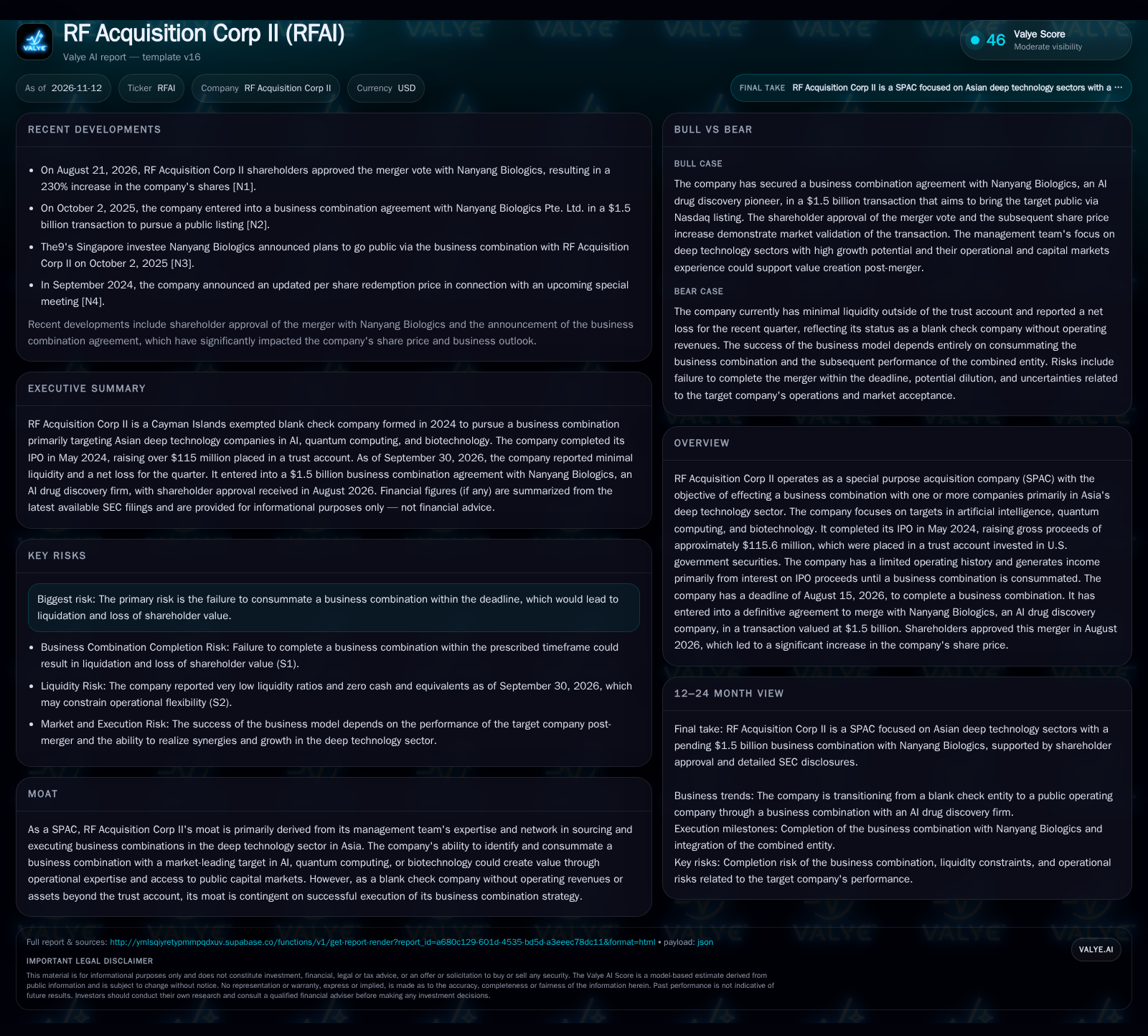
The most consequential recent development for RF Acquisition Corp II is the August 2026 shareholder approval of its merger with Nanyang Biologics, an AI drug discovery company, in a transaction valued at $1.5 billion. This event triggered a dramatic 230% increase in the company’s share price, reflecting significant market enthusiasm and perceived value creation potential [N1] [N2]. The business combination agreement, originally announced in October 2025, aims to take Nanyang Biologics public via Nasdaq, pivoting RF Acquisition Corp II from a passive cash shell to an active operator in deep tech [N3].
As of September 30, 2026, RF Acquisition Corp II reported minimal liquidity outside its trust account and continued to incur a net loss, consistent with its status as a pre-merger SPAC [S2]. The company faces a hard deadline of August 15, 2026, to close the deal or risk liquidation, making the successful completion and integration of this merger the primary catalyst for future value.
From Interest Income to AI Drug Discovery: The Shift in Economic Model
RF Acquisition Corp II’s economics to date have been straightforward: the company raised $115.6 million in its May 2024 IPO and has generated income solely from interest on these proceeds, which are held in a trust account invested in U.S. government securities [S2]. Operating expenses and transaction costs have produced net losses typical of early-stage SPACs.
Post-merger, the economics change fundamentally. The combined entity’s ability to create value will depend on Nanyang Biologics’ platform for AI-driven drug discovery—a model that, if successful, could enable accelerated drug candidate identification, lower R&D costs, and potentially faster time-to-market for new therapeutics. However, AI drug discovery is capital-intensive, with high fixed costs associated with software, compute infrastructure, and regulatory compliance, and variable economics tied to milestone achievements, licensing deals, or drug commercialization.
The company’s future funding needs are likely to be substantial: scaling AI platforms, supporting clinical trials, and pursuing commercialization all require sustained capital. The SPAC structure provides initial public market access, but further follow-on offerings or partnerships may be necessary if Nanyang Biologics aims to compete with established biotech incumbents.
Assessing Moat and Rivalry in AI-Driven Biotech
RF Acquisition Corp II’s competitive position post-merger will be defined by Nanyang Biologics’ technology, data assets, and execution capabilities. In AI-powered drug discovery, key sources of advantage can include proprietary algorithms, exclusive datasets (such as unique biological or clinical data), and talent capable of integrating machine learning with life sciences.
The competitive landscape is crowded, with global biotech and pharma majors, as well as well-funded startups, investing heavily in AI-driven platforms. Barriers to entry are high due to the need for deep technical expertise, regulatory know-how, and access to high-quality training data. However, switching costs for large pharma partners may be modest unless Nanyang Biologics can demonstrate clear superiority in predictive accuracy, speed, or cost reduction.
The Asia focus could provide some differentiation, particularly if Nanyang Biologics leverages regional networks, regulatory pathways, or partnerships less accessible to Western competitors. Nevertheless, the ultimate moat will rest on the ability to translate AI predictions into clinically and commercially successful drugs—a challenge that has proven formidable even for well-capitalized incumbents.
Unlocking Value: If Nanyang’s AI Platform Delivers Breakthrough Results
The most favorable scenario is one in which the merger closes smoothly, and Nanyang Biologics’ AI platform delivers clear, validated breakthroughs in drug discovery. If the company can rapidly identify novel drug candidates, secure lucrative development partnerships, and move compounds into the clinic faster than traditional methods, it could attract both investor capital and strategic interest from major pharmaceutical companies.
Evidence confirming this upside would include: early-stage licensing deals, successful clinical trial initiations, recurring R&D partnerships, and rapid revenue growth from milestone or royalty payments. If disclosed, metrics such as drug candidate pipeline progression, AI-driven prediction accuracy, and partner retention would provide further validation.
Sustained capital markets appetite for deep tech—particularly in Asia—would reinforce the upside case, potentially enabling additional funding rounds to fuel growth and platform expansion.
Integration, Execution, and the Realities of AI Biotech Commercialization
The most plausible path is that the merger proceeds as planned, Nanyang Biologics transitions to public company status, and the combined entity faces the typical challenges of scaling an AI drug discovery platform. Execution risks will be front and center: integrating SPAC infrastructure with a high-growth operating company, navigating public market scrutiny, and managing the burn rate while pursuing partnership or licensing deals.
Near-term revenues are likely to be modest, with the bulk of value dependent on achieving scientific and commercial milestones. The company may face volatility as it balances investor expectations, the long timelines of drug development, and the need for additional capital. Confirming evidence would include progress updates on integration, new R&D collaborations, and disclosure of development pipelines moving forward. Missed targets, delays in partnership formation, or lack of traction in pipeline advancement would argue against this scenario.
Deal Failure or Post-Merger Underperformance: Pathways to Value Erosion
A negative outcome could materialize if the business combination fails to close by the August 2026 deadline, resulting in liquidation and loss of shareholder value. Even if the deal closes, significant downside risk remains if Nanyang Biologics fails to deliver on its AI drug discovery promise—whether due to technical setbacks, inability to secure partnerships, or insufficient funding for clinical progress.
Confirming evidence for this scenario would include deal delays, regulatory or shareholder obstacles, or post-merger disclosures showing weak R&D pipeline progression and missed partnership milestones. Persistent net losses without corresponding operational traction, or a sharp decline in share price post-listing, would further validate the downside case.
Milestones and Metrics to Gauge Post-Merger Deep Tech Value Creation
Completion of the business combination with Nanyang Biologics before the August 15, 2026, deadline.
Disclosure of Nanyang Biologics’ post-merger R&D pipeline progress, including number and stage of drug candidates.
If disclosed, new partnership or licensing agreements with major pharma or biotech firms.
Updates on integration and organizational alignment post-merger, including management continuity and operational milestones.
Reported revenue growth tied to licensing, milestone payments, or R&D collaborations, if available.
Burn rate and capital position of the combined entity, especially in relation to planned clinical trials and platform expansion.
Share price performance and trading liquidity post-combination, as a proxy for market confidence in the deep tech thesis.
If disclosed, metrics on AI platform predictive performance and real-world validation in drug candidate identification.
Disclaimer: This is research-only, informational analysis and not investment advice. It may include AI-generated interpretation and general industry context. Always verify important details using primary sources.

Comments