
Nortech Systems: Shifting Toward Value-Added Solutions Amid Concentration and Supply Chain Headwinds
Nortech Systems is navigating a pivotal transformation, seeking to move up the value chain with solution-based offerings in complex EMS while contending with acute customer concentration and persistent supply chain risks. The company’s Q3 2026 results, restructuring efforts, and focus on fiber-optic technologies highlight both the potential for higher-margin growth and the operational hurdles that could define its next phase.
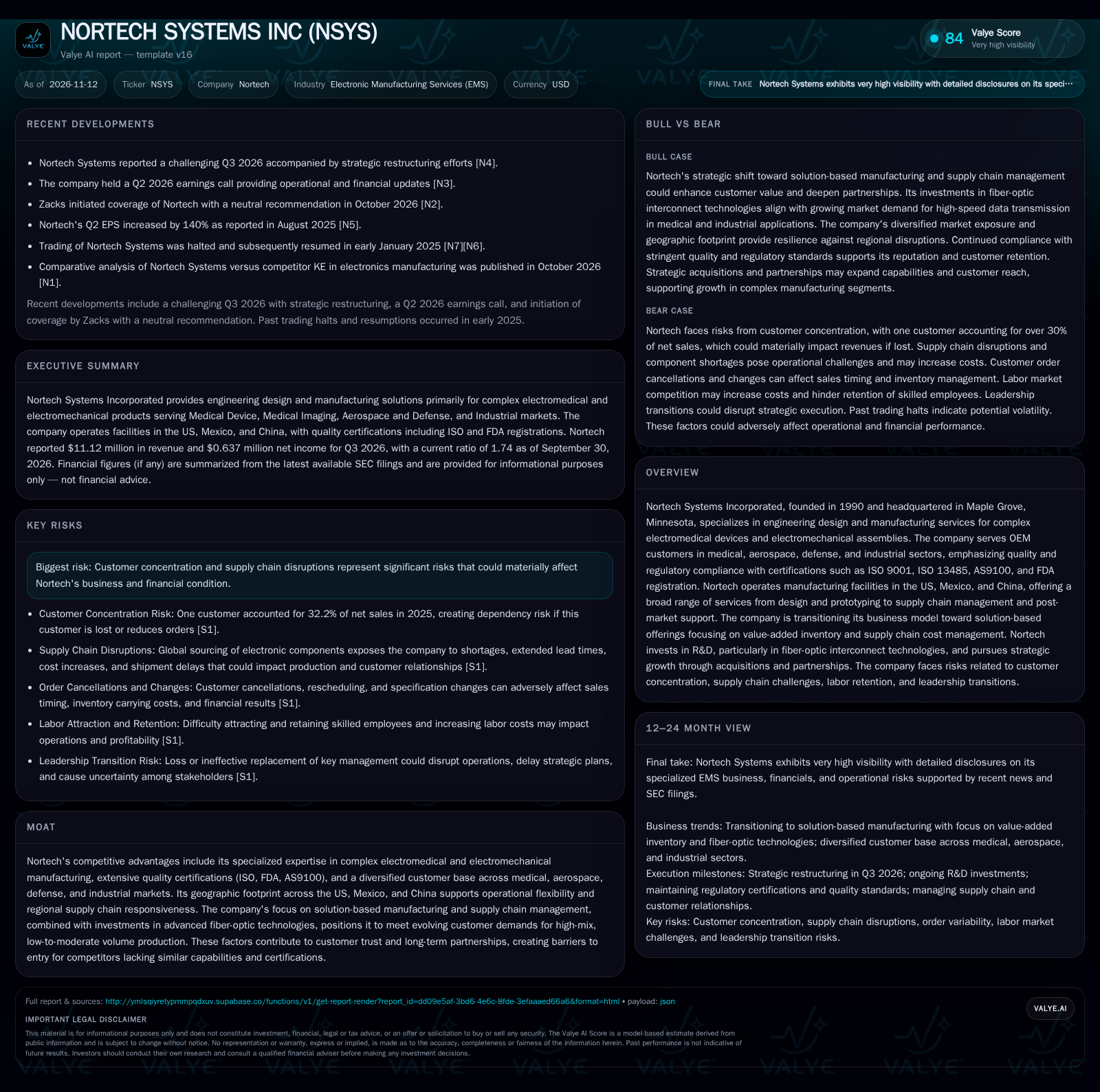
Nortech Systems is repositioning from transactional EMS to solution-based manufacturing, targeting higher-value, lower-volume opportunities in medical, aerospace, and industrial markets. The company’s Q3 2026 results reflect both this strategic pivot and ongoing challenges, including high customer concentration and supply chain disruptions. Success hinges on deepening customer relationships, expanding advanced technology offerings, and managing operational risks tied to concentrated revenue streams and global sourcing dependencies. [S1] [S2] [N4]
Nortech Systems stands at an inflection point as it seeks to redefine its role in the electronic manufacturing services (EMS) landscape. Following a challenging Q3 2026 that prompted strategic restructuring, the company is doubling down on value-added, solution-based offerings for OEMs in medical, aerospace, and industrial sectors. However, with over 30% of revenue tied to a single customer and ongoing supply chain volatility, the path to sustainable margin improvement remains complex. The company’s near-term performance will hinge on its ability to deepen customer integration, execute on advanced technology investments, and mitigate acute operational risks.
Q3 Results, Customer Concentration, and Strategic Restructuring Define Today’s Reality
For the quarter ended September 30, 2026, Nortech reported $11.12 million in revenue and net income of $0.637 million, resulting in basic EPS of $0.23. These figures come in the context of a challenging operating environment and strategic restructuring efforts disclosed in March 2026, suggesting management is responding proactively to margin pressures and operational complexity. [S2] [N4]
Customer concentration remains acute: one OEM accounted for 32.2% of net sales in 2025, making Nortech highly sensitive to changes in this relationship. [S1]
The company reported cash and liquidity metrics for the period; these figures do not by themselves establish operating runway, investment capacity, financial flexibility, or financing capacity. [S2]
Nortech’s business model shift—to solution-based, value-added supply chain and inventory management for complex assemblies—anchors both recent restructuring and ongoing R&D investment, particularly in fiber-optic interconnects. [S1] [N4]
How Nortech’s Economics Could Shift with Its Move Up the Value Chain
Historically, EMS providers like Nortech have operated on thin gross margins, typically in the mid-single digits to low teens, largely due to transactional, price-driven contracts and intense competition. The shift to solution-based offerings—encompassing design, prototyping, supply chain management, and post-market services—can improve margins by embedding the company deeper into customer workflows and allowing for premium pricing on complexity, flexibility, and regulatory compliance.
Nortech’s focus on low-to-moderate volume, high-mix production for electromedical and aerospace customers positions it for higher unit economics than commodity high-volume EMS. If the company succeeds in providing integrated inventory and supply chain management, it may extract recurring or semi-recurring revenue streams and reduce dependency on purely transactional sales cycles.
Operating leverage is a double-edged sword: fixed costs in engineering, quality, and certifications are high, but incremental revenue from value-added projects can drop more profitably to the bottom line once facility utilization improves. Conversely, underutilization—exacerbated by customer order volatility or single-customer attrition—can quickly erode margins.
Capital needs in this segment are moderate but persistent, driven by ongoing R&D (notably in fiber-optic technologies), regulatory compliance, and required investments in facility capabilities across the US, Mexico, and China. [S2]
Specialization, Certifications, and Geographic Spread: Sufficient to Sustain Differentiation?
Nortech’s competitive positioning rests on its credentials in complex, regulated manufacturing. Certifications such as ISO 9001, ISO 13485, AS9100, and FDA registration allow access to medical, aerospace, and defense markets that impose high switching costs and regulatory hurdles for new entrants. This provides a modest moat compared to commodity EMS players.
However, the EMS sector is crowded with both global giants and regional specialists. Larger competitors often offer broader service portfolios, lower costs through scale, and greater ability to absorb supply chain shocks. Smaller niche players may compete on agility, customer intimacy, or technical specialization.
Nortech’s geographic footprint—US, Mexico, China—provides flexibility to meet customer preferences for regional sourcing and supply chain redundancy. Yet, this also increases management complexity and exposure to cross-border logistics and regulatory risks.
The company’s emphasis on fiber-optic interconnects targets an area of rising demand, especially in medical imaging and high-speed industrial applications. Whether this specialization can produce sustainable pricing power or simply keeps pace with evolving customer expectations is an open question.
Unlocking Margin Expansion Through Deepened Customer Integration and Advanced Solutions
If Nortech successfully executes its transition to solution-based manufacturing—embedding itself as a strategic partner rather than a transactional supplier—it could achieve higher-margin, longer-duration contracts, especially with medical and aerospace OEMs that value quality, regulatory compliance, and supply chain co-management.
Growth in fiber-optic interconnects could support premium pricing if Nortech can demonstrate distinctive technical capabilities and reliability in demanding applications. Expansion of post-market services (e.g., inventory management, rapid prototyping, and end-of-life support) may also produce stickier customer relationships and recurring revenue streams.
Upside would be confirmed by a rising gross margin trend, evidence of multi-year or programmatic customer commitments, successful cross-selling of new technology offerings, and declining revenue concentration as the customer base diversifies.
A falsification would be continued margin compression, persistent dependence on a single customer, or inability to scale new solution offerings beyond pilot or legacy programs.
Incremental Progress Amid Structural Risks and Execution Demands
The most plausible outcome is that Nortech achieves modest growth and gradual margin improvement as it expands solution-based services, but remains constrained by customer concentration and ongoing supply chain challenges. The company is likely to win additional business from existing OEMs and possibly add select new customers in adjacent verticals, but its revenue mix will remain skewed toward a handful of large accounts.
Operating margins may drift upward if restructuring yields cost savings and if value-added contracts become a larger share of total sales. However, supply chain volatility and labor market pressures could offset some of these gains. The capital base is sufficient for incremental investment but does not support aggressive expansion without external funding.
Evidence supporting this scenario would include stable or slightly improving gross margins, retention of major customers, and steady progress in R&D outputs (such as new fiber-optic solutions or expanded certifications). A reversal—such as the loss of the largest customer or a major supply chain disruption—would indicate downside risk.
A Single-Customer Shock or Unresolved Supply Chain Issues Derail the Strategy
The most acute risk is the loss or significant reduction of orders from the customer accounting for over 30% of sales. This would result in rapid revenue and margin contraction, underutilization of fixed assets, and likely restructuring charges or layoffs. Given the high fixed cost structure of regulated EMS, the company may struggle to right-size quickly.
Unresolved supply chain disruptions—such as persistent component shortages, extended lead times, or major shipment delays—could lead to missed deliveries, customer dissatisfaction, and increased costs from expedited sourcing or inventory write-downs.
A downside scenario would be confirmed by a sharp drop in quarterly revenue, negative operating income, or disclosures of order cancellations and major customer losses. A prolonged period of cash burn or the need for distress financing would further confirm severe operational stress.
Milestones and Metrics That Will Reveal Whether Nortech’s Transformation Is Gaining Traction
Gross margin trend: Sustained improvement would confirm value-added solution uptake and improved pricing power.
Customer concentration ratio: Declining dependence on the top customer would signal healthier revenue diversification and reduced risk.
Order backlog and program renewals (if disclosed): Growth in multi-year or programmatic contracts would indicate deeper strategic integration with OEMs.
New product introduction rate—especially in fiber-optic interconnects and complex assemblies: Acceleration would suggest R&D productivity and competitive differentiation.
Facility utilization rates (if disclosed): Higher and more stable utilization would reflect successful demand smoothing and operational leverage.
Supply chain lead times and component availability: Improved metrics here would validate supply chain management initiatives.
Employee retention and labor cost trend: Stability or improvement would reduce operational disruption risk and support execution.
Disclaimer: This is research-only, informational analysis and not investment advice. It may include AI-generated interpretation and general industry context. Always verify important details using primary sources.

Comments