
Johnson Controls: Data Center Cooling, AI-Driven Upgrades, and the Stakes of Scale in Building Technologies
Johnson Controls is deepening its focus on energy-efficient HVAC and advanced cooling for AI data centers, leveraging direct sales and a vast installed base for recurring service revenue. While recent operational expansion and robust earnings point to solid execution, the company’s future hinges on continued innovation, navigating customer concentration in hyperscale data centers, and maintaining differentiation amid intensifying competition.
Johnson Controls is expanding production and targeting advanced cooling solutions for AI-driven data centers, which are increasingly central to its growth. Recent earnings growth and operational expansion in Dublin reflect momentum, but the company’s reliance on innovation and a concentrated customer base in data centers introduce both opportunity and risk. Execution on new product development, recurring service revenue, and navigating evolving competition will determine the next phase.
Johnson Controls International plc is at a strategic crossroad, leveraging its global scale and innovation engine to capture surging demand for energy-efficient HVAC and advanced cooling—especially in AI-powered data center infrastructure. Recent operational expansion in Dublin and a strong Q4 earnings print point to near-term execution strength. Yet, the company’s heavy focus on mission-critical verticals such as data centers introduces both upside from secular growth and downside from customer concentration and technological disruption. The question for investors: Can Johnson Controls sustain its edge in a sector where recurring service revenue, regulatory demands, and rapid innovation collide?
Operational Expansion and Data Center Focus Define the Present Landscape
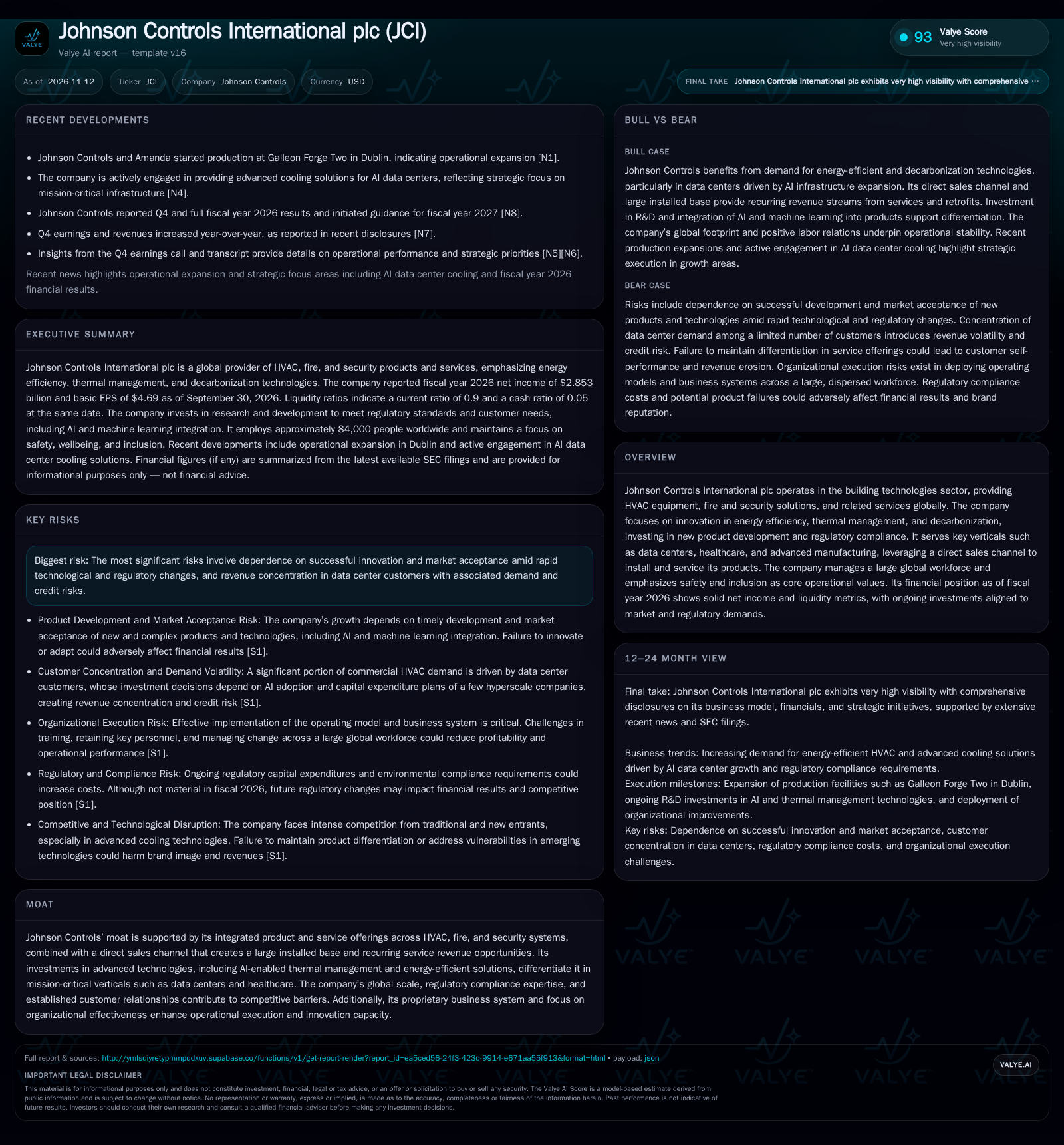
Several recent developments are reshaping the near-term context for Johnson Controls. First, production has commenced at the Galleon Forge Two facility in Dublin, signaling a tangible commitment to increasing operational capacity and serving European and global customers [N1]. Second, the company is actively developing and deploying advanced cooling solutions for AI data centers, a rapidly expanding and technically demanding vertical [N4]. Third, fiscal Q4 2026 saw both earnings and revenues increase year-over-year, confirming momentum in core operations [N7]. Finally, as of September 30, 2026, Johnson Controls reported net income of $2.853 billion and a global workforce of 84,000, with safety metrics suggesting operational discipline [S1]. These facts collectively indicate a business in expansion mode, with a sharpened focus on mission-critical infrastructure and a stable operational backbone.
How Johnson Controls Captures Value: Recurring Revenue, Capital Needs, and the Leverage of Scale
Johnson Controls’ business model is anchored in a blend of equipment sales (HVAC, fire, security) and recurring service revenue from its installed base, especially via its direct sales channel [S1]. The economics of this model rely on a high upfront capital outlay for customer acquisition and installation, followed by ongoing maintenance, retrofit, and upgrade contracts. In mission-critical verticals like data centers, the mix is shifting toward higher-value solutions—such as AI-optimized cooling—where performance, reliability, and regulatory compliance are paramount.
Pricing power is typically stronger in these regulated, high-stakes environments, particularly as data center operators demand energy efficiency and thermal management tailored for AI workloads. However, the capital intensity of scaling production (e.g., new facilities like Galleon Forge Two) and the need for continuous R&D investment to keep pace with regulatory and technological change create a constant funding requirement. Operating leverage can be significant: once fixed investments in R&D, manufacturing, and organizational systems are made, incremental service contracts and retrofits can drive improved margins—provided the installed base is retained and expanded.
Seasonality affects product sales (notably air conditioning in summer), but service revenues help smooth cash flows. Regulatory capital expenditures, though not material in fiscal 2026, could become more significant if standards tighten, impacting free cash flow and capital allocation flexibility [S1].
Competitive Moats and Evolving Threats in HVAC and Data Center Infrastructure
Johnson Controls benefits from several entrenched advantages: an integrated suite of HVAC, fire, and security solutions; a global direct sales and service network; and deep relationships in regulated, high-specification verticals like data centers, healthcare, and advanced manufacturing [S1]. Its proprietary business system and focus on organizational effectiveness provide a framework for continuous improvement.
However, these moats are under pressure from two directions. First, the rapid adoption of AI in data centers is attracting both established industrials and technology-driven new entrants, intensifying competition in advanced cooling and energy management. Second, customer concentration—especially among hyperscale data center operators—creates revenue and credit risk. If these customers seek more in-house solutions or negotiate harder on price, margin pressure could follow.
Substitution risk also looms from emerging technologies, such as liquid cooling, modular data center designs, or software-driven energy optimization. While Johnson Controls invests in AI and machine learning integration, sustaining differentiation will depend on the pace of innovation, ability to prove superior outcomes, and responsiveness to shifting regulatory and customer demands.
AI Infrastructure Surge and Regulatory Tailwinds Could Unlock Accelerated Growth
In a favorable scenario, global investment in AI-driven data centers continues to accelerate, with hyperscale operators prioritizing energy efficiency and advanced cooling as core to their capital programs. Johnson Controls, leveraging its direct sales force and relationships, becomes a preferred partner for these mission-critical retrofits and new builds.
If the company’s R&D investments yield differentiated solutions—such as AI-optimized thermal management that demonstrably reduces power usage effectiveness (PUE)—it could secure multi-year service and upgrade contracts, increasing recurring revenue and customer lock-in. Regulatory tightening on building energy standards would further boost demand for Johnson Controls’ decarbonization offerings.
Evidence that would confirm this scenario includes sustained double-digit growth in orders and service contracts from data center clients (if disclosed), new regulatory-driven product launches, and margin expansion in the service segment. An uptick in production output from facilities like Galleon Forge Two and customer win announcements in AI infrastructure would also support this thesis.
Incremental Innovation and Balanced Execution in a Competitive Market
The most plausible scenario is a continuation of moderate growth, driven by incremental product innovation, steady service revenue from the installed base, and selective wins in high-growth verticals. Johnson Controls maintains its competitive position through ongoing R&D and operational efficiency, but faces periodic pricing pressure and technology substitution threats.
Customer concentration in data centers results in some revenue lumpiness, but is partly offset by diversification into healthcare, higher education, and other commercial sectors. Regulatory requirements for energy efficiency steadily ratchet up capital expenditures, but not to a level that fundamentally alters the company’s ability to generate free cash flow.
This scenario would be confirmed by continued year-over-year growth in earnings and revenue, a stable or slowly improving margin profile, and evidence of new product launches or retrofits in both data centers and other core verticals. Failure to disclose significant customer losses or margin compression would also support the base case.
Innovation Stalls or Customer Concentration Risks Materialize
Adverse outcomes could emerge if Johnson Controls fails to keep pace with new cooling and energy management technologies, leading to lost bids or customer defections—particularly among hyperscale data center clients. If a handful of large customers delay or reduce capital spending due to macro or technology shifts, the impact on revenue and visibility could be material.
A further risk is regulatory or compliance cost escalation, which could erode margins—especially if the company must accelerate capital expenditures to meet new standards. Organizational execution missteps, such as failure to integrate new technologies or manage talent across a vast workforce, would amplify volatility.
Evidence for this scenario would include a decline in orders from data center and other mission-critical customers, negative earnings surprises, or disclosures of major project delays or cost overruns. An uptick in customer self-performance or new competitive entrants winning large contracts would also signal downside.
What Will Distinguish Johnson Controls’ Performance in the Next 12-24 Months?
Growth rates in orders and service contracts from data center and mission-critical verticals—if disclosed—would provide direct evidence of momentum or customer concentration risk.
The pace and scale of new product launches in AI-optimized cooling and energy efficiency, including commercial adoption rates and customer testimonials.
Gross margin trends in the service and retrofit segments, as a proxy for pricing power and recurring revenue resilience.
Capital expenditure disclosures, especially relating to regulatory compliance or facility expansions, would indicate investment discipline and future capacity.
Updates on operational output and utilization rates at new facilities such as Galleon Forge Two.
Evidence of customer wins or losses in hyperscale data centers and other major verticals—announced contracts or project awards would be most informative.
Trends in safety and labor metrics, such as TRIR and LTIR, especially amid global workforce expansion or restructuring.
If disclosed, retention and renewal rates for long-term service contracts across core verticals would help test the sustainability of recurring revenue.
Disclaimer: This is research-only, informational analysis and not investment advice. It may include AI-generated interpretation and general industry context. Always verify important details using primary sources.

Comments