
Applied Aerospace & Defense: Integration Ambitions, Sector Complexity, and the Stakes of Post-IPO Expansion
A string of targeted acquisitions and fresh IPO capital position Applied Aerospace & Defense, Inc. to pursue broader solutions in aerospace and defense manufacturing, but customer concentration, integration risk, and the realities of government budget cycles introduce meaningful execution hurdles.
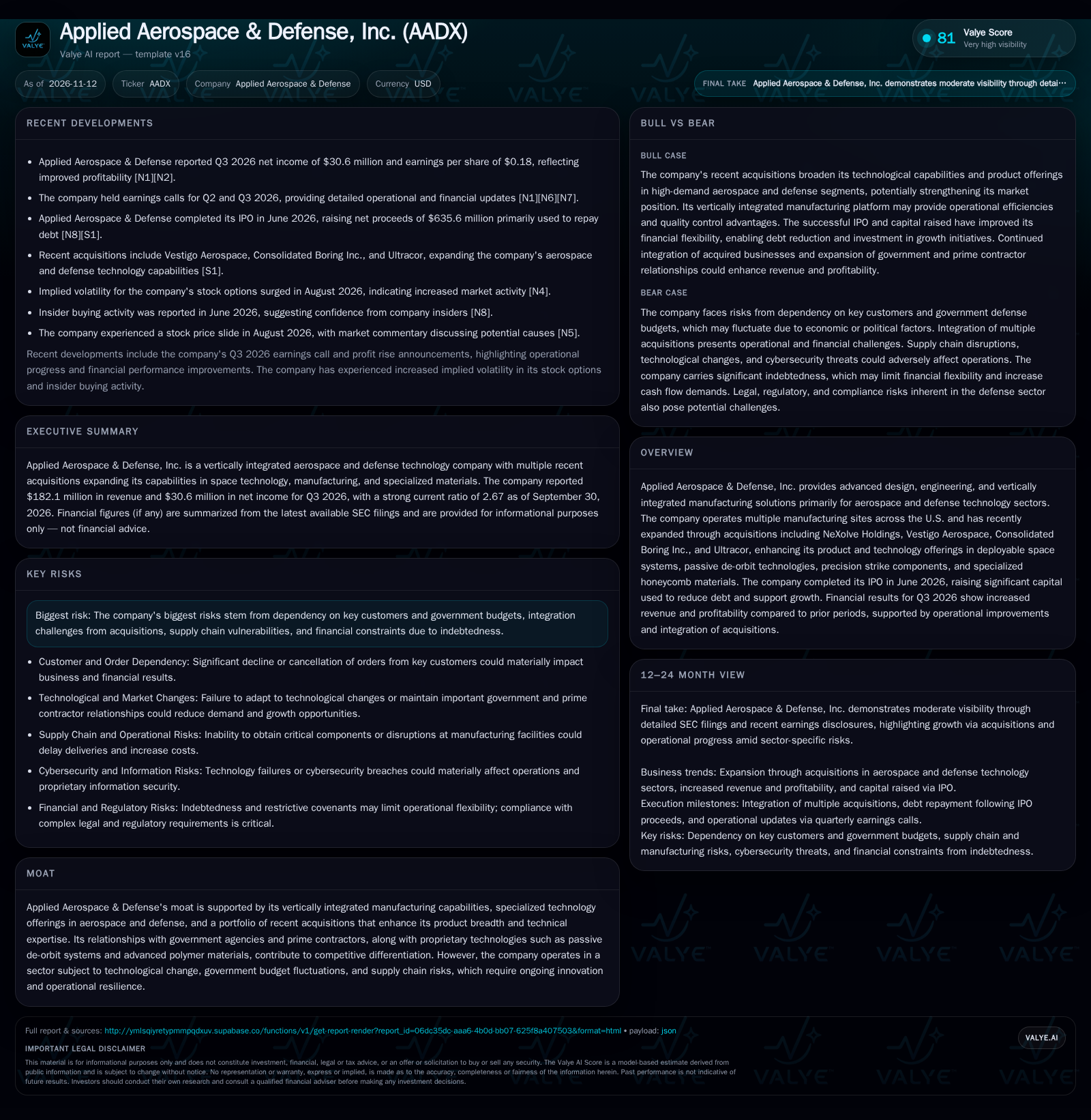
Applied Aerospace & Defense, Inc. (AADX) is leveraging recent acquisitions and the proceeds from its June 2026 IPO to expand its capabilities in advanced aerospace and defense manufacturing. Its vertically integrated model and new technologies could drive operational leverage and broaden its customer base, but the company remains exposed to government budget cycles, customer dependency, and the challenge of integrating multiple businesses in quick succession. The near-term thesis pivots on how effectively AADX can translate its broadened capabilities into sustainable, higher-margin contracts while managing sector-specific risks and capital discipline. [S1]
Applied Aerospace & Defense, Inc. is at a strategic inflection point following a high-profile IPO and a wave of targeted acquisitions that have broadened its technical and manufacturing capabilities. With a freshly recapitalized balance sheet and an expanded portfolio spanning deployable space systems, precision strike components, and advanced materials, the company is seeking to deepen its footprint in mission-critical aerospace and defense markets. The challenge now is to realize the promised benefits of scale and integration in a sector marked by customer concentration, technology shifts, and the unpredictability of government spending cycles. The next 12-24 months will test AADX’s ability to convert its platform into sustained growth and margin improvement—or reveal the limits of rapid expansion in a complex, risk-laden industry. [S1]
IPO Proceeds and Acquisition Wave Reshape Strategic Options
Applied Aerospace & Defense completed its IPO in June 2026, issuing 32.5 million shares at $20 per share for net proceeds of $635.6 million, which were primarily used to repay borrowings. This event significantly altered the company’s capital structure and provided a foundation for further investment. [S1]
Between March 2025 and March 2026, AADX acquired four businesses—NeXolve Holdings (deployable space technology), Vestigo Aerospace (passive de-orbit systems), Consolidated Boring (precision strike components), and Ultracor (specialized honeycomb core materials)—broadening its reach across the aerospace and defense value chain. [S1]
As of September 30, 2026, the company reported $11.5 million in cash and cash equivalents, current assets of $385.6 million, and current liabilities of $144.2 million, yielding a current ratio of 2.67. Shareholders’ equity stood at $858.6 million. [S1]
Approximately 74% of AADX’s shares remain controlled by AA&D Holdings, LP, maintaining a concentrated governance structure post-IPO. [S1]
How Vertically Integrated Manufacturing Could Drive Margins and Scale
AADX’s business model centers on providing advanced design, engineering, and manufacturing solutions for demanding aerospace and defense applications. The vertically integrated platform—spanning design, fabrication, assembly, and testing—may enable tighter quality control, faster prototyping, and cost efficiencies, particularly as the company absorbs specialized technologies from its recent acquisitions.
Revenue is primarily derived from aerospace and defense customers, with contract structures that may include both fixed-price and cost-plus arrangements, depending on the program and customer type. If successfully integrated, the new capabilities in deployable space systems and advanced materials could support higher-value, more technically complex contracts, potentially improving margin mix and reducing reliance on commoditized manufacturing.
Operating leverage is plausible if AADX can drive higher throughput across its network of U.S. manufacturing facilities and realize procurement or process synergies from its acquisitions. However, the capital intensity of the sector—requiring ongoing investment in equipment, compliance, and R&D—means that fixed costs are significant, and underutilization risk is non-trivial.
The company reported cash and liquidity metrics for the period; these figures do not by themselves establish operating runway, investment capacity, financial flexibility, or financing capacity. [S1]
Specialization and Scale: Defining Edges in a Demanding Sector
AADX competes against a mix of large prime contractors, established subsystem suppliers, and niche technology firms in the aerospace and defense value chain. Its recent acquisitions provide a broader portfolio—ranging from deployable space systems to advanced composite materials—which, if effectively integrated, could differentiate the company in bids for technically demanding, mission-critical roles.
Vertically integrated manufacturing may offer an edge in quality, speed, and cost for select customers, especially those seeking turnkey subsystem solutions. Proprietary technologies, such as passive de-orbit systems and advanced polymer materials, enhance the company’s ability to address emerging regulatory and technical requirements in the space and defense domains.
However, customer concentration—likely with government agencies and major defense primes—exposes AADX to budgetary cycles, program delays, and the risk of abrupt order changes. The competitive landscape is further complicated by rapid technological evolution and the entrance of well-capitalized peers with digital engineering, additive manufacturing, or autonomous systems capabilities.
Switching costs in aerospace and defense manufacturing can be high due to qualification requirements and the mission-critical nature of components, but these advantages are counterbalanced by the long sales cycles and the need for continual innovation and compliance investment.
If Integration Accelerates Contract Wins and Margin Expansion
The most favorable scenario for AADX is one in which it rapidly integrates its new acquisitions, leveraging cross-selling and technology transfer to win larger, higher-margin contracts across its target markets. This would require smooth operational integration, realization of cost and process synergies, and the successful translation of new capabilities into differentiated bids.
Evidence that would confirm this trajectory includes a rising proportion of revenue from new technologies or acquired businesses, improved gross and operating margins, and announcements of multi-year, higher-value contracts with defense and space customers. Consistent backlog growth and improved cash flow conversion would also support the case.
AADX’s vertically integrated model could, in this scenario, attract new program wins by demonstrating the ability to deliver turnkey, high-reliability solutions—potentially allowing the company to move up the value chain and capture a larger share of customer budgets.
Managing Integration and Sector Cycles in the Near Term
The most plausible outcome is that AADX spends the next 12-24 months focused on integrating its acquisitions, maintaining legacy business, and selectively pursuing growth opportunities as government budgets and program timelines dictate. Execution risk is moderate: integration is rarely seamless, and the company’s exposure to customer and government funding cycles may result in lumpier-than-expected revenue and margin performance.
Confirming evidence would include stable or gradually improving operating margins, retention of key customers, and progress updates on integration milestones. Modest incremental contract wins from newly acquired platforms—rather than transformational new business—would be consistent with this scenario.
Negative signals would be persistent cost overruns, delays in realizing acquisition synergies, or signs of customer attrition, especially if government budget headwinds materialize.
When Customer Concentration and Integration Risk Collide
A materially adverse scenario unfolds if AADX faces delays or failures in integrating its acquisitions, resulting in operational disruption, cost overruns, or the loss of critical personnel and know-how. In parallel, if key government or prime contractor customers reduce orders or cancel programs—whether due to budget cuts, shifting priorities, or performance issues—the company could see sharp revenue and earnings declines.
This downside would be confirmed by declining sales, margin compression, missed integration milestones, or negative commentary around program performance or customer relationships. Signs of working capital strain, such as a rising need for short-term borrowing or delayed receivables collection, would also be red flags.
Given the sector’s high fixed-cost base, underutilization of manufacturing assets could quickly erode profitability and limit the company’s ability to invest in further innovation or growth.
Milestones That Will Test AADX’s Integration and Growth Thesis
Revenue and margin contribution from recently acquired businesses—if disclosed—will be crucial for assessing the success of integration and the accretive potential of the new portfolio.
Backlog evolution and the proportion attributable to new technology platforms would help gauge market acceptance and future growth prospects.
Operating margin trends and cost synergy realization, especially in the context of increased scale and vertical integration, will provide evidence of improved economics.
Customer concentration metrics—such as the percentage of revenue from top customers—will indicate progress (or lack thereof) in diversification.
Any material contract awards or extensions, particularly for mission-critical subsystems or new regulatory-driven technologies, would signal commercial validation.
Working capital and cash flow trends, especially days sales outstanding (DSO) and inventory turns, will highlight whether the company is managing growth and integration effectively.
Updates on cybersecurity readiness and supply chain resilience would be important, given the sector’s exposure to operational and regulatory shocks.
Disclosures around retention of key personnel and culture integration post-acquisition would help assess organizational risk.
Disclaimer: This is research-only, informational analysis and not investment advice. It may include AI-generated interpretation and general industry context. Always verify important details using primary sources.

Comments