
SusGlobal Energy: Facility Shutdowns, Asset Sales, and the Challenge of Rebuilding a Circular Economy Platform
SusGlobal Energy’s proprietary waste-to-energy technology and regulatory licenses once positioned it to ride the wave of circular economy mandates.
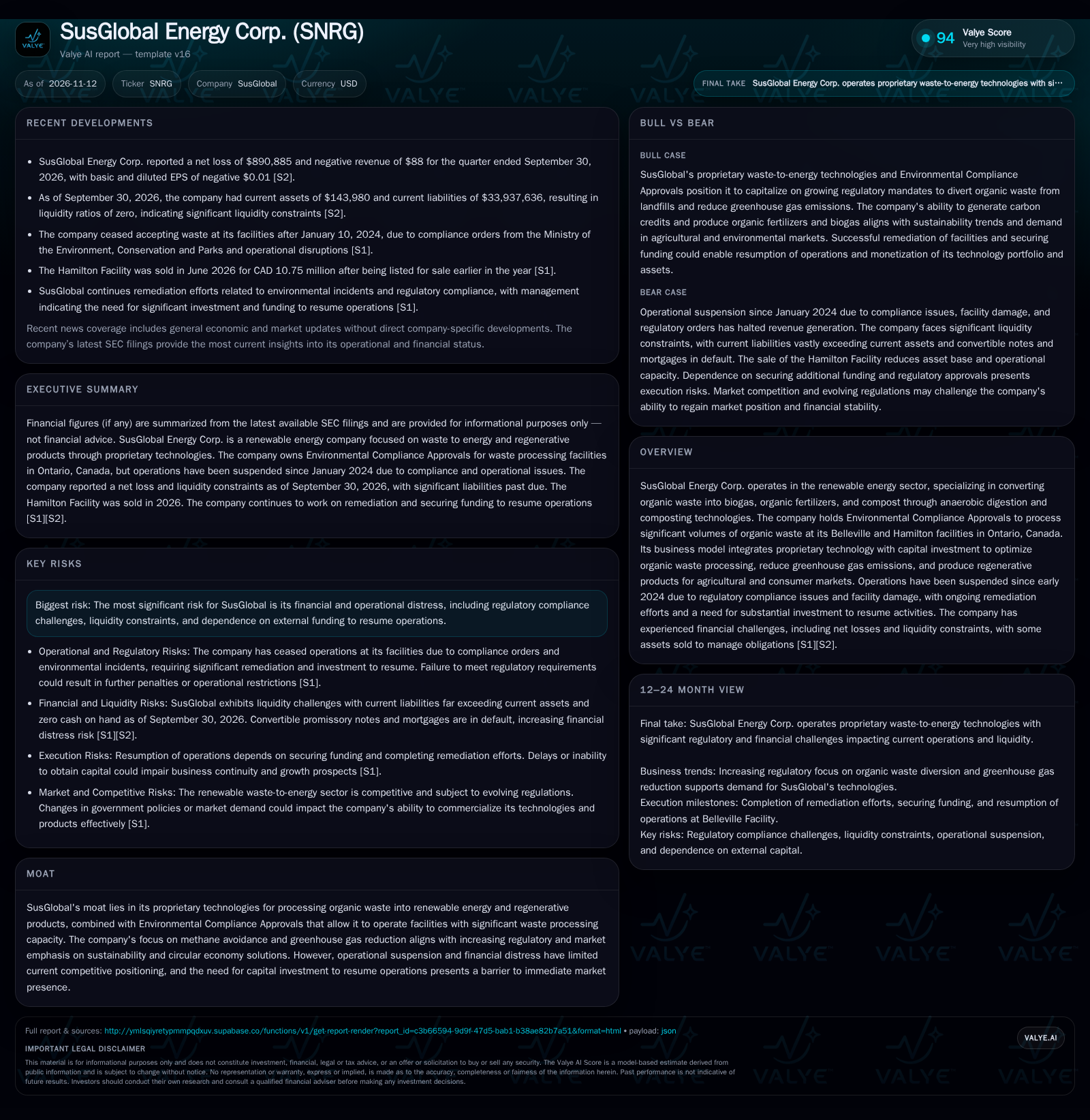
SusGlobal Energy Corp., a renewable energy company specializing in organic waste conversion and regenerative products, has suspended operations since early 2024 due to regulatory compliance failures and facility damage. The sale of its Hamilton Facility and ongoing remediation at Belleville have left it with minimal assets and a severe liquidity shortfall. The company’s prospects now rest on securing significant new funding and meeting environmental standards to resume operations, with execution and capital risks dominating the outlook. [S1] [S2]
SusGlobal Energy Corp. once aimed to be a cornerstone of the circular economy in Ontario, converting municipal organic waste into biogas, compost, and carbon credits. But a combination of regulatory setbacks, facility damage, and a severe liquidity crisis has forced the suspension of all operations and the sale of a flagship asset. With its remaining facility offline and its liabilities far exceeding assets, SusGlobal’s future now hinges on its ability to secure rescue financing and satisfy environmental mandates—an uphill battle in a capital-intensive, compliance-driven sector.
Facility Closures, Asset Sale, and Liquidity Crisis Define Present Reality
SusGlobal Energy’s operational landscape is dominated by three interlinked developments: the suspension of waste processing at all facilities since January 2024, the sale of its Hamilton Facility for CAD 10.75 million in 2026, and a crippling liquidity shortfall. The cessation of operations followed compliance orders and significant facility damage, halting revenue streams and triggering a net loss of $890,885 for the quarter ended September 30, 2026. The company’s balance sheet as of that date reveals current assets of just $143,980 against $33.9 million in current liabilities, with convertible promissory notes and mortgages in default—a textbook liquidity crisis. Meanwhile, the Belleville Facility, once a core asset with regulatory approval to process up to 70,000 tonnes of organic waste annually, remains offline, requiring substantial remediation and investment to address environmental mandates. These facts crystallize the company’s acute operational and financial distress, fundamentally altering its risk profile and strategic options. [S1] [S2]
Waste-to-Energy Economics: Capital Intensity, Revenue Volatility, and the Funding Gap
The economics of SusGlobal’s business model are rooted in high fixed costs and capital intensity, typical of waste-to-energy and composting operations. Revenue potential is tied to processing fees from municipalities, sales of organic fertilizers and compost to agricultural and consumer markets, and the ability to generate and monetize carbon credits. However, these revenue streams are highly sensitive to operational uptime, regulatory compliance, and the ability to maintain processing capacity. The company’s Environmental Compliance Approvals (ECAs) once authorized significant throughput, but without operational facilities, these approvals become stranded assets rather than revenue drivers.
Operating leverage in this sector is substantial; fixed costs for facility maintenance, regulatory compliance, and labor must be covered before incremental revenue translates into profit. With the Hamilton Facility sold and Belleville offline, SusGlobal faces a scenario where overheads persist but revenue is essentially nil. Restarting operations would require not just capital for remediation and repairs, but also working capital to rehire staff, secure feedstock contracts, and potentially invest in technology upgrades. The company’s past ability to generate Verified Emission Reductions and Removals (VERRs) from composting projects demonstrates a potential secondary revenue stream, but the market for carbon credits can be volatile and is subject to price and regulatory risk. Without a significant infusion of new capital, the path to positive cash flow appears remote. [S1] [S2]
Regulatory Licenses and Proprietary Technology: Former Advantages, Now on Hold
SusGlobal’s historical competitive edge derived from its proprietary anaerobic digestion and composting technologies, as well as its hard-won ECAs, which are regulatory prerequisites for large-scale waste processing in Ontario. These approvals can serve as a significant barrier to entry, as new competitors face lengthy permitting and compliance hurdles. Additionally, the company’s ability to generate carbon credits and serve diversified end markets—including agriculture, consumer lawn and garden, and sectors like wine and cannabis—suggested a platform for multi-product monetization.
However, these potential moats have eroded due to operational suspension and financial distress. The sale of the Hamilton Facility has reduced processing capacity and asset depth, while the non-operational status of Belleville exposes the company to the risk of regulatory revocation if remediation is delayed. Competitive pressure in the waste-to-energy sector remains intense, with municipalities and industrial customers able to shift contracts to operational rivals. In the interim, SusGlobal’s technology and licenses have become dormant assets, and the company risks losing customer relationships and market relevance the longer it remains offline.
Rescue Financing, Remediation, and Regulatory Clearance Could Reignite Growth
A favorable outcome for SusGlobal would require a multi-step recovery: securing substantial external funding (via equity, debt, or strategic partnership), completing mandated remediation at Belleville, regaining regulatory clearance, and restarting operations. With capital in hand, the company could restore processing activities, re-engage municipal and agricultural customers, and resume the generation of saleable products and carbon credits. The regulatory and market tailwinds supporting landfill diversion and greenhouse gas reduction would provide a demand backdrop for its services.
Confirmation of this scenario would come from announcements of new financing, progress on remediation milestones, regulatory approvals for facility reopening, and the signing of new or renewed customer agreements. Early revenue or backlog figures following restart would further validate a turnaround. Conversely, a lack of financing, continued regulatory setbacks, or inability to attract customers post-remediation would quickly falsify the upside case.
Extended Stagnation as Capital Constraints Delay Operational Restart
The most plausible trajectory is a prolonged period of limited activity, with SusGlobal focused on remediation and fundraising, but with no near-term path to operational resumption. In this scenario, the company’s remaining assets (primarily the Belleville Facility and intellectual property) remain underutilized, while overhead and compliance costs persist. The company may secure small bridge financings or enter into negotiations for partnerships, but absent a transformative capital injection, the pace of progress is slow.
Evidence supporting this scenario would include continued financial distress in quarterly reports, incremental remediation updates without full regulatory clearance, and a lack of new commercial contracts or product shipments. Any further asset sales or dilutionary financings would reinforce the view that the company is in survival mode rather than pursuing growth.
Protracted Insolvency or Liquidation if Remediation and Funding Stall
The adverse scenario is one where SusGlobal fails to secure the necessary capital or meet regulatory mandates, resulting in protracted insolvency, asset foreclosure, or outright liquidation. The company’s current liabilities vastly outstrip its assets, and with key debt instruments already in default, creditor actions or regulatory penalties could force asset sales or a wind-down of the business. Regulatory authorities could also revoke environmental approvals if remediation is not completed, further eroding any latent asset value.
Confirmation of this scenario would come from bankruptcy filings, forced asset sales at distressed prices, creditor litigation, or announcements of regulatory license revocation. Complete cessation of remediation activities or the departure of key executives would also signal a move toward dissolution rather than recovery.
Milestones That Will Determine SusGlobal’s Strategic Future
Announcement of new equity or debt financing to fund remediation and restart activities.
Progress reports on environmental remediation at the Belleville Facility, including MECP sign-off or milestone completions.
Regulatory updates regarding the status and retention of Environmental Compliance Approvals for the Belleville site.
Disclosure (if any) of new or renewed customer contracts with municipalities or agricultural buyers.
Information on the volume and pricing of carbon credits generated or sold, if operations resume.
Quarterly updates on current assets, liabilities, and any changes in the status of defaulted notes or mortgages.
Retention or replacement of key executives and consultants, particularly those responsible for compliance and finance.
Evidence of asset sales, partnership agreements, or potential M&A activity that could reshape the company’s footprint.
Disclaimer: This is research-only, informational analysis and not investment advice. It may include AI-generated interpretation and general industry context. Always verify important details using primary sources.

Comments