
LENDWAY, INC.: Leadership Transition, Balance Sheet Constraints, and the Stakes of a Turnaround
LENDWAY, INC. faces persistent net losses and a leveraged balance sheet amid recent co-CEO appointments. With liquidity above the minimum threshold but no clear evidence of a defensible moat or scalable margin structure, the company’s outlook hinges on whether new leadership can drive a credible operational reset.
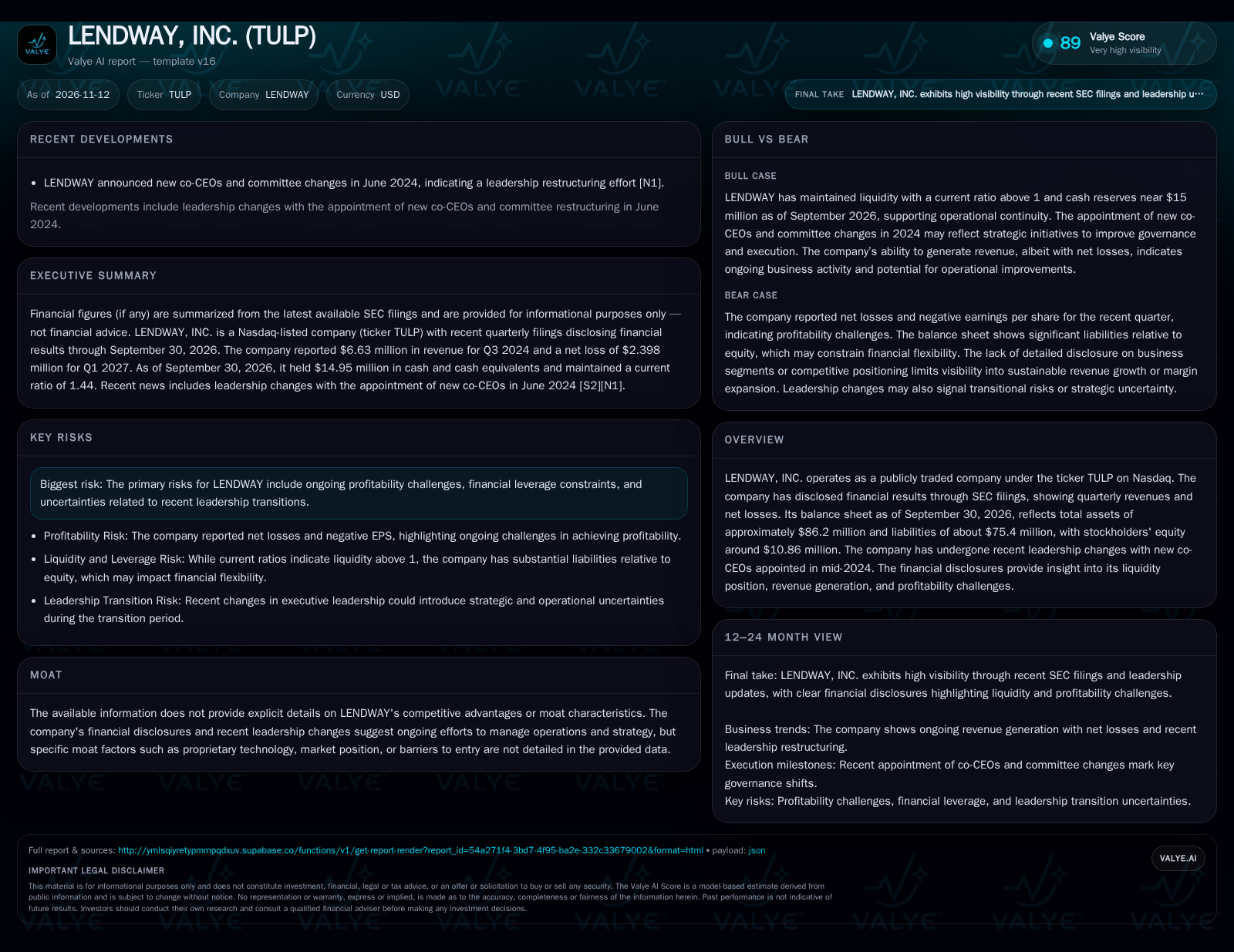
LENDWAY, INC. (Nasdaq: TULP) reported a Q3 2024 revenue of $6.63 million but remains unprofitable, posting a net loss of $2.398 million in its most recent quarter. As of September 2026, cash reserves stand at $14.95 million, with current assets exceeding current liabilities by a modest margin. The appointment of new co-CEOs in June 2024 signals a potential strategic shift, but high liabilities relative to equity and the absence of disclosed commercial advantages leave the turnaround thesis unproven. Investors must weigh execution risk and capital structure against any prospective operational improvements.[S2] [N1]
LENDWAY, INC. stands at a crossroads shaped by persistent financial underperformance, a leveraged capital structure, and a recent leadership overhaul. Despite maintaining operational liquidity, the company’s liabilities far outweigh its equity, and quarterly losses continue to pressure the business. The June 2024 appointment of new co-CEOs may signal a bid for strategic renewal, but without clear disclosure of competitive strengths or scalable business mechanics, the company’s ability to pivot remains uncertain. The next phase depends on whether leadership can deliver operational improvements substantial enough to offset structural balance sheet constraints and restore confidence in long-term value creation.
Recent Financial Performance and Leadership Overhaul Set the Stage
LENDWAY, INC. reported revenue of $6.63 million for the quarter ended September 30, 2024, but posted a net loss of $2.398 million and negative EPS for the subsequent quarter, as per its latest filings [S2]. The balance sheet as of September 30, 2026, shows cash and cash equivalents of $14.95 million, current assets of $21.31 million, and current liabilities of $14.81 million, resulting in a current ratio of 1.44 and a cash ratio of 1.01 [S2]. Total liabilities stand at approximately $75.4 million against total assets of $86.2 million, leaving stockholders’ equity at just $10.86 million [S2]. In June 2024, LENDWAY announced the appointment of new co-CEOs and restructured its governance committees, marking a significant leadership transition [N1]. These developments collectively define the company’s current operational and strategic context.
How LENDWAY’s Financial Structure Constrains Its Business Model
The company’s business model, as inferred from available financials, appears to be asset-heavy and margin-constrained: liabilities represent nearly 88% of total assets, and persistent net losses suggest insufficient gross or operating margins to cover fixed costs [S2]. With quarterly revenue below $7 million and negative EPS, the company’s scale does not yet support profitability. The company reported cash and liquidity metrics for the period; these figures do not by themselves establish operating runway, investment capacity, financial flexibility, or financing capacity. [S2]
Without segment disclosure or margin detail, it is unclear whether the losses stem from low pricing power, high variable costs, or structural overhead. If the business is capital-intensive (as suggested by the asset base), break-even would require either a significant increase in revenue (volume) or a material improvement in margin (mix/pricing). However, leverage amplifies downside risk: interest, debt service, or refinancing needs could further erode cash flow if operating losses persist.
Competitive Position Remains Opaque Amid Lack of Disclosed Moat
LENDWAY has not disclosed any proprietary technology, unique service model, or market position that would confer a durable competitive advantage. The absence of moat-related detail—such as switching costs, intellectual property, long-term contracts, or dominant customer relationships—implies that the company may compete on price, scale, or undifferentiated service, all of which are structurally vulnerable in commoditized or low-margin industries. The recent leadership restructuring could be an attempt to address these gaps, but until the company articulates a differentiated strategy or reveals evidence of stickier economics, its competitive position must be considered tenuous.
In the broader context, companies with similar leverage and lack of disclosed moat typically face intense competition from both established peers and new entrants, unless they can quickly demonstrate operational discipline, cost leadership, or niche focus. The risk is that, absent a clear defensible position, any improvement in revenue could be offset by margin compression or share loss to better-capitalized rivals.
Operational Reset Under New Leadership Unleashes Margin Expansion
The most optimistic scenario is that the new co-CEOs implement a successful turnaround strategy—potentially involving cost rationalization, asset divestitures, or a pivot to higher-margin offerings. If the company can improve operating efficiency, renegotiate liabilities, or identify a defensible niche, it could stabilize cash burn and move toward breakeven. Evidence supporting this scenario would include sustained revenue growth above fixed-cost thresholds, improving gross and operating margins, and a clear reduction in net losses over consecutive quarters. Additional signals would be new customer wins, product launches, or strategic partnerships that hint at a differentiated value proposition.
Confirmation of this scenario would require disclosure of actionable restructuring plans, evidence of cost discipline, and visible margin improvement in future filings. It would be further strengthened by reductions in leverage—either through asset sales, debt refinancing on more favorable terms, or equity infusions that improve the capital structure.
Incremental Progress but Persistent Headwinds Limit Near-Term Value Creation
The most plausible middle path is a period of incremental operational improvement that is insufficient to fundamentally alter the company’s risk/reward profile. LENDWAY may stabilize revenues and modestly reduce losses, but ongoing leverage and lack of a disclosed moat cap upside potential. Leadership may succeed in improving some operational discipline, but the absence of clear margin expansion levers means that any gains could be offset by external pressures (such as rising input costs or competitive pricing).
This scenario would be confirmed by modest improvements in quarterly losses, stable or gradually increasing revenues, and maintenance of liquidity ratios above 1. However, without evidence of a material change in business mix, cost structure, or strategic direction, the company would remain vulnerable to macro shocks, credit tightening, or sudden competitive shifts.
Leverage and Structural Deficits Trigger Strategic Review or Capital Actions
If operating losses persist and leverage remains high, LENDWAY could face mounting pressure on liquidity, potentially forcing management to pursue asset sales, a dilutive capital raise, or even strategic alternatives such as a merger or sale. In this scenario, fixed costs and debt service outpace any incremental gains from operational tweaks, and the company’s inability to articulate or execute a defensible strategy accelerates cash burn.
Evidence for this outcome would include sequential declines in cash balances, worsening current or cash ratios, rising net losses, or new disclosures regarding going-concern risk, covenant breaches, or engagement of external advisors for restructuring. A sudden leadership change or board turnover could also foreshadow a more urgent pivot or distress-driven transaction.
Signals That Will Determine Whether LENDWAY Can Deliver a Sustainable Turnaround
Quarterly trends in gross and operating margin, if disclosed, to assess whether new leadership is delivering cost discipline or margin expansion.
Sequential changes in net loss and EPS, as sustained improvement would signal credible progress toward breakeven.
Updates on strategic initiatives, such as asset sales, restructuring plans, or new business lines that could shift the revenue mix.
Disclosures on customer concentration, retention, or new contract wins, as evidence of market traction and reduced vulnerability to share loss.
Management commentary or filings outlining a clear strategy for differentiation or competitive positioning.
Signals of capital market activity, such as new equity or debt issuances, which may indicate funding needs or capital structure shifts.
Board or governance changes that could presage further strategic review or external intervention.
Disclaimer: This is research-only, informational analysis and not investment advice. It may include AI-generated interpretation and general industry context. Always verify important details using primary sources.

Comments