
Sight Sciences: Navigating Reimbursement Headwinds and Adoption Hurdles in Ophthalmic Device Markets
The company's future hinges on the interplay between regulatory policy, clinical evidence, and its ability to translate innovation into sustainable procedure volumes.
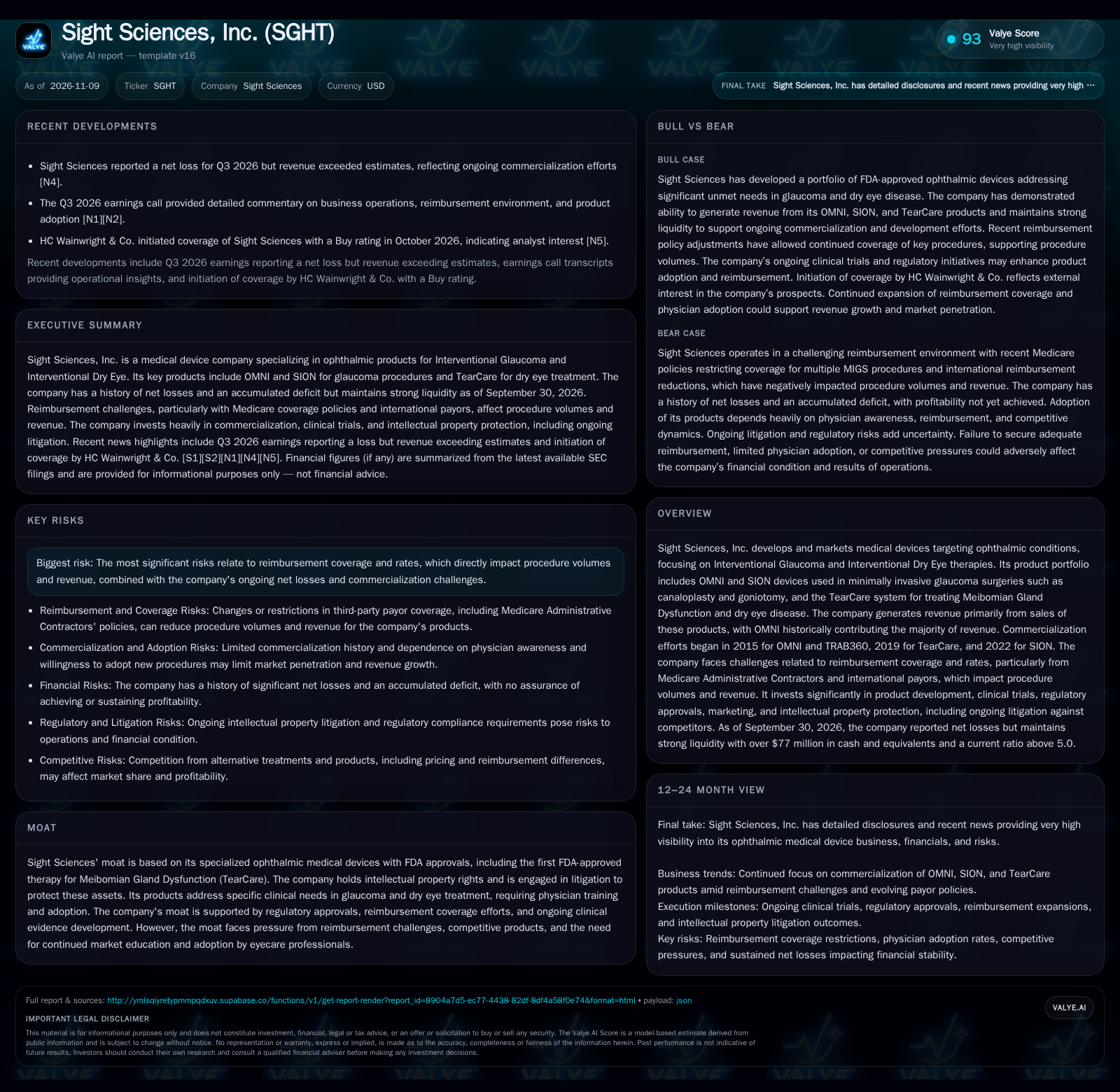
Sight Sciences, Inc. markets devices for minimally invasive glaucoma and dry eye treatment, with OMNI as its primary revenue driver. The company reported a Q3 2026 net loss despite exceeding revenue estimates, reflecting ongoing commercialization and reimbursement challenges. Physician adoption and the outcome of ongoing litigation will be critical to future performance. [S1] [S2] [N4]
Sight Sciences, Inc. finds itself at a pivotal moment as it seeks to scale commercialization of its ophthalmic medical devices—primarily the OMNI, SION, and TearCare systems—amid persistent operating losses and a fluid reimbursement environment. The next phase will test whether innovation and clinical evidence can overcome the structural challenges of the U.S. and international ophthalmic device markets. [S1] [S2] [N4]
Liquidity, Losses, and Policy: The Current Operating Picture
Sight Sciences reported a net loss of $6.81 million for Q3 2026, adding to an accumulated deficit of $384.7 million as of December 31, 2025. The company reported cash and liquidity metrics for the period; these figures do not by themselves establish operating runway, investment capacity, financial flexibility, or financing capacity. Revenue for the quarter exceeded analyst estimates, but this performance was achieved against a backdrop of continued reimbursement challenges—most notably, recent Medicare Administrative Contractor (MAC) policy changes that, while ultimately allowing coverage for certain minimally invasive glaucoma surgeries (MIGS), introduced new restrictions that have reduced overall claims volumes. International markets present similar headwinds, with NHS policy changes in the UK reducing reimbursement for OMNI procedures. These dynamics underscore a business model highly sensitive to third-party payor policy and procedure volume swings. [S1] [S2] [N1] [N4]
How Sight Sciences Earns—and the Leverage and Frictions in the Model
Sight Sciences generates revenue almost entirely from sales of its OMNI, SION, and TearCare devices, with OMNI historically accounting for the bulk of top-line contribution. The company’s economics are driven by procedure volumes, which are themselves dependent on physician adoption, reimbursement coverage, and clinical outcomes. The product portfolio addresses different but related ophthalmic indications, enabling some cross-selling potential within the specialist eyecare channel.
The fixed cost base is substantial, encompassing R&D, clinical trials, regulatory work, and commercialization—spending that is necessary not only to support product innovation but also to sustain reimbursement and defend intellectual property. Variable costs include manufacturing, distribution, and sales commissions. Given the device nature of the business, gross margins may be structurally higher than pharma but are pressured by pricing negotiations with hospitals and payors, especially as reimbursement rates face downward pressure.
Operating leverage could be significant if Sight Sciences achieves higher utilization rates and broader physician adoption, but the company’s limited commercialization history and ongoing reimbursement volatility have so far prevented sustained profitability.
Competitive Pressures, Substitutes, and the Role of Clinical Evidence
Sight Sciences operates in a competitive segment of the ophthalmic device space, where minimally invasive glaucoma surgery (MIGS) devices and dry eye treatment systems face both established players and new entrants. The primary competitive levers are clinical efficacy, safety, ease of use, and—critically—reimbursement coverage. Alternative treatments for glaucoma (such as traditional surgery, laser therapy, or pharmaceutical regimens) and for dry eye (including other device-based therapies and topical medications) act as substitutes that can shift procedure volumes away from Sight Sciences products if reimbursement or clinical outcomes are perceived as inferior.
The company’s intellectual property portfolio and ongoing litigation (notably against Alcon Inc.) are intended to protect its product offerings, but litigation introduces uncertainty and cost. Physician training and familiarity create some switching costs, but the incentive for eyecare professionals to adopt new devices is heavily influenced by reimbursement stability, peer-reviewed evidence, and patient outcomes. As coverage policies evolve, the competitive environment may intensify, especially if alternative products achieve superior reimbursement or demonstrate stronger clinical results.
What Could Unlock Durable Growth: Reimbursement Tailwinds and Expanding Clinical Validation
An upside scenario for Sight Sciences would be catalyzed by stabilization or expansion of reimbursement coverage for MIGS and dry eye procedures—particularly if Medicare MACs and international payors adopt more favorable policies or remove restrictive clauses. If ongoing clinical trials produce compelling data demonstrating superior patient outcomes, this could drive a positive feedback loop of increased physician adoption, higher procedure volumes, and improved negotiating leverage with payors.
Commercial execution would be further enhanced if the company secures clear legal victories in its intellectual property litigation, reducing the threat from competitors and solidifying its differentiated position. In this scenario, operating leverage could begin to materialize as fixed costs are spread over a larger revenue base, potentially narrowing losses or tipping into profitability. Confirmation of this scenario would include sustained procedure volume growth, expansion in the installed base of OMNI and SION users, and improving gross and operating margins—alongside positive reimbursement policy updates.
Most Likely Trajectory: Incremental Gains Amid Ongoing Policy and Adoption Friction
The most plausible short- to medium-term path is one of incremental progress: Sight Sciences continues to invest in commercialization and clinical evidence, but reimbursement remains a persistent friction—neither deteriorating further nor improving meaningfully. Procedure volumes may stabilize or grow modestly as physician awareness and comfort with OMNI, SION, and TearCare increase, but upside is capped by policy constraints and competitive alternatives.
Litigation and regulatory developments remain wildcards, with any resolution likely to affect sentiment more than near-term economics. Evidence for this trajectory would include flat or modestly rising procedure volumes, continued investment in R&D, and operating expenses remaining high relative to revenue, with gross margins pressured by reimbursement and pricing dynamics.
When Headwinds Compound: Reimbursement Cuts and Stalled Adoption
A negative scenario would result from further cuts or restrictions in Medicare or international reimbursement, leading to a sharp decline in procedure volumes and revenue. If ongoing clinical trials fail to yield compelling new evidence, or if competitor products gain reimbursement advantages or demonstrate better outcomes, physician adoption could stagnate or reverse.
Legal setbacks in intellectual property litigation could open the door to more direct competition, eroding market share and pricing power. Under this scenario, operating losses would widen, liquidity would erode more quickly, and the company could be forced to seek additional capital under less favorable terms. Confirmation would come from declining procedure and revenue trends, further negative reimbursement policy changes, and adverse litigation outcomes.
Tracking the Commercialization and Policy Levers for Sight Sciences’ Next Chapter
Quarterly procedure volumes for OMNI, SION, and TearCare—if disclosed—would provide direct evidence of adoption and market traction.
Updates on Medicare and international reimbursement policies, including any reversals or expansions in coverage for MIGS and dry eye procedures.
Gross and operating margin trends, which would reflect pricing power, reimbursement environment, and operating leverage.
Outcomes of ongoing intellectual property litigation, particularly with Alcon Inc., as these could materially affect competitive positioning.
Physician adoption rates and feedback from eyecare professionals, especially in response to new clinical trial data or product enhancements—if the company provides such metrics.
Competitive product launches or regulatory approvals that may affect Sight Sciences’ share of the MIGS or dry eye device markets.
Progress and results from ongoing or upcoming clinical trials, as positive data could influence both reimbursement and physician adoption.
Disclaimer: This is research-only, informational analysis and not investment advice. It may include AI-generated interpretation and general industry context. Always verify important details using primary sources.

Comments