
Allstate’s Diversification and AI Ambitions: Margin Expansion and the Stakes of Regulatory Constraint
Allstate’s Q3 2026 performance underscores the growing importance of its Protection Services unit and the company’s drive to leverage AI for underwriting and operational efficiency. The outlook hinges on whether technology and product diversification can offset intensifying price competition and state-level regulatory pressures.
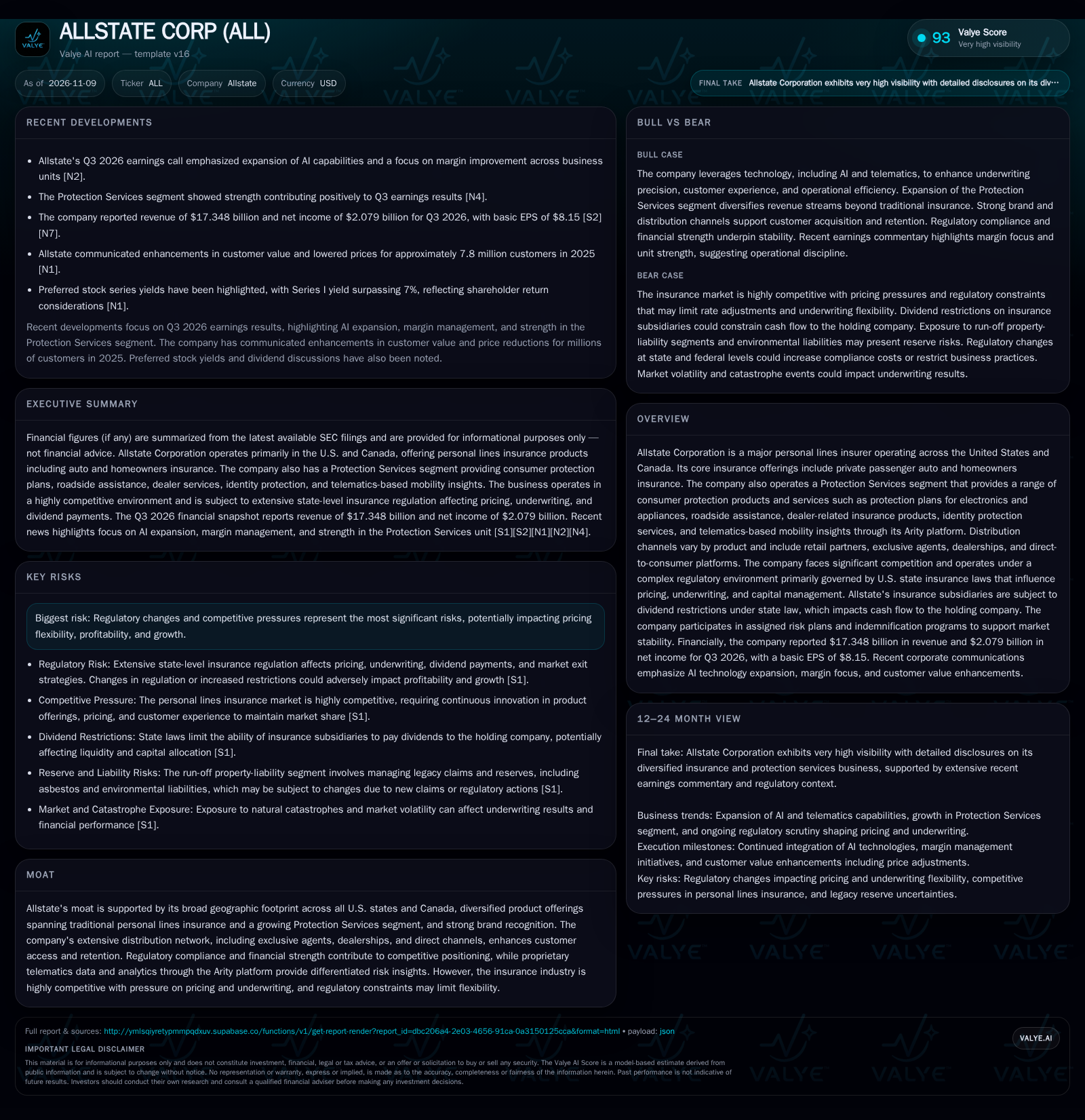
Allstate posted $17.3 billion in revenue and $2.1 billion in net income for Q3 2026, boosted by strength in its Protection Services segment and continued focus on margin improvement. The company is aggressively expanding AI capabilities across its insurance and protection platforms. With regulatory frameworks shaping pricing and cash flow, Allstate’s ability to scale new service lines and manage legacy insurance risks will be key to sustaining growth and profitability. [S2] [N2] [N4]
Allstate’s latest financials and management commentary signal a company at a strategic crossroads: its traditional auto and homeowners insurance business remains highly competitive and tightly regulated, while its Protection Services segment is gaining scale and relevance. The push into AI-enabled underwriting and customer engagement reflects a broader industry imperative to enhance efficiency and risk selection. However, the core challenge for Allstate is whether these technological and product innovations can deliver sustainable margin gains in the face of relentless price competition and regulatory headwinds. The next phase of performance will likely be determined by the interplay between diversification, technology execution, and the evolving regulatory environment.
Q3 2026: Diversification Momentum and Margin Focus
Allstate reported Q3 2026 revenue of $17.348 billion and net income of $2.079 billion, with basic EPS of $8.15. Notably, the Protection Services segment contributed 5% of consolidated revenue and accounted for over 80% of policies in force by year-end 2025 [S1] [S2]. Recent earnings calls emphasized AI expansion and a renewed focus on margin improvement across business units [N2]. The company also implemented price reductions for 7.8 million customers in 2025, aiming to enhance customer value amidst competitive pressure [N1].
These developments matter because they signal a dual-track strategy: Allstate is leveraging technology and expanding non-traditional service lines to offset the margin and growth constraints of its core regulated insurance business. The ability of Protection Services to scale, combined with operational efficiencies from AI, will be pivotal in determining whether Allstate can sustain or expand profitability as competitive and regulatory pressures mount.
How Allstate Monetizes Risk and Service Across Segments
Allstate’s primary revenue engine remains personal lines insurance, where premiums are earned in exchange for assuming underwriting risk on auto and homeowners policies. The economics of this segment are shaped by the balance between premium pricing (which is state-regulated), underwriting accuracy (claims frequency and severity), and investment returns on float. Fixed costs include regulatory compliance, distribution, and technology, while variable costs are dominated by claims and commissions. The result is a business with moderate operating leverage—subject to sharp swings in profitability during catastrophe years or periods of adverse claims development.
The Protection Services segment introduces a different economic profile. Here, revenue is earned from protection plans (covering electronics, appliances, etc.), roadside assistance, dealer services, and identity protection. These products typically have lower risk exposure and shorter contract cycles than traditional insurance, but require strong distribution partnerships and efficient claims/service delivery. Margins in this segment can be attractive if scale is achieved, as many services are delivered digitally or via third-party networks. Importantly, the segment’s revenue is less sensitive to weather events and can provide countercyclical ballast.
AI and telematics, particularly through the Arity platform, offer the potential to improve risk selection, reduce claims fraud, and streamline operations—directly impacting both loss ratios and expense ratios. However, the upfront investment in technology, data acquisition, and integration represents a significant fixed cost. The economic payoff hinges on the degree to which these tools improve underwriting precision and customer retention versus the speed at which competitors close the technology gap.
Defending Share in a Crowded, Regulated Marketplace
Allstate competes in the intensely contested personal lines insurance sector, where scale, brand, and distribution breadth are necessary but not sufficient for durable advantage. Key competitor categories include national multiline insurers, direct-to-consumer digital insurers, regional specialists, and new entrants leveraging data and AI to undercut pricing or offer tailored products.
The company’s moat is anchored by its broad geographic footprint, diversified product suite, and strong brand recognition. Exclusive and independent agent networks, along with partnerships for Protection Services, provide multifaceted customer access. Proprietary telematics data and analytics via Arity could offer differentiated risk insights if leveraged effectively.
However, the industry’s low switching costs, price sensitivity, and regulatory constraints on product design erode much of the traditional stickiness. Direct insurers and insurtechs can compete aggressively on price and digital experience, while regulatory oversight limits the speed with which incumbents can adjust rates or innovate. The challenge for Allstate is to translate its technology investments and service diversification into tangible customer retention and margin benefits before these advantages are commoditized.
Technology and Protection Services Drive Outperformance
A favorable scenario sees Allstate’s AI and telematics investments delivering measurable improvements in underwriting accuracy, claims efficiency, and customer segmentation. If Arity’s risk scoring leads to superior loss ratios and the automation of claims reduces expense ratios, the company could achieve sustainable margin expansion—even in a competitive pricing environment.
Simultaneously, if Protection Services continues to grow share—leveraging retailer, mobile operator, and dealership partnerships—this segment could become a more material contributor to both revenue and earnings, softening the cyclicality and regulatory drag of core insurance. Higher attach rates for protection plans and cross-selling into traditional insurance customers would further diversify risk and revenue.
Evidence supporting this scenario would include continued outperformance in combined ratios relative to peers, accelerating revenue and margin contribution from Protection Services, and public disclosures of AI-driven efficiency gains or customer retention improvements. Conversely, if these metrics stagnate or competitors rapidly replicate AI capabilities, the bull thesis would be undermined.
Incremental Gains Amid Regulatory and Competitive Headwinds
The most plausible trajectory is that Allstate achieves incremental margin and efficiency gains from AI and service diversification, but these are partially offset by persistent pricing pressure and regulatory limits on underwriting flexibility. Protection Services continues to grow, but remains a modest share of consolidated revenue, providing some diversification but not transforming the business’s risk profile.
Premium growth in core insurance lines is constrained by state-level rate approvals and customer price sensitivity, especially after recent price reductions. The company’s overall profitability remains closely tied to claims trends, catastrophe frequency, and investment returns, with technology investments yielding gradual—but not dramatic—improvements in expense and loss ratios.
Confirmation of this scenario would be a stable (but not sharply improving) combined ratio, modest growth in Protection Services, and steady (rather than accelerating) EPS growth. Falsification would require evidence of either a step-change in operating leverage from technology or, conversely, a deterioration in claims trends or regulatory outcomes that erode margins.
Margin Compression from Rate Pressure and Regulatory Constraints
A negative outcome would result if competitive intensity and regulatory action combine to squeeze underwriting margins faster than technology or diversification can offset. Prolonged price wars, adverse claims development (especially in auto or property lines), or regulatory refusals to approve necessary rate hikes could drive combined ratios above target levels.
If Protection Services stalls—whether due to weak partner demand, declining attach rates, or operational missteps—the diversification benefit erodes, and the company remains highly exposed to the volatility of traditional insurance lines.
This scenario would be confirmed by persistent deterioration in loss and expense ratios, declining net income/EPS, and weak or negative growth in the Protection Services segment. Regulatory setbacks, such as high-profile rate disapprovals or new compliance burdens, would also reinforce the bear case.
Milestones and Metrics That Will Shape Allstate’s Next Chapter
Combined ratio trends, particularly in auto and property, as a direct measure of underwriting discipline and claims environment.
Revenue and margin growth rates for the Protection Services segment, including attach rates by distribution channel (if disclosed).
AI and telematics adoption rates—such as the proportion of policies using Arity risk scoring or digital claims processing (if disclosed).
State-level rate approval outcomes and regulatory commentary on pricing flexibility or new compliance requirements.
Dividend flows from insurance subsidiaries to the holding company, and any commentary on capital management constraints.
Customer retention and policy growth metrics, especially in geographies or segments where price cuts were implemented (if disclosed).
Expense ratio movements and public disclosures of technology-driven cost reductions or operational efficiencies.
Disclaimer: This is research-only, informational analysis and not investment advice. It may include AI-generated interpretation and general industry context. Always verify important details using primary sources.

Comments