
Security National Financial: Segment Integration, Niche Focus, and the Stakes of Real Estate Expansion
Security National Financial Corporation’s diversified model—combining life insurance, cemetery/mortuary services, and mortgage lending—creates cross-segment synergies but also exposes the firm to niche pricing, geographic, and real estate market risks. Recent developments highlight both active capital management and ongoing execution in complex development projects.
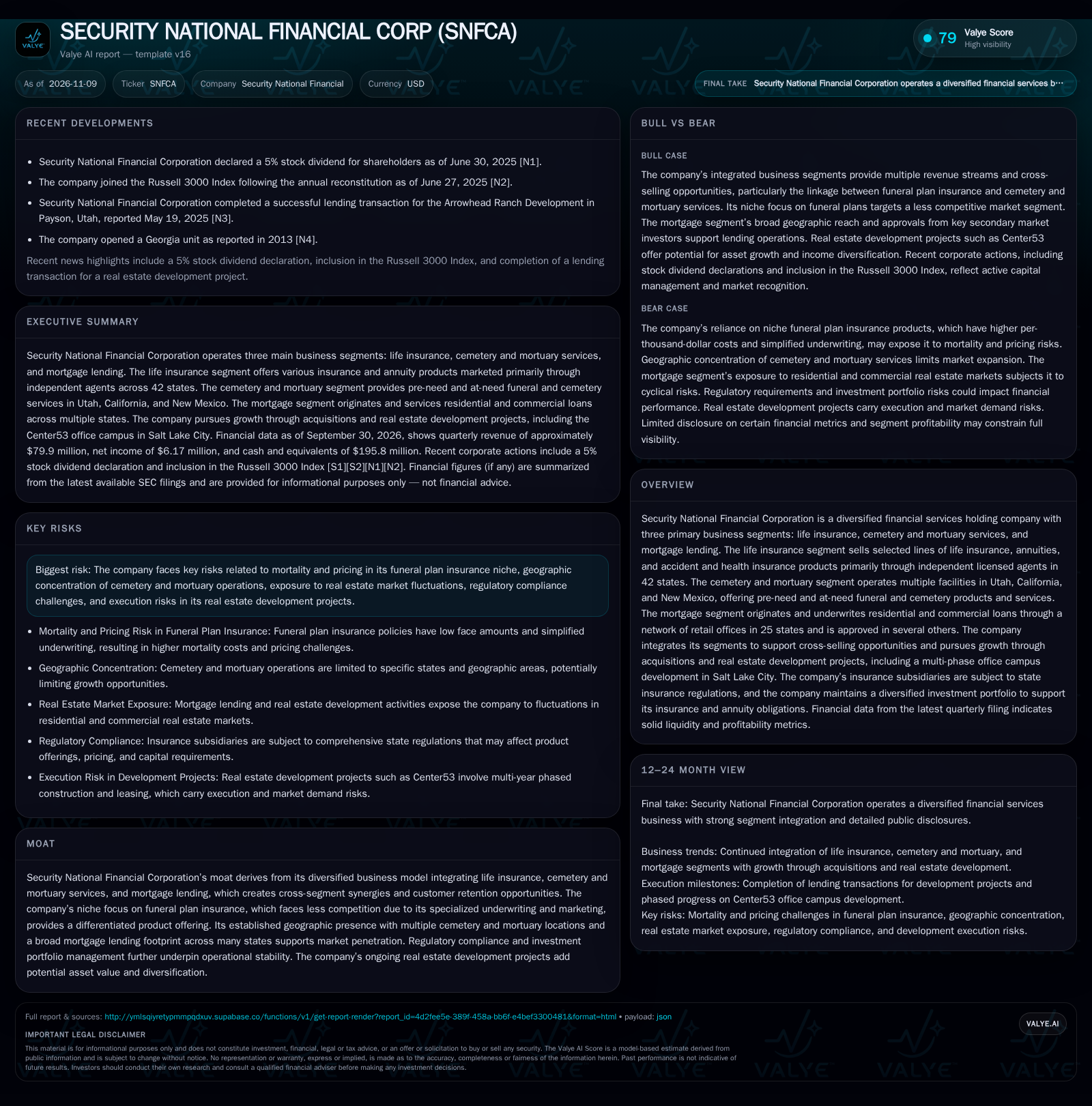
Security National Financial Corporation operates across life insurance, cemetery/mortuary, and mortgage segments, recently reporting $79.9 million in quarterly revenue and $6.17 million in net income. The company leverages segment integration for cross-selling, pursues growth through acquisitions, and is actively engaged in large-scale real estate development. While this model offers diversification and asset-building potential, it brings exposure to mortality pricing, geographic concentration, and development execution risk. The cited source reports dividend-related activity; that disclosure alone does not establish dividend-policy continuity, management confidence, or a material constraint on capital flexibility. [S1] [S2] [N1] [N2] [N3]
Security National Financial Corporation stands out as a small-cap financial conglomerate with a unique integration of life insurance, cemetery/mortuary operations, and mortgage lending. This multi-pronged structure allows the company to cross-sell products and diversify revenue streams, but also exposes it to highly specific risks—such as mortality pricing in its funeral plan insurance, geographic limits in its at-need services, and execution challenges in ambitious real estate development. [S1] [S2] [N1] [N2] [N3]
Recent Results and Strategic Actions Shape the Near-Term Outlook
Security National Financial Corporation reported $79.9 million in revenue and $6.17 million in net income for the quarter ending September 30, 2026, with $195.8 million in cash and equivalents. The company reported cash and liquidity metrics for the period; these figures do not by themselves establish operating runway, investment capacity, financial flexibility, or financing capacity. [S2]
The company’s recent declaration of a 5% stock dividend and inclusion in the Russell 3000 Index reflect both active capital management and increased market visibility. These developments may help attract new investor interest and facilitate access to capital markets, potentially supporting future acquisition or development initiatives. [N1] [N2]
A notable operational milestone was the successful lending transaction for the Arrowhead Ranch Development in Utah, highlighting ongoing activity in real estate and mortgage segments. The company’s ongoing multi-phase Center53 office campus project in Salt Lake City further signals commitment to real estate asset growth. [N3] [S1]
Diversified Revenue Streams and the Mechanics of Segment Integration
Security National Financial’s business model is distinctive for its integration of three segments: life insurance (with a focus on funeral plans), cemetery and mortuary services, and mortgage lending. Each segment generates revenue through different mechanisms—premiums and investment income for insurance, service and merchandise sales for funeral operations, and origination/servicing fees plus interest income for mortgages. [S1]
The cross-selling linkage is most pronounced between funeral plan insurance and the cemetery/mortuary segment. Funeral insurance policies are often marketed alongside pre-need cemetery and mortuary services, with the company’s own facilities sometimes named as beneficiaries. This can enhance customer lifetime value and improve retention, reducing external customer acquisition costs and potentially stabilizing revenue through recurring or bundled sales.
The mortgage segment, operating via 85 retail offices in 25 states, adds both geographic and revenue diversification. As a HUD- and Fannie Mae-approved lender, the company can generate fee and interest income while leveraging internal and external funding. However, mortgage origination is notoriously cyclical and sensitive to rate environments, which can amplify earnings volatility.
The company’s investment portfolio—spanning stocks, bonds, real estate, and mortgages—serves both as a source of income and as a regulatory capital requirement for insurance obligations. This creates some inherent asset-liability matching risk, but also provides flexibility in capital deployment.
Niche Focus and Geographic Footprint: Advantages and Constraints
Security National Financial’s competitive position is rooted in its niche focus on funeral plan insurance and its integration with owned cemetery and mortuary facilities. Funeral plan insurance, targeting the 45–85 age demographic with low to moderate income, faces less direct competition from national insurers due to specialized underwriting and the bundled nature of the offering. This can confer pricing power and customer stickiness—at least within its target markets. [S1]
The cemetery and mortuary segment’s geographic concentration (primarily Utah, with smaller footprints in California and New Mexico) limits exposure to national competitors but also caps growth opportunities and makes the business more vulnerable to local demographic or regulatory shifts.
The mortgage segment’s broad state footprint and secondary market approvals provide access to a larger pool of borrowers and investors, but also place the company in competition with national and regional mortgage originators who may have greater scale or technology investment.
The integrated business model may create switching frictions for customers who value bundled funeral and insurance offerings, but the competitive advantage is less pronounced in the mortgage segment, where commoditization and price competition are high.
Cross-Segment Synergy and Real Estate Wins Could Drive Durable Growth
The most favorable outcome for Security National Financial would involve sustained cross-selling between funeral insurance and cemetery/mortuary services, leading to high customer retention and stable recurring revenue streams. If the company successfully executes its Center53 development and similar projects—either by leasing up the office space at attractive rates or realizing asset appreciation—this could meaningfully increase earnings diversification and asset value.
Further, if the mortgage segment maintains strong origination volumes during favorable interest rate environments, the company could benefit from both fee and interest income, amplifying operating leverage.
Confirmation of this scenario would come from rising pre-need sales and funeral insurance penetration rates, successful leasing or sale of Center53 phases, and consistently strong mortgage origination volumes with manageable credit metrics. Disclosure of segment-level profitability improvement and increased cross-segment customer retention would further validate the upside thesis.
On the capital side, continued active management—such as additional shareholder-friendly actions or accretive acquisitions—would suggest the company is leveraging its diversified model to create incremental value.
Diversification Balances Segment Volatility with Steady, If Uneven, Progress
The most plausible trajectory is that Security National Financial continues to generate moderate growth by leveraging its diversified business mix. Cross-segment integration provides some insulation against shocks in any one segment, but each business line remains exposed to its own risks: mortality pricing and regulatory changes for insurance, local demographic and competition shifts for cemetery/mortuary, and macroeconomic cycles for mortgages and real estate.
Real estate development projects like Center53 could contribute incremental earnings if executed on time and within budget, but may face leasing lags or cost overruns. The mortgage segment is likely to experience cyclical swings, but broad state approval and secondary market relationships should allow continued participation in most market environments.
The base case would be confirmed by continued positive net income, steady revenue growth across segments, and progress on real estate development milestones—along with evidence that segment-specific risks (such as funeral insurance claims volatility or mortgage credit deterioration) remain contained.
Segment-Specific Shocks or Development Missteps Could Derail the Model
Adverse outcomes could materialize from several directions. A spike in mortality rates or mispricing in funeral plan insurance could erode underwriting margins and strain capital, especially if investment returns falter. Geographic concentration in the cemetery/mortuary business leaves the company exposed to local economic or regulatory shocks—such as changes in consumer preferences, increased competition, or adverse legislation.
In the mortgage segment, a sharp downturn in residential or commercial real estate markets—driven by rate hikes, credit tightening, or economic slowdown—could depress origination volumes and increase credit losses, undermining earnings.
The greatest potential for financial drag or capital impairment comes from real estate development: if the Center53 project faces significant cost overruns, construction delays, or leasing shortfalls, the company could encounter liquidity pressures and write-downs.
This scenario would be confirmed by rising claims and declining profitability in the insurance segment, declining pre-need sales, high vacancy rates or cost overruns in Center53, or a spike in mortgage delinquencies and loan losses. Deterioration in cash flow or the need for dilutive capital raises would further corroborate a downside trajectory.
What Will Test Security National Financial’s Integration and Expansion Thesis
Disclosure of segment-level profitability trends, particularly in funeral plan insurance and cemetery/mortuary operations, would help test the effectiveness of cross-selling and integration.
Pre-need sales growth rates and funeral plan insurance penetration, if disclosed, are essential to gauge the sustainability of the company’s niche strategy.
Leasing progress, occupancy rates, and cost-to-completion updates for the Center53 development are critical milestones for assessing real estate execution risk.
Mortgage origination volumes, credit quality metrics, and delinquency trends should be monitored to evaluate exposure to real estate cycles.
Evidence of cost discipline and investment returns in the insurance portfolio would indicate prudent capital management.
Updates on acquisition activity and the integration of acquired blocks of insurance or mortuary assets could reveal the company’s ability to scale and diversify.
Changes in regulatory environment or state-level insurance/cemetery rules could materially impact operating flexibility and profitability.
Disclaimer: This is research-only, informational analysis and not investment advice. It may include AI-generated interpretation and general industry context. Always verify important details using primary sources.

Comments