
InterPrivate Investment Partners V: Blank-Check Structure, Disclosure Gaps, and the Stakes of SPAC Deal-Making in a Tightening Regulatory Climate
Yet, the absence of operational transparency, unspecified investment targets, and evolving SPAC regulations leave the company’s future returns and risk profile highly contingent on forthcoming deal execution.
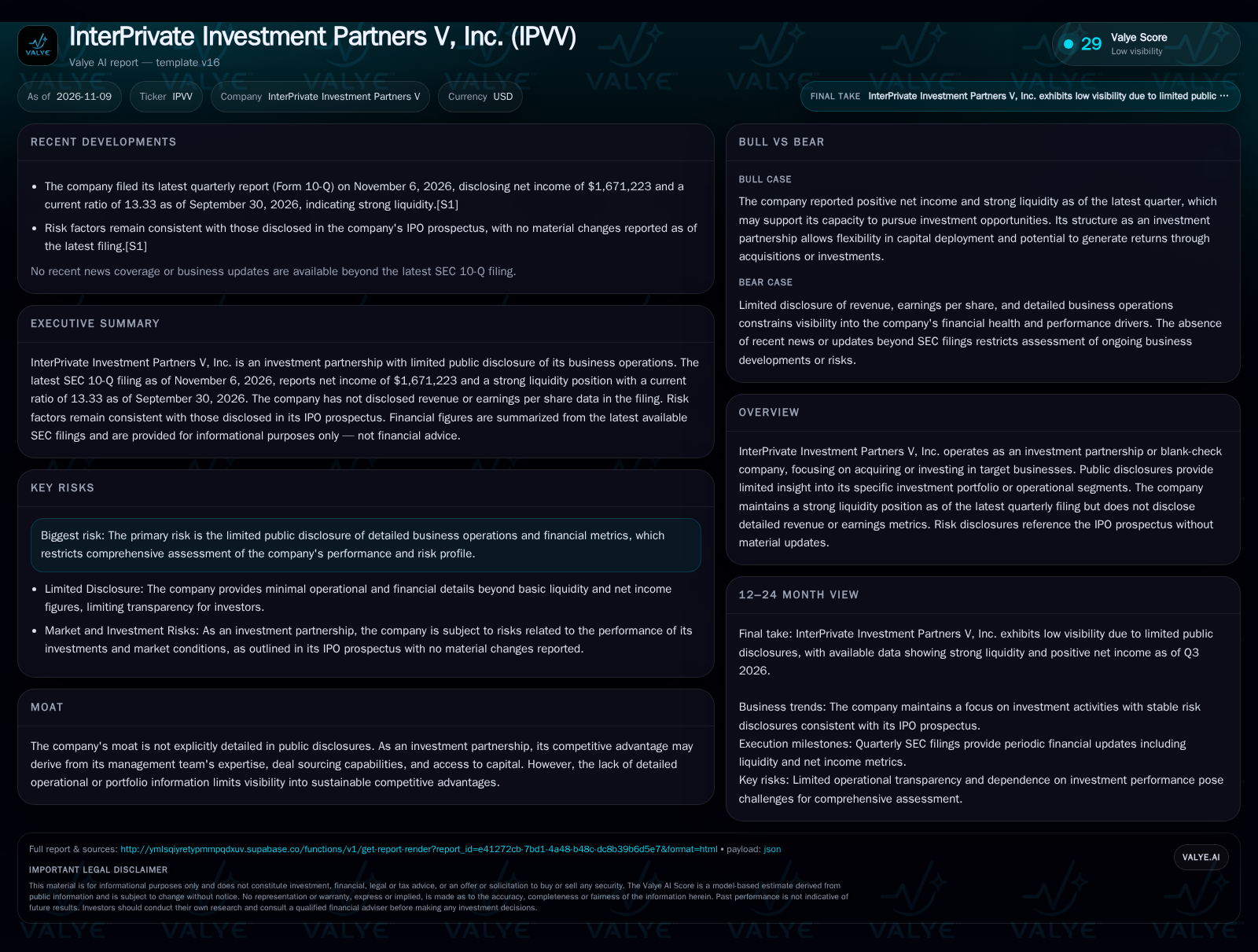
Its potential hinges on successful deal sourcing amid increased SPAC regulatory scrutiny, but limited disclosure and lack of operational visibility make assessment of future value and risk challenging.[S1]
InterPrivate Investment Partners V, Inc. (IPVV) enters the public markets as a newly minted SPAC, flush with IPO cash, but with its entire future staked on sourcing and executing a value-creating business combination. The company’s latest filings show reported liquidity position and positive net income — both artifacts of its IPO structure and interest on idle capital, not evidence of operating momentum. With no deal target identified, minimal portfolio transparency, and SPAC regulations tightening, IPVV’s risk/reward is poised on the knife-edge of future deal execution. Investors are left to weigh the blank-check promise against the growing headwinds of regulatory friction and the inherent opacity of the SPAC model.[S1]
IPO Proceeds, Idle Assets, and the Absence of a Business Combination Target
As of September 30, 2026, InterPrivate Investment Partners V, Inc. had completed its IPO, raising $201.25 million through the sale of 20,125,000 units and $5.4 million from 540,000 private placement units. The company reported a current ratio of 13.33 for the period. [S1]
SPAC Economics: Fee Structure, Interest Income, and the Binary Nature of Value Realization
As a blank-check company, InterPrivate Investment Partners V’s economics are fundamentally different from operating businesses. Until a business combination is executed, the company earns interest on funds held in trust, which accounts for its reported net income. There are no operating revenues or expenses outside those related to administration, deal search, and compliance. The economics become binary at the point of a business combination: if a deal is consummated and the acquired business performs, value can be created for shareholders; if no deal is reached within the SPAC’s permitted timeline, funds are returned to investors (less expenses), and sponsor interests may be wiped out.
SPACs typically charge a promote (often 20% of post-deal equity) and may also benefit from warrant coverage, creating strong incentives for the sponsor to close a deal. However, dilution from sponsor equity and warrants can erode returns for public shareholders, especially if the deal is value-neutral or subpar. The company’s capital structure (units, shares, and warrants) is designed to attract both institutional and retail investors, but the actual economics will depend entirely on the nature, timing, and quality of the eventual acquisition. The cost structure is largely fixed in the pre-deal phase, but significant legal, advisory, and regulatory costs accrue upon deal negotiation and closing.
SPACs in a Crowded Field: Deal Sourcing, Sponsor Reputation, and Regulatory Headwinds
InterPrivate Investment Partners V operates in a highly competitive SPAC environment, where dozens of blank-check companies vie for a limited pool of attractive targets. The primary differentiators are the sponsor’s reputation, deal-sourcing ability, sector expertise, and access to proprietary opportunities. Without public disclosure of management’s track record or sector focus, it is difficult to assess whether IPVV has a competitive edge in sourcing high-quality deals.
The competitive landscape is further complicated by tightening SEC regulations introduced in 2024, which require enhanced disclosures, co-registrant status for targets, and additional scrutiny on projections and conflicts of interest. These changes increase compliance costs, lengthen deal timelines, and may deter some private companies from pursuing SPAC mergers. Traditional private equity, direct listings, and IPOs remain viable alternatives for many targets, intensifying competition for high-quality acquisition candidates. In this context, the lack of a disclosed target or sector specialization for IPVV adds to uncertainty around its competitive positioning.
What Success Would Look Like: A High-Quality, Accretive Business Combination
The most favorable scenario for IPVV investors is the identification and successful merger with a high-growth, profitable private company that would otherwise be difficult to access via traditional IPO routes. If the sponsor leverages its network to source an exclusive or proprietary deal, negotiates favorable terms, and structures an accretive transaction, public shareholders could benefit from an immediate re-rating and long-term value creation.
Confirmation of this scenario would include: public announcement of a definitive agreement with a well-regarded, growing business; clear, detailed disclosures about the target’s financials and growth prospects; minimal redemptions by IPO investors; and positive market reception post-deal. Falsification would be evident if the company fails to announce a deal, proposes a low-quality or highly dilutive transaction, or faces significant shareholder redemptions and negative share price reaction upon deal closure.
The Most Likely Outcome: Extended Search, Rising Costs, and Value Erosion Risk
Given current market conditions and regulatory headwinds, the most plausible path for IPVV is a protracted search for an acquisition target. During this phase, interest income continues to accrue on idle capital, offset by ongoing administrative and diligence costs. As the SPAC approaches its deal deadline (typically two years from IPO), pressure mounts to announce a transaction — sometimes resulting in deals with less attractive targets or unfavorable terms for public shareholders.
Evidence supporting this scenario would include incremental SEC filings reflecting only interest income and administrative expenses, repeated extensions of the deal deadline (if permitted), and eventual announcement of a business combination with a target of average or below-average quality. Falsification would occur if the company rapidly announces a well-received deal with minimal dilution and strong sponsor alignment.
Deal Failure, Redemption Wave, or Regulatory Snags: How Value Could Unravel
The adverse scenario for IPVV is one where the company is unable to identify or close a business combination within the allotted timeframe, triggering a liquidation and return of trust proceeds to shareholders (less expenses). In this case, the sponsor’s interest is effectively wiped out, and public shareholders receive their pro rata share of the trust — typically resulting in a small loss due to expenses and opportunity cost.
Other downside risks include regulatory delays, SEC challenges to the proposed deal structure, or target company withdrawal in response to the heightened compliance burden. A poorly received or highly dilutive deal can also spark a wave of redemptions, eroding the trust pool and leaving the post-merger company undercapitalized. Confirmation of the downside would be a lack of deal announcements, extension requests, liquidation filings, or a definitive agreement with a low-quality target followed by high redemption rates and share price decline.
Milestones and Disclosures That Will Define InterPrivate Investment Partners V’s Trajectory
Announcement of a letter of intent or definitive agreement with a specific target — this would be the single most material development for value realization.
Disclosure of detailed financials, growth prospects, and sector focus for the target company, if and when a deal is announced.
Redemption rates following deal announcement — high redemption rates would indicate lack of shareholder confidence and threaten deal viability.
Level of dilution from sponsor promote and warrants — a useful metric would be the post-deal ownership split between public shareholders and sponsors/PIPE investors.
SEC feedback, regulatory delays, or additional compliance costs as a result of the 2024 SPAC rule changes.
Administrative and deal-related expenses reported in future filings, which could erode the trust value available for a business combination or liquidation.
Any extensions to the SPAC’s original timeline, which would indicate difficulty in sourcing or closing a suitable deal.
Disclaimer: This is research-only, informational analysis and not investment advice. It may include AI-generated interpretation and general industry context. Always verify important details using primary sources.

Comments